Mirror of Justice

A blog dedicated to the development of Catholic legal theory.
Affiliated with the Program on Church, State & Society at Notre Dame Law School.

Monday, August 4, 2008

Social Spending by Government in the United States and The Burden on Taxpayers: Getting the Numbers Out

From the way our friends on the leftward side of our Catholic academic community here on the Mirror of Justice sometimes talk about government social programs and spending on the poor in this society, a person understandably might be left with the impression that we live in a libertarian regime in which the capitalist market distributes all income, government is small and starved for resources, taxes are low, and the disadvantaged are utterly neglected. Thus, Eduardo Penalver laments in a recent post that “a serious governmental commitment to human development among the poorest Americans” has never been manifested in the United States, “at least not during [his] lifetime.”

I want to suggest that the dollar-and-cents reality is something quite different. We can debate whether an even larger government presence and more government spending, accompanied by higher taxes, higher compliance costs, and more draws against economic productivity, is a good thing or not. But we should not be unaware of the enormous level of government expenditures already in place, among which social spending is by far the largest segment. We should also debate whether a state-centric approach to social justice is a good thing, either in material or spiritual terms. But only by appreciating the real-world economic realities can we fairly evaluate the remaining differences among us.

During fiscal year 2007, the total amount of government spending at all levels was $4.9 trillion. To place this in perspective, based on a Gross Domestic Product of $13.67 trillion, government spending consumed 35.9 percent of our economic production as a nation. The following table was helpfully compiled from Census Bureau statistics by usgovernmentspending.com:

2007piechart_3


To see the same figures stated as percentages by category of overall government spending and in the form of a pie-chart:

Piechart_2


Of that government spending, social spending constituted some 55.8 percent of total spending, totaling more than $2.88 trillion. Defining social welfare spending more narrowly to include only welfare, health care, and education, these spending categories add up to more than 40 percent of overall government spending and some 15 percent of our entire economic output. (And this social spending figure dwarfs the expenditures on national defense, which now stands at 13.4 percent of government outlays and less than 5 percent of GDP.)

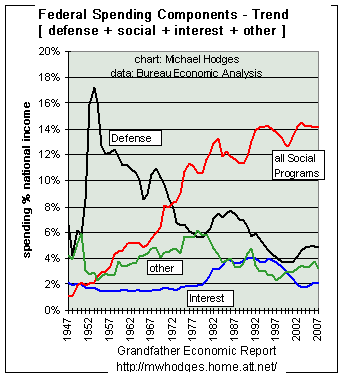
Far from there being an absence of a serious government commitment to the poor during our lifetime, the trend in government spending during my lifetime at least has been nothing less than dramatic. Looking only at the federal budget, which significantly understates the total government spending on social programs, Michael Hodges on his web page documents how the percentage of the federal budget devoted to defense has plummeted while social spending has skyrocketed:

Fedcomp_2


Nor should we look only to the government spending side and ignore the source of those revenues―the burden on the taxpayer. As calculated by the Tax Foundation from Bureau of Economic Analysis data, the average American spends nearly a third of each year working simply to earn enough to pay various local, state, and federal taxes:

Taxfreedom1_2


Now I understand that some of our friends on the Mirror of Justice would like to see these numbers go higher, both in spending and taxes (and the two of course move together). They envision a still larger role for government in moving our society toward social justice. (And if Barack Obama does become President, as he at least appears to presume, we undoubtedly will see just such a major expansion of government.) But we should never pretend that government is not already a monumental presence in our lives, that government does not already expend gigantic sums of money, that the government does not already consume a huge segment of our national economy, and that we are not already paying a hefty part of our incomes in taxes.

Greg Sisk

Solzhenitsyn, hero, dead at 89

Aleksandr Solzhenitsyn -- who was sent to the camps for referring to Stalin as the "man with the mustache" -- died on Sunday night.  (Here is the very thorough NYT obit.)  We here at MOJ talk, think, and write about "conscience"; Solzhenitsyn, in my view, really showed us how it's done.  His work and witness shamed all those who, from the comfort of western salons, romanticized the Soviet Union.  What the Times calls his "hectoring jeremiads" -- his speech at Harvard, for example, "A Warning to the West" -- were, it seems to me, also important.  R.I.P.

Sunday, August 3, 2008

Legislators who stepped up (or down, as the case may be)

Today’s Boston Globe has as its lead editorial a brief exhortation, Legislators who stepped up [HERE], commending the Massachusetts legislators who voted this past week to repeal the 1913 statute that has barred out-of-state homosexual couples from marrying in Massachusetts and then returning to their home state jurisdiction in the hope of having their Massachusetts same-sex marriage recognized in a place that does not permit this. The Globe heaped praise on the legislators who voted “yes” in favor of the repeal. Governor Deval Patrick quickly signed the legislative repeal noting that with the repeal, “All people come before their governments as equals.” I hasten to add some agreement and some disagreement with this position: in some things yes, they are equal, but in other matters no—especially when reason, common sense, and irrefutable facts demonstrate that “equality” is impossible. Michael Jordan and I both love basketball, but I doubt that the Commonwealth of Massachusetts will deem the two of us “equal” when it comes to our respective claims concerning the ability to play the game.

The Globe editorial took passing notice of opposition to the repeal from “social conservatives”. I wonder if the paper’s editorial board members who authored this congratulatory opinion would consider the legislators who voted “no,” that is, against the repeal, to be “social conservatives.” If a web log developing Catholic Legal Theory is a place to consider what is it that Catholic legislators should do and not do in their official capacities (something that members of MOJ have addressed from time to time), I would offer an opinion that the legislators voting “no” were the members of the General Court (the legislature) who, in fact, stepped up. It is clear that many of the legislators who voted “yes” consider themselves Catholic. But it was those Catholics, and other legislators who are not Catholic, who voted “no” who understand well the wise counsel of Pope John Paul II when he stated that “the value of democracy stands or falls with the values which it embodies and promotes.” [Evangelium Vitae, N. 70]

In my opinion, the “no” votes belong in the circle of those who upheld the values crucial to democracy. I fear that those who cast “yes” votes have imperiled the values of “democracy” insofar as it exists in Massachusetts and will lead us further along a road to the diminishment of values crucial not only to democracy but to the society that it should preserve and protect.

RJA sj

Friday, August 1, 2008

Human Dignity and the End of Life

I just saw a reference to an article (Human Dignity and the End of Life) in America magazine (August 4, 2008 issue) by Cardinal Rigali and Bishop Lori. I am not sure if the article is available for free on America's website. The article is a response to previous America articles by Thomas Shannon and John Hardt on providing artificial nutrition and hydration to PVS patients. Shannon and Hardt, according to the article, "appear to misunderstand and subsequently misrepresent the substance of church teaching on these difficult and important ethical questions."

I think the current article by Cardinal Rigali and Bishop Lori commendably explains the Church's position on this issue and the errors in the Shannon and Hardt articles, about which we have blogged in the past. I am curious what people think about what seems to be a growing practice of the Bishops to issue statments of this sort. Since the implementation of Ex Corde, there hasn't been any real use of the mandatum and maybe this is a concerted (non-disciplinary) effort on the part of the Bishops to try to make sure that Church teaching is articulated clearly.

Richard M.

Faith-based lawyer advertising

The ABA Journal has a story on lawyers referring to their religious faith on their websites:

Among the mentions on [the lawyer's] firm site are the numerous mass tort cases that he handles, the multimillion-dollar settlements or verdicts he has won for clients and the Bible literacy classes, with a link, that he teaches at Champion Forest Baptist Church. The community page also mentions the Christian Trial Lawyers Association, which Lanier founded. Both his firm’s website and the association’s site mention Lanier’s faith and his profession.

For many reasons, I support a lawyer's integration of their own faith commitments with their professional lives.  I also think that it's important for clients to be aware of the ways in which a lawyer's personal beliefs might shape, or even limit, the services she offers.  At the same time, advertising a lawyer's religious identity makes me a little uneasy.  In a major metropolitan area, I don't think it's a problem because there will always be a robust marketplace of legal services providers who have no desire to scare off potential clients, or who have no relevant religious (or other personal moral) commitments to advertise in the first place.  I could imagine, though, that in a small Bible-belt town, it could be a different story.

Thursday, July 31, 2008

article on conscience in Washington Post

Here is a recent article on rights of conscience in health care. The article deals with the draft HHS regs. One of the key issues involves the proposed definition of "abortion." The proposed definition states that an abortion is "any of the various procedures--including the prescription and administration of any drug or the perfromance of any procedure or any other action--that results in the termination of the life of a human being in utero between conception and natural birth, whether before or after implantation." The controversy is whether this definition is an effort to restrict the availability of "birth control." It seems that the Post article emphasizes the views of the critics of the HHS proposal on this point. I mentioned to the reporter that some medical authorities had redefined pregnancy as beginning at implantation rather than at fertilization, but that this change was not due to any new science on the issue. The reporter mentions, without any sense of irony, that a critic of the HHS proposal states that the HHS definition is ideologically based.

Even if there is room for reasonable disagreement on this point, isn't that the reason for the existing federal law that protects conscience in this area? If everyone agrees on what is a reasonable course of conduct, then we don't need protection for conscience.

Richard M.   

More on Humanae Vitae: A Response to Eduardo

Expecting a response like Eduardo’s, I almost didn’t include in my post the reflections on the complicated family situations of the two young men.  Yes, at first blush and without being snarky, the reaction is maybe those creating the complicated family situations should have used birth control.  But, at second blush, maybe the answer is that they should have exercised self-control.

Here are the questions.  Has widespread acceptance of birth control contributed to a general lowering of moral standards in society as Paul VI predicted?  Has it contributed to a rise in infidelity?  Has it contributed to a lessening of respect for women by men?  We might rephrase this last one:  Has it contributed to an objectification of persons, both men and women?  If the answer is “yes” to any or all of these questions, then might it be conceded that possibly, just possibly, the Church has an insight into the human condition that has been overlooked by much of the rest of society, including many within the fold?

*          *          *

I’m not sure that looking to Europe undermines the modest connection I attempted to make between human development and contraceptive use.  First, I think it is way too early to tell whether Europe’s social safety net (human development) is sustainable given a declining and culturally changing population. (As an aside for another day, I am not sure why the phrase "demographic suicide" has “some extremely unfortunate eugenecist overtones.”).  Second, although it appears that Europe has been more successful – maybe too successful for its own long-term good – in avoiding the “risk” of pregnancy in an era of sexual revolution than the United States, what is point to be drawn from this fact? 

Can’t we concede that a sexually and relationally “liberated” society with high divorce rates, high rates of children born out of wedlock, high rates of personal and material absenteeism by fathers, is bad for human development?  Aren’t these conditions related to a general atmosphere of self-indulgence predicted by Paul VI?  And, isn’t it possible that the widespread acceptance of artificial birth control with its illusion of giving us control over sexual lives has contributed to this atmosphere of self-indulgent autonomy where a 21 year old fathers three children by at least two women and a 17 year old has six siblings with four different last names?

*          *          *

Eduardo concludes his post with this:  “I think I'd be willing to accept our president's current policy of official hostility to contraception (e.g., abstinence-only sex education, etc.) if the trade-off were a serious governmental commitment to human development among the poorest Americans.  Unfortunately, that deal has never been on the table, at least not during my lifetime.” 

In friendship, I offer two critiques of this statement.  First, if widespread acceptance of contraception is problematic, then why not embrace “abstinence-only sex education, etc.” regardless of what other people are doing or whether the government is serious about human development?  In other words, if “abstinence-only sex education, etc.” is a social good why condition acceptance of it on a trade for some other good?  Second, I want to note the state-centric nature of Eduardo’s concluding lines.  Whether or not the state is involved in the contraception business or abstinence business, we as individuals, professors, Catholics, spouses, parents, members of various communities, can acknowledge that today’s hook-up culture made possible by wide-spread acceptance of contraceptives is not healthy for many reasons.  Can’t we? 

Maybe I am naïve about this, but there shouldn’t be a left/right, liberal/conservative divide here.  We ought to be able to take a common sense look at society and acknowledge that Paul VI had some important insights into what would happen to a society that artificially uncoupled sex from the possibility of procreation. 

Saint Batman?

Fr. Raymond J. de Souza reviews society through the lens of "The Dark Knight."  In the middle of his column, he says:  "The fight between Batman and the Joker is not a fight between good and evil, but about something more fundamental than that: the question of whether good and evil exist at all. Is there order, including moral order, or chaos?" 

Bix on Truth in Law

Brian Bix has posted Will Versus Reason: Truth in Natural Law, Positive Law, and Legal Theory.  (HT: Solum)  From the abstract:

It seems probable, and perhaps inevitable, that theorists about the nature of truth in morality must choose between reason and will - that morality, at its core, is either one or the other. What makes law distinctive is that it is, as a practical matter if not by conceptual necessity, a mixture of both. And it is this intertwining of reason and will, of normative system and practical reasoning, which makes assertions about the nature of legal truth, and theories about the nature of law, so difficult.

The arguments about truth in law are as much disagreements about what it means to say that a legal proposition is truth as they are about what makes legal propositions true. Are declarations of truth in law statements about legal norms and legal sources, or are they statements about the results of particular disputes or particularized inquiries?

And from the text:

I would not purport to resolve debates within the natural law tradition that go back many centuries. I would note that Finnis is right to raise David Hume’s is/ought problem to traditional voluntarist natural law theory (Hume’s argument, it will be recalled, is that one cannot deduce a normative [‘ought’] conclusion from purely descriptive [‘is’] premises). However, rationalism escapes Hume’s is/ought problem only by entering its own foundational conundrum: what can replace God’s will as a foundational axiom, as a justification for following all the specific norms that natural law will offer as part of a moral code?

The volume in which this paper will appear, Truth: Studies of a Robust Presence (Catholic UP 2009)should be a must-read for MoJers with an interest in philosophy.

Tuesday, July 29, 2008

Human Development, Human Capital, and Contraception

Michael S. ponders:

The other day, I read the obituaries of a 21 year old male with three children bearing two different last names and an unrelated 17 year old with six siblings carrying four different last names. (May they rest in peace). As I read, I couldn’t help but wonder if there was a connection between the lack of human development (flourishing), the predictions of Paul VI concerning the widespread acceptence of contraceptives, and the complicated family situations of so many people, including these two young people.

Of course, my first thought when reading Michael's post was that, given the number of children/siblings involved in his examples, the problem in these young men's tragically short lives might not have been contraception but rather the lack of it, but his question is a serious one and  deserves more than my snark. 

I think it's very difficult as an empirical matter to attribute the poor showing of the U.S. on the human development front to contraception.  As one MOJ reader correctly observed to me in an email, Europeans consistently do quite well on human development, and their  widespread use of contraception is well noted among defenders of HV.  (Whether Europe's declining population, which is no doubt related to European use of contraception, is really a problem in a world projected to hit 9 billion people shortly and whether the notion of Europe's "demographic suicide" -- to use George Weigel's phrase -- has some  extremely unfortunate eugenecist overtones is a discussion for another day.)  On the other side of the coin, use of contraception in Central America is more limited than in both Europe and the United States, and Central American countries do particularly badly on human development measures.

Rob Vischer's observations in his most recent post are also relevant to Michael's query.  If one reads the social encyclicals during the roughly 70 years before HV, one finds very rich discussions from Rerum Novarum on about the many social and cultural maladies that result from poverty and inequality, including things like the breakdown of the family, the rise of immorality, and spiritual despair.  Unlike the claims made on behalf of contraception, there are actually a number of studies that have found a connection between, for example, economic inequality and failure of the poor to invest in human capital.  I suspect that, if there's a connection between  contraception and the U.S. problem with human development, it is the one Rob's post obliquely highlights -- our poverty policy discussion has, since the 1980s, been dominated by people who are ideologically far more interested in combating the spread of contraception than in investing in the development of the human capital of the sorts of people in Michael's example. 

Personally, I believe that there is absolutely nothing wrong with the responsible use of contraception within marriage, and that it is usually not appropriate to judge something (whether it be guns, cars, alcohol, or contraception) solely on the basis of its least responsible (or most oppressive) uses.  Nor do I think the evidence remotely supports Eberstadt's view that virtually every sexual, marital or cultural dysfunction that has emerged in Western societies since the 1960s can be attributed to the widespread use of contraception.  Nevertheless, I think I'd be willing to accept our president's current policy of official hostility to contraception (e.g., abstinence-only sex education, etc.) if the trade-off were a serious governmental commitment to human development among the poorest Americans.  Unfortunately, that deal has never been on the table, at least not during my lifetime.