Mirror of Justice

A blog dedicated to the development of Catholic legal theory.
Affiliated with the Program on Church, State & Society at Notre Dame Law School.

Monday, August 20, 2012

"Bishops, Budgets, and Getting Moral Theology Right"

David Cloutier has a good post over at Catholic Moral Theology, called "Bishops, Budgets, and Getting Moral Theology Right," in which he is (respectfully) critical of a recent open letter by Rep. Paul Ryan's bishop, Robert Morlino.  Bishop Morlino said, among other things:

Making decisions as to the best political strategies, the best policy means, to achieve a goal, is the mission of lay people, not bishops or priests. As Pope Benedict himself has said, a just society and a just state is the achievement of politics, not the Church. And therefore Catholic laymen and women who are familiar with the principles dictated by human reason and the ecology of human nature, or non-Catholics who are also bound by these same principles, are in a position to arrive at differing conclusions as to what the best means are for the implementation of these principles — that is, “lay mission” for Catholics.

Thus, it is not up to me or any bishop or priest to approve of Congressman Ryan’s specific budget prescription to address the best means we spoke of. Where intrinsic evils are not involved, specific policy choices and political strategies are the province of Catholic lay mission. . . .

I think that Prof. Cloutier helpfully reminds us that "intrinsic" evils are not necessarily more "grave".  That said, I think I read Bishop Morlino's letter a bit differently than he did.  He wrote, among other things, that Bishop Morlino "suggest[ed] that Catholic teaching involves certain absolutes – such as the right to life and the right to private property – and beyond these, bishops have no competence to make moral pronouncements."  But, I didn't take Bishop Morlino to be questioning the competence (and obligation!) of bishops to make "moral pronouncements" about matters outside the "intrinsic evil" category (killing the innocent, etc.).  Instead, I took the Bishop to be saying that, when it comes to the identification and enactment of the best package of social-welfare and budgetary programs, the "moral prouncements" that it is appropriate for a Bishop to make authoritatively are going to be more at the level of principle and less at the level of conclusive evaluations of particular proposals. 

Of course a Bishop may and should remind Catholics -- including Catholic politicians -- that the Gospels and the Church's social doctrines speak to matters of taxation, budgeting, and spending, as well as to laws regulating abortion.  I didn't hear Bishop Morlino suggesting otherwise.  But, it seems to me that he's right to say that authoritative evaluations -- that is, a determination that it does, or does not, meet the criteria proposed by the Church's social teaching -- of something as complex as a ten-year budget plan is almost certainly going to depend on factual questions and predictions that a Bishop might not have the expertise to answer or make.

Does this mean that all specific policy proposals -- outside the intrinsic-evil arena -- are beyond evaluation or criticism by Bishops?  I guess I don't think so.  There will be situations, I am sure, where the policy in question is simply beyond any defense as a reasonable, good faith application of the Church's social teachings.  But, those situations are going to be pretty rare. 

Sunday, August 19, 2012

O'Donnell on Capital Punishment and Religion

I enjoy looking through Patrick O'Donnell's bibliographies on various subjects, and this post -- with some thoughts (generally negative) about the relationship between capital punishment and certain religious ideas -- as well as the link to an instructive list of references, is both interesting and useful.

Friday, August 17, 2012

Alive, alas: the vilest form of hatred of Jews and Judaism

It is only with reluctance that I even comment on this stomach-turning video and share it with MoJ readers.  But it seems to me that it must not be passed over in silence or ignored by Christians, Jews, and Muslims in the United States.

http://freebeacon.com/saudi-cleric-questions-holocaust/

It is important for us not to avert our gaze from the fact that the vile and, it seems, ineradicable evil of hatred of Jews and Judaism continues to fester and is treated in some places as a respectable position or point of view.  In the video, a Saudi cleric, one who evidently commands a significant following, slanders the Jewish people viciously, even to the point of reasserting the unspeakable lie that Jews use human blood in their religious ceremonies. The entire world should stand up and condemn this---especially at a time of rising anti-Semitism even in Europe, where memories of the Holocaust among non-Jews seem to be fading.

The cleric in the video does not speak for Islam; and Christians, Jews, and others in the United States must not suppose that he does.  His disgusting beliefs are not drawn from Islamic sources.  He no doubt gets them from the same sewer Hitler drew them from. The vast majority of American Muslims are as appalled by his hatred and bigotry as the rest of us are. What we need is a united Christian-Jewish-Muslim witness against it.  Ignoring it will not make it go away.  It must be condemned by men and women of goodwill of every tradition of faith who share a sincere desire to honor God and observe His commandments.

Thursday, August 16, 2012

Victims Lost in the Discussion

Today the government of Ecuador granted asylum to Julian Assange. Apparently the reason for this decision was a concern regarding, not the allegations of rape and sexual misconduct in Sweden, but a fear claimed by Assange that he would be extradited from Sweden to the United States. As I reviewed the press coverage I could not help but notice that conspicuously absent from the discussion were the alleged victims of the sexual misconduct and rape. Ecuador claimed its decision was based on its "respect for human rights." Yet, where was the consideration of the rights of the alleged victims?

It was not only Ecuador who was silent on the rights of the alleged victims, but the media as well. As far as I could tell from the press coverage and a rough translation of Ecuador's press release on the matter, there was little to no mention of the alleged victims. Therefore, the central issue for which Assange was to be extradited was not discussed.

I am not an international lawyer and I do not claim to know the correct outcome for any of the several issues the Assange criminal case raises. I do note, however, that his seeking of asylum follows a complete and exhausted litigation in the British courts of his claims regarding the invalidity of the allegations against him. His arguments were repeatedly denied. It does seem to me that the alleged victims' dignity, right to be free from sexual violence and discrimination, and right to have their allegations investigated and litigated should at least be considered. Yet it seems that without even a mention, the claims of alleged victims have been lost in this international discussion. I thought we were past that.

Dana Milbank displays some impressive integrity

Some conservatives, I'm one, recognize that there are people on the right whose conduct and rhetoric contribute to the poisoning of our political discourse, but believe that people on the left are much worse.  Some liberals acknowledge that there are people on the left who contribute to the poisoning, but believe that folks on the right are much worse.  I suppose it's natural to have an exaggerated sense of the faults of one's political opponents and a diminished sense of the faults of one's allies.  We see a bit of this in a column by liberal writer Dana Milbank published by the Washington Post in the wake of the shooting of a Family Research Council employee by someone angry at the organization for its stand on marriage and sexual morality.  But to his very great credit, Milbank pulls no punches in directly and sharply criticizing people and institutions on the liberal side for smearing as "bigots" and "haters" those who disagree with them.  In fact, he goes so far as to say that "[t]he National Organization for Marriage, which opposes gay marriage, is right to say that the attack [at FRC] is the clearest sign we’ve seen that labeling pro-marriage groups as ‘hateful’ must end.”  The entire piece is worth reading:  http://www.washingtonpost.com/opinions/dana-milbank-hateful-speech-on-hate-groups/2012/08/16/70a60ac6-e7e8-11e1-8487-64e4b2a79ba8_story.html.  Milbank's central claim is sound.  But beyond that, his making it displays impressive integrity.  He surely knows that it will earn him a hefty share of the abusive rhetoric he rightly deplores.

A possible Ryan response to Reid

Rob links here to Chuck Reid's HuffPo piece on Paul Ryan, Ayn Rand, and Catholic Social Thought.  After what I think is, for Reid, an uncharacteristic misstep -- "The record of [Ryan's] public life is that of a man in thrall to a curdled, warped individualism" -- Reid asks, "I, for one, would like to know what he thinks about the magisterium of the Church regarding the positive value of the state."

The Hill reported, a while back, that Ryan had this to say, in a CBN interview:

“Through our civic organizations, through our churches, through our charities, through all of our different groups where we interact with people as a community, that’s how we advance the common good, by not having Big Government crowd out civic society, but by having enough space in our communities so that we can interact with each other, and take care of people who are down and out in our communities,” Ryan said.

“Those principles are very, very important, and the preferential option for the poor, which is one of the primary tenets of Catholic social teaching, means don’t keep people poor, don’t make people dependent on government so that they stay stuck at their station in life, help people get out of poverty, out into a life of independence.”

And, in his recent speech at Georgetown, he said:

Simply put, I do not believe that the preferential option for the poor means a preferential option for big government.

Look at the results of the government-centered approach to the war on poverty. One in six Americans are in poverty today– the highest rate in a generation. In this war on poverty, poverty is winning. We need a better approach.

To me, this approach should be based on the twin virtues of solidarity and subsidiarity–virtues that, when taken together, revitalize civil society instead of displacing it.

Government is one word for things we do together. But it is not the only word.  We are a nation that prides itself on looking out for one another– and government has an important role to play in that. But relying on distant government bureaucracies to lead this effort just hasn’t worked.

It seems to me that these two quotes -- whether or not one agrees with them -- do not reflect a "curdled, warped individualism", but rather a healthy appreciation for civil society institutions, and also that they are not inconsistent with the view (which Reid and I, I'm sure, both hold) that the political authority -- "the state" -- has a positive role (albeit only a $40 trillion, and not a $47 trillion, role) to play in promoting the common good and protecting the vulnerable.

As Julie Rubio urges, in a really thoughtful and generous post over at Catholic Moral Theology, by all means let's engage and argue about the question whether the common good -- understood as Catholics understand it -- is better served (with "better" being identified with reference to criteria supplied by the Church's social doctrines) by the policies proposed by the President and the Democrats in Congress, or by Gov. Romney, Rep. Ryan, and the Republicans in Congress.  But this engagement is far more likely to avoid the pitfalls of mere "I'm with my team!" partisanship if we don't charge that Ryan's views and proposals are reducible to Rand or that concerns about the inefficiencies and "crowding out" effects of big government, or the sustainability of current social-welfare programs, reveal "warped individualism" and a denial of the positive role to be played by the state.

SUNY Buffalo Student Judiciary: Group Requiring Leaders to Agree with Its Beliefs "Is Common Sense, Not Discrimination"

See here (the full opinion by the student judiciary is not online so far as I can see) (UPDATE: here is the full, pretty extensive, student opinion):

InterVarsity’s chapter at the State University of New York at Buffalo (UB) is once again functioning as a recognized student organization following a July 28th decision by UB’s Student Wide Judiciary (SWJ). The chapter was de-recognized by the Student Association Senate on April 15, 2012. The de-recognition followed the resignation of the chapter treasurer, who stepped down from his leadership position after revealing that he did not agree with InterVarsity’s Doctrinal Basis.

SWJ ruled that UB’s Student Association Senate improperly failed to distinguish between leadership requirements and membership requirements. InterVarsity chapter activities are open to all students. The 16-page ruling said that “it is common sense, not discrimination, for a religious group to want its leaders to agree with its core beliefs.”

HT: Christianity Today; reader Clark Huston for the full-opinion link

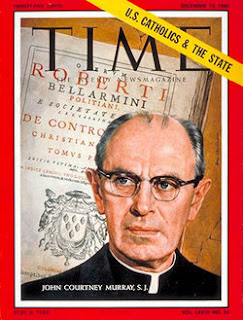
Remembering John Courtney Murray, S.J.

John Courtney Murray, one of the most important Catholic intellectuals of the 20th century, died 45 years ago today.  This site collects a whole bunch of his work, and also work about his work.  Check it out.  And, of course, if you don't own We Hold These Truths, well, you should.

Requiescat in pace
Wednesday, August 15, 2012

Reid on Ryan on Rand

My colleague Chuck Reid has a short essay on the Huffington Post raising questions about the tensions between Catholic social teaching and Paul Ryan's embrace of Ayn Rand.  An excerpt:

Ayn Rand, to her great credit, rejected racism emphatically. But she celebrated much of the rest of the social darwinist creed. There is no room in her work for cooperation, for community, for concern for the less advantaged. The maximization of individual productive capacity, freed of the impediments of state control, is the byword of her philosophy, so-called "Objectivism." The noble entrepreneur, the far-sighted man of wealth and power, the bold individualist who casts off the shackles of the "takers" and the "hangers-on," is the hero of her fiction. Without him, society itself would crumble to dust.

These philosophical premises, of course, stand in contradiction to the social thought of the Catholic Church, as developed over two millenia of experience. Paul Ryan surely knows this. His tepid protest that he reads the Bible and so cannot be a follower of Ayn Rand rings hollow. The record of his public life is that of a man in thrall to a curdled, warped individualism. I, for one, would like to know what he thinks about the magisterium of the Church regarding the positive value of the state.

Tuesday, August 14, 2012

Unscripted Praise for Paul Ryan from a Serious Democrat

As someone who is still a Democrat (though virulently opposed to the party’s radical pro-abortion agenda) I found the following heartening.  See the video in the link here.  In it, Erskine Bowles, former White House Chief of Staff under President Clinton, and co-chair of President Obama’s Nation Commission on Fiscal Responsibility and Reform, praises Paul Ryan:

“I’m telling you this guy is amazing. I always thought I was o.k. with arithmetic.  I’m telling you this guy can run circles around me.   He is honest.  He is straightforward.  He is sincere.  And the budget he came forward with is just like Paul Ryan.   It is a sensible, straightforward, honest, serious budget and it cut the budget deficit just like we did by $4 trillion.”

The link also provides some of the text of an op-ed piece in the Washington Post in which Mr. Bowles criticizes both Mr. Romney and Mr. Obama for their respective approaches to addressing the nation’s debt crisis through tax and spending policies – Romney for not closing tax loopholes, Obama for not reducing healthcare spending.  The entire op-ed is available here.

The tickets of the two parties are now set.  By all means, let’s have a serious, adult conversation about the policies advanced by the two sets of candidates.  Bowles has showed us how to begin that conversation.  This does not mean that any candidate should be somehow immune from criticism.  In a society that values freedom of expression how could it be?!

But it does mean that we not demonize candidates, no matter how strongly we disagree with them, and that the criticisms we offer be based on facts.  Bowles' example contrasts sharply with that of other Democrats, like Debbie Wasserman Schultz who in “not minc[ing] words” claims that Ryan “would be a nightmare for the middle class” and that he supports legislation that would “ban birth control” (here), and Vice President Joe Biden who in commenting on Romney and Ryan’s approach to banking regulation told a crowd in Danville, Virginia (a town that is 49% African-American) that “They’re gonna put y’all back in chains!” (here at 32:19).

Rep. Schultz and V.P. Biden are of course adults, so maybe the distinction shouldn’t be put in terms of “grown-ups” and “children” since it runs the danger of perpetuating the very discourse we seek to avoid.  Perhaps the distinction to draw is one between citizens who have a sincere party affiliation but who wish to engage others in good faith, and those who are hopelessly partisan.  The former are most welcome at MOJ.  There are plenty of other blogs for the latter.