Mirror of Justice

A blog dedicated to the development of Catholic legal theory.
Affiliated with the Program on Church, State & Society at Notre Dame Law School.

Friday, October 9, 2015

Judge O'Scannlain on "The Future of Religion in the Public Square"

With permission, I am posting a copy of the Red Mass lecture that Judge Diarmuid O'Scannlain recently delivered to the St. Thomas More Society in Milwaukee.  Here is a link:  Download DOS Red Mass lecture 

As one would expect, the lecture is thoughtful and learned.  Among other things, Judge O'Scannlain asks "what does Obergefell prescribe for the future of religious liberty in America?"  Like the man says, "highly recommended."

"The Pope's Subversive Message"

I enjoyed Arthur Brooks's piece in the New York Times:

. . . Francis’ secular admirers often stumble at his apparent preoccupation with evil. In an impromptu speech to schoolchildren in Harlem, he disconcertingly asked: “But who is it that sows sadness, that sows mistrust, envy, evil desires? What is his name? The devil.”

Some dismiss this as a clerical tic or South American eccentricity. It is nothing of the sort. The word “devil” comes from the Greek verb diabolos, meaning “slander” or “attack.” And “demon” comes directly from the Greek root meaning “to divide.” For Francis, happiness comes from unity, both with God and with one another. Unhappiness comes from division from either — which comes from the Dark One.

Many people around the world have found themselves attracted to the pope’s warm message of unity. And well they should be — unity is in short supply in our unhappy world today. But Francis is asking for more than a mass chorus of “Kumbaya.” He is in the hunt for the whole human soul.

Thursday, October 8, 2015

"Wolf Hall" gets Cromwell (and More, and the Church, and the Reformation . . .) wrong

Alfred Thomas explains, at Commonweal:  

. . . Cromwell . . . presided over the creation of a Tudor police state aimed at imposing conformity through terror. More than three hundred religious dissidents were executed between 1532 and 1540, years coterminous with Cromwell’s tenure. Yet in Wolf Hall we have Cromwell assuring other characters (and thus the audience) that “we do not do such things”—by which he presumably means torture. If his contention was simply presented as political spin—if we saw him practicing what he says he doesn’t do—that would be one thing. But in fact we never do see Cromwell torturing his victims, whereas Thomas More is shown positively relishing the experience.

. . . [I]nviting viewers to identify with a man who enabled Henry to tyrannize his subjects and force on them a religion they didn’t want is ethically problematic. The show comes perilously close to reproducing the Whiggish view of the Reformation as a much-needed sweeping away of a corrupt and outdated form of medieval Catholicism.

For more on "Wolf Hall's" inaccuracies (and clear anti-Catholic agenda), see this, this, and this.

Wednesday, October 7, 2015

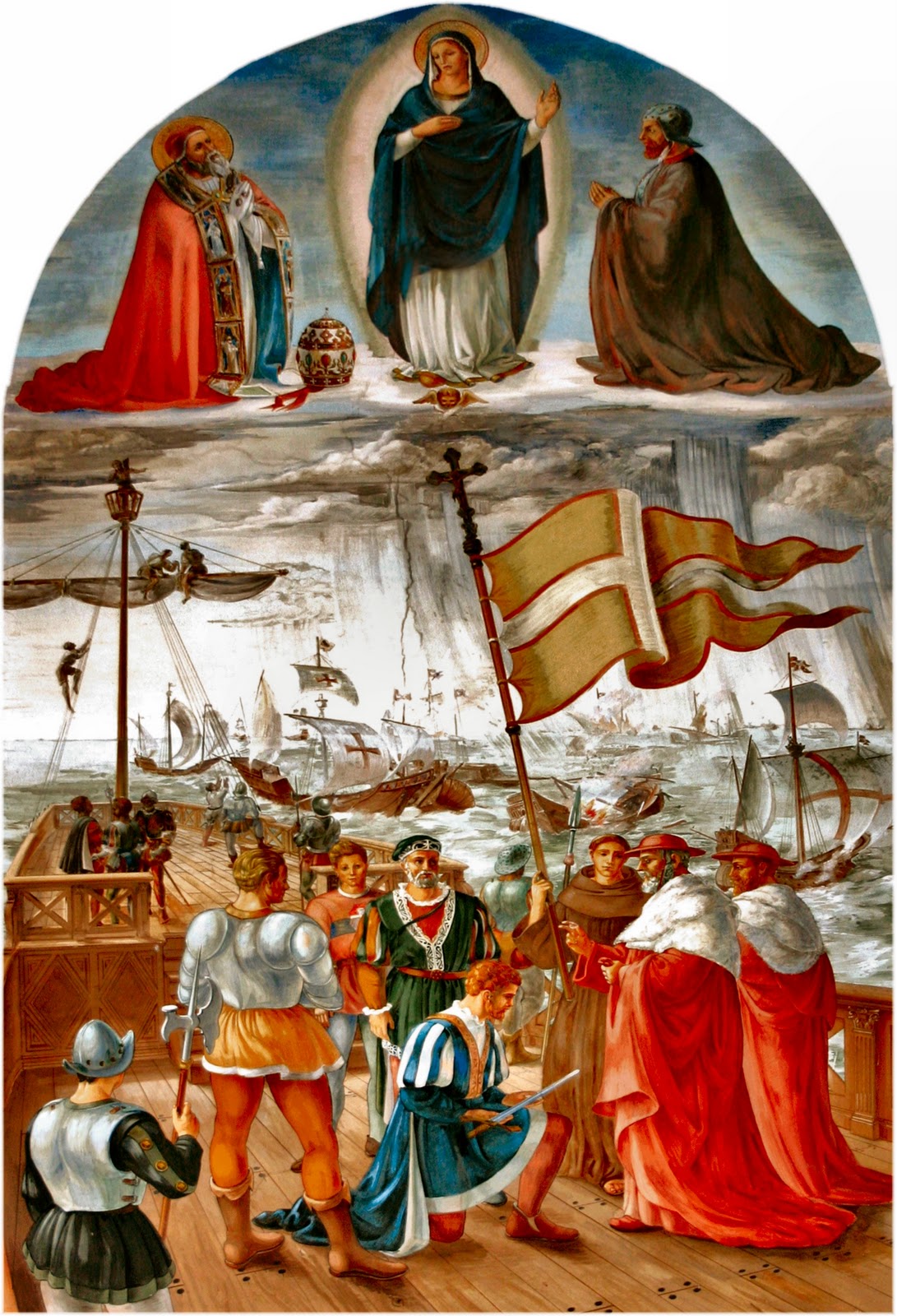
G.K. Chesterton's "Lepanto"

Always worth a (re-)read!

On this day in history: Lepanto

Our Lady of the Rosary, pray for us!

Tuesday, October 6, 2015

"An Epidemic of Loneliness": Community ties, Catholicism, and Suicide

This is very interesting.   In the Oct. 5 issue of National Review, Kevin Hassett has a piece called "An Epidemic of Loneliness."  Here's a taste:

For more than a hundred years, economists and sociologists have studied an empirical regularity: When the population share of Protestants relative to Catholics rises, suicides increase markedly. Two major theories emerged to explain the pattern. The first rests on theological differences, and holds that Catholics but not Protestants are dissuaded from suicide by the fear that it will lead to eternal damnation. The second is that Protestants are more likely to have weaker ties to the community, and it is this separation from the support of a community that leads to despair and suicide.

While the early literature focused on these two competing forms of Christianity, researchers have begun to explore religion and the role of community more generally. As time has gone on, the community-based rather than theological explanation seems to have become more widely accepted in the literature. For instance, research has found that while Protestants commit suicide more than Catholics, atheists are even more likely to take their own lives than Protestants, an observation that would favor the community-based rather than theological channel. . . .

. . . As Protestantism spread and Catholicism declined in Europe, individuals found themselves increasingly separated from the community support mechanisms that could help sustain them in difficult times. Suicides surged. Today’s coarsening world is having a similar effect on far too many. Suicide has become an urgent public-health crisis with astronomical economic costs.

Yet another reason to regret the recent enactment in California of assisted-suicide legalization.

Monday, October 5, 2015

Gov. Brown signs assisted-suicide law

Bad news out of California.  

Caught between conflicting moral arguments, Gov. Jerry Brown, a former Jesuit seminary student, on Monday signed a measure allowing physicians to prescribe lethal doses of drugs to terminally ill patients who want to hasten their deaths.

Approving the bill, whose opponents included the Catholic Church, appeared to be a gut-wrenching decision for the 77-year-old governor, who as a young man studied to enter the priesthood.

“In the end, I was left to reflect on what I would want in the face of my own death,” Brown added. “I do not know what I would do if I were dying in prolonged and excruciating pain. I am certain, however, that it would be a comfort to be able to consider the options afforded by this bill. And I wouldn’t deny that right to others."

Friday, October 2, 2015

Ah, "tolerance"

Here's the abstract for a new book by a senior lecturer at Keele University:

This book aims to examine and critically analyse the role that religion has and should have in the public and legal sphere. The main purpose of the book is to explain why religion, on the whole, should not be tolerated in a tolerant-liberal democracy and to describe exactly how it should not be tolerated - mainly by addressing legal issues. The main arguments of the book are, first, that as a general rule illiberal intolerance should not be tolerated; secondly, that there are meaningful, unique links between religion and intolerance, and between holding religious beliefs and holding intolerant views (and ultimately acting upon these views); and thirdly, that the religiosity of a legal claim is normally a reason, although not necessarily a prevailing one, not to accept that claim.

Yossi Nehushtan, "Intolerant Religion in a Tolerant-Liberal Democracy" (Hart 2015).

Wow.

Thursday, October 1, 2015

New Blog: "The New Reform Club"

Here's a new-ish group blog, that I'm liking a lot.  It's called "The New Reform Club:  God & Man in the 21st Century."  Check out, just for samples, this post by Gonazaga's Mark DeForrest on "Russell Kirk on the Conservatism of Continuity" and this one, by Seth Tillman, called "Why Punish Wrongdoing"?  A blog that identifies Chesterton and Belloc as two of its "patron saints" will likely be of interest to MOJ readers!  

Wednesday, September 30, 2015

The Pope met with Kim Davis / Responses to Vischer and Bowman [UPDATED]

The New York Times has an account, here.  This bit of news seems clearly to disrupt some narratives about the Pope and his visit, as do the Pope's remarks about the human right to conscientious objection, including by public officials.  I do not know what to make of the fact that he made these statements after leaving the United States and that his meeting with Davis was not publicized.  I do not agree with those who have tried to interpret the Pope's collection of events, addresses, and statements as somehow downplaying the importance of (and threats to) religious freedom, and yet, had the visit with Davis and his conscientious objection statements been part of that collection, it seems like it would have made that interpretation even more implausible than, in my view, it already is.

UPDATE:    A Vatican spokesperson "clarifies" regarding the meeting, here.  Clearly, some very different accounts are emerging, both of what happened between Pope Francis and Ms. Davis and how.  

UPDATE:    Spokesperson expresses a "sense of regret" over meeting?   And yet . . . the Pope said what he said about a human right to conscientious objection -- even by officials . . ..  One thing is clear:  those who imagine Vatican conspiracies to take over the world and steal our precious bodily fluids needn't worry.  The Church just isn't that organized.

 Like Rob Vischer (read his piece here), I think the Kim Davis case presents some tricky questions.  It is not as clear to me as it is to some that she can, in this moment, expect to be exempted from performing duties that attach to her elected, official position.  (This is not to say that it does not make sense to find ways -- as Robin Fretwell Wilson and others have described -- to accommodate, if possible, public employees' religious objections to participating in the legal recognition of same-sex marriages, if it can be done in a way that does not deny anyone legal rights.)  At the same time, I think Matt Bowman is clearly right to warn that those who control the power to define what "doing your job" means (or to control access to various positions and professions through licensing, accreditation, etc.) will be trying to use that power in the coming years against, say, pro-life doctors and nurses, or judges who belong to "discriminatory" organizations, or student groups and religious colleges with "discriminatory" views, practices,  or mission statements, etc.  Stay tuned.