I begin by thanking Tom and Susan for their contributions regarding the AALS annual meeting and the desire of certain groups of law teachers to boycott the early-New Year conference because the owner of the hotel, Mr. Manchester—who, by the way is a practicing Catholic according to news sources—contributed to the political campaign geared for the fall electoral season to address the California Supreme Court’s 4-3 decision in In Re Marriage Cases. It seems that Mr. Manchester disagrees with the majority opinion in that case, and he, along with other citizens of California, are using the means of democracy to express their disagreement.
According to the article about this matter appearing in the National Law Journal to which Tom kindly gave us the link, Mr. Manchester, the hotel owner, employs men and women who, in some fashion, identify themselves as homosexual. So, it appears that there is no employment or other discrimination prohibited by the law such that may offer protections that address this inclination.
But the boycott is focused on something else that the law also addresses, and that is Mr. Manchester’s Constitutional, and I would say God-given, right to participate in the political process. The problem with that, according to the law faculty who have expressed their decision to boycott his hotel, and perhaps the conference, is based on Mr. Manchester’s political contribution to a side in a referendum endorsed by the California Supreme Court. In short, these law faculty are challenging his right to exercise his political voice.
This is a tragedy, but it is also a violation of the law. How ironic that those who teach law would object to a person’s right to exercise his political voice in a democratic exercise. This is not the sort of thing one would expect in a democracy, but it may be the sort of thing to which one could expect in a totalitarian state.
Many years ago, in the 1930s, Christopher Dawson, the first holder of the Charles Chauncey Stillman Chair of Roman Catholic Theological Studies at Harvard University, had these words to say about the totalitarian mind in the academy and in society:
The totalitarian state—and perhaps the modern state in general—is not satisfied with passive obedience; it demands full co-operation from the cradle to the grave… [I]f Christians cannot assert their right to exist in the sphere of higher education, they will eventually be pushed not only out of modern culture but out of physical existence. That is already the issue in Communist countries, and it will also become the issue in England (Mr. Dawson’s country of birth) and America if we do not use our opportunities while we still have them.
I find Mr. Dawson’s counsel wise and timely. I hope that it benefits those who may be attending or may be considering attending the AALS conference early next year. If you join the boycott, you have certainly expressed your political decision. In that case, let Mr. Manchester and those who agree with him be able to exercise, without intimidation or any other pressure, their political decision, too. That is what democracy is about. But when it no longer is, then democracy has mutated into the totalitarian regime to which it is supposed to stand in clear counterpoint—and this would make our national motto, e pluribus unum, rather ironic indeed.
In reporting the plan of several law professor organizations to boycott the Association of American Law Schools annual meeting if held in the San Diego hotel owned by a contributor to the California campaign against same-sex marriage, Tom Berg says that we ought to regard the protest/boycott as "legitimate."
If by "legitimate," Tom means legally protected, then by all means, definitely yes. The government should not interfere with the choice by consumers singly or organized (and I would argue many service providers as well) not to patronize (or serve) those whose actions or positions they find offensive. But if by "legitimate," Tom means that this is a laudatory development or one arguably in keeping with the nature of all of the entities that are behind the boycott plan, then I think we should say, definitely no.
Most of the law professor organizations that are involved in this boycott campaign—the Legal Writing Institute, the AALS Section on Legal Writing Research and Reasoning, and the AALS Section on Teaching—are scholarly and academic organizations, not political lobbies. These entities should have no political platform by which to guide their actions. Since when has the Legal Writing Institute or the AALS or any of its subunits been permitted to adopt political resolutions? Does this now mean that a member of the Legal Writing Institute or these AALS sections who is opposed to same-sex marriage is no longer a member in good standing? Does this mean that a member of these entities who dissents from the new official position in favor of same-sex marriage would be well-advised to remain silent or even resign? Should a scholarly organization committed to legal writing or teaching excellence be identified as a political lobbying entity and one that takes a particular stand on a disputed issue? Again, the answer should be definitely no.
When the American Political Science Association (APSA) was recently considering whether to move a future annual meeting from New Orleans, the advocates of relocation were careful to frame their argument in terms of the alleged concrete harms that gay and lesbian political scientists might experience when visiting a state that not only rejected same-sex marriage but also prohibited any legal recognition of same-sex couples comparable to marriage. The debate focused on whether there was a real risk that the legal regime in Louisiana would prevent a gay person's partner from participating in health decisions should that gay person be hospitalized during the annual meeting. Ultimately, the executive board of the APSA concluded that the risk was not substantial enough to justify moving the meeting, to which gay rights groups and others within the APSA have responded with a boycott.
However, during the APSA debate, it was always common ground that political viewpoints alone were not a "legitimate" basis for the APSA as a scholarly organization to make decisions about siting a meeting. No one contended that the APSA should take a stand for or against same-sex marriage. To contend otherwise would have been to corrupt the nature of a scholarly organization, which should be committed to the open exchange of ideas, into that of a political pressure group with a distinct political viewpoint. Not only would such a step have contradicted the very nature of a general scholarly organization and compromised academic freedom, it also would have created inappropriate political conflict among the members.
The boycott of AALS meeting events now proposed by these law professor entities has taken the very step that the APSA wisely understood was never a "legitimate" option for any entity that calls itself a scholarly association and claims to represent an entire field of scholarly study. As I understand it, no one is suggesting that gay and lesbian law professors will be endangered, denied service, or mistreated in any way at this San Diego hotel. The boycott is crudely political, nothing less. It is based solely on the illegitimate and non-scholarly endorsement of one side of an election referendum, which then is advanced by an attempt to preclude any association with those who take the other side of that election contest. Such an openly political gambit, on an election matter no less, is unworthy of a scholarly association. By so corrupting a scholarly association, academic freedom for all law professors is diminished. This is a sad day indeed for the AALS.
(By contrast, the Society of American Law Teachers (SALT) is an openly political organization, not a general scholarly association, and thus its threat of a boycott poses less of a contradiction to its nature. Nonetheless, by taking the unwise step of urging the AALS to become politicized and act in conformity with a particular political stance on a controverted election, SALT improperly seeks to enmesh a scholarly association in a political controversy. As Susan Stabile inquires in her post, SALT's action arguably also undermines freedom of expression for controversial viewpoints, which from time to time SALT has suggested is part of its mission. We apparently may expect SALT in the future to adopt political litmus tests for hotel owners, vendors, etc., which it then will demand be honored by the AALS at the risk of a political boycott.)
Susan Stabile kindly responds to my post documenting the massive size of current government programs and the enormous expenditures on social programs already in place. She challenges the significance or meaning of some of the data that I provided and concludes that they fail to demonstrate a "serious commitment to the human flourishing of the poorest."
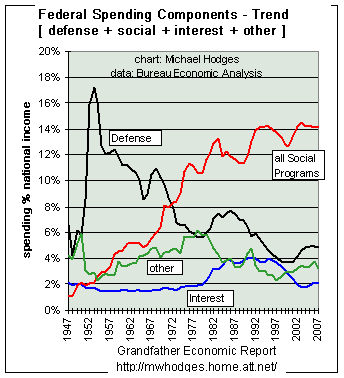
While the Hodge chart that I included in my prior post does include government pensions in the description of skyrocketing social spending (as compared with defense spending) over the past 60 years, I carefully separated out government pensions when noting that the categories of welfare, health care, and education spending by government constitute 40 percent of overall government spending and some 15 percent of our entire national economy. Now even if we were to assume that only half of health care spending by government and only one quarter of education spending by the government provides benefits to the poor, with all spending on welfare obviously being directed to poverty programs, government spending on programs for the poor in 2007 exceeded $1 trillion. If a trillion dollars of government spending on poverty programs, not even accounting for the many more tens of billions contributed by Americans each year to charities that serve the disadvantaged, does not demonstrate a "serious commitment to the human flourishing of the poorest," then apparently the sky really is the only limit.
I also offer this further defense of the reliability of the data that I provided: As evidence that the figures supposedly are hard to pin down, Susan says that Census Bureau statistics indicate that defense spending in 2007 was 20 percent of government outlays rather than the 13 percent figure that I used. In fact, the figures on government spending are readily available in some detail in Census Bureau statistics. The 20 percent figure that Susan identified is the share of defense spending as a part of the federal government budget viewed in isolation. As I'd noted in my post, and as the heading in the pertinent chart confirms, I was presenting the figures for government spending at all levels: federal, state, and local. The federal government is not the centerpoint for all governmental activity and programs in this country. State and local spending on poverty programs and education is considerable and should not be neglected. Defense spending indeed is only 13.4 percent of overall government spending and less than 5 percent of GDP, a level of defense spending that is lower today than before the Clinton Administration and much lower than it has been at many periods during the past half-century. And while defense spending as a share of GDP has been stable or declining, social spending as a share of GDP has nearly doubled in the past 40 years.
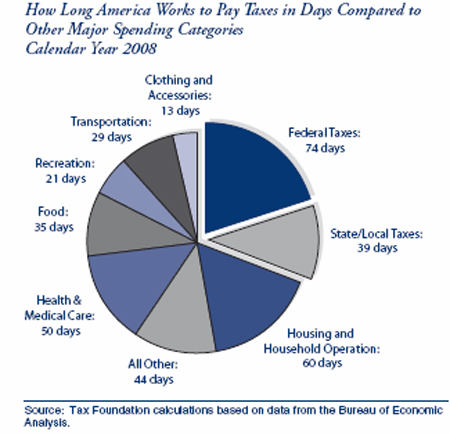
I stand by my earlier observation that those who advocate more government spending, new government poverty programs, and higher taxes to pay for it all have a great burden in proving that government consumption of more than a third of economic production in this country and government exaction of the product of nearly a third of our work lives to pay the taxes is negligible and insufficient.
Tom's post suggests that a boycott of a hotel owned by someone who donated funds to oppose same-sex marriage by groups who are part of the AALS is legitimate, but wonders at some point a market power counterargument kicks in. I'm still sorting out what I think about this but what I wonder is whether this isn't more of a speech issue than a market one. That is, it is one thing to organize a boycott against the hotel if there is something about the business itself that is objectionable (e.g., there is evidence of discrimination against homosexuals in the actual operations of the hotel). I assume no one would find such a boycott objectionable. But isn't it another thing for a legal academic group (which presumably thinks freedom of speech and expression is a good thing) to organize a boycott based on the owner's speech (in this case evidenced by a donation), even if we disagree with that speech? I'd be interested in hearing the thoughts of others on this.
From the National Law Journal (thanks to Mark Scarberry at Pepperdine Law for the pointer):
Organizations representing thousands of legal educators say they will boycott the Association of American Law Schools annual meeting in January if it is held at a San Diego hotel owned by a foe of same-sex marriage. . . .
The groups are the Society of American Law Teachers; the Legal Writing Institute; the AALS Section on Legal Writing Research and Reasoning; and the AALS Section on Teaching Methods. The groups represent as many as 2,500 members.
Several of us here, in varying degrees, emphasize the importance of, prima facie, letting people express their conscience in marketplace actions (landlords renting a few apartments, pharmacies refusing to dispense Plan B) without government interference. We also emphasize the value and inevitability of people acting in groups, not just as isolated individuals. So a boycott like this is legitimate, yes? -- but at what point should a "market power" counterargument kick in?
Greg's post does little to ally the concerns some of us have that (as expressed by Eduardo) there has been lacking “a serious governmental commitment to human development among the poorest Americans.” "Social spending," even as Greg narrows it to include only "welfare, health care and education," does not give us an indication of funds spent to help those living in poverty. For example, the Hodges chart figures for social programs includes, e.g., pensions for government employees. Or how much of the funds included for health care reach the poorest among us? It is hard to even tell from the first link Greg gives us what some of the categories of expenditures mean. These concerns are apart from the fact that even the total figures are hard to pin down. The Census bureau stats suggest that National Defense is about 20% of government outlays rather than 13%. So more is necessary to persuade that there is the serious commitment to the human flourishing of the poorest among us.
From the way our friends on the leftward side of our Catholic academic community here on the Mirror of Justice sometimes talk about government social programs and spending on the poor in this society, a person understandably might be left with the impression that we live in a libertarian regime in which the capitalist market distributes all income, government is small and starved for resources, taxes are low, and the disadvantaged are utterly neglected. Thus, Eduardo Penalver laments in a recent post that “a serious governmental commitment to human development among the poorest Americans” has never been manifested in the United States, “at least not during [his] lifetime.”
I want to suggest that the dollar-and-cents reality is something quite different. We can debate whether an even larger government presence and more government spending, accompanied by higher taxes, higher compliance costs, and more draws against economic productivity, is a good thing or not. But we should not be unaware of the enormous level of government expenditures already in place, among which social spending is by far the largest segment. We should also debate whether a state-centric approach to social justice is a good thing, either in material or spiritual terms. But only by appreciating the real-world economic realities can we fairly evaluate the remaining differences among us.
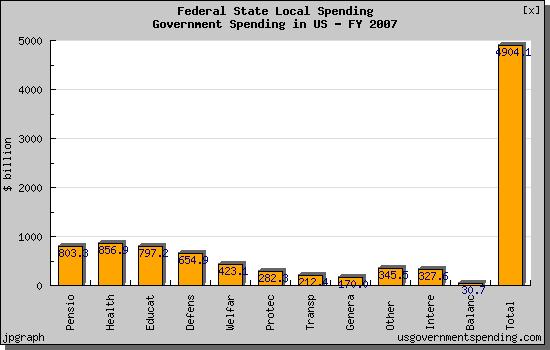
During fiscal year 2007, the total amount of government spending at all levels was $4.9 trillion. To place this in perspective, based on a Gross Domestic Product of $13.67 trillion, government spending consumed 35.9 percent of our economic production as a nation. The following table was helpfully compiled from Census Bureau statistics by usgovernmentspending.com:
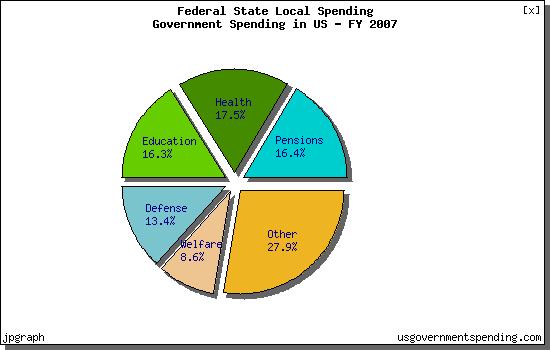
To see the same figures stated as percentages by category of overall government spending and in the form of a pie-chart:
Of that government spending, social spending constituted some 55.8 percent of total spending, totaling more than $2.88 trillion. Defining social welfare spending more narrowly to include only welfare, health care, and education, these spending categories add up to more than 40 percent of overall government spending and some 15 percent of our entire economic output. (And this social spending figure dwarfs the expenditures on national defense, which now stands at 13.4 percent of government outlays and less than 5 percent of GDP.)
Far from there being an absence of a serious government commitment to the poor during our lifetime, the trend in government spending during my lifetime at least has been nothing less than dramatic. Looking only at the federal budget, which significantly understates the total government spending on social programs, Michael Hodges on his web page documents how the percentage of the federal budget devoted to defense has plummeted while social spending has skyrocketed:
Nor should we look only to the government spending side and ignore the source of those revenues―the burden on the taxpayer. As calculated by the Tax Foundation from Bureau of Economic Analysis data, the average American spends nearly a third of each year working simply to earn enough to pay various local, state, and federal taxes:
Now I understand that some of our friends on the Mirror of Justice would like to see these numbers go higher, both in spending and taxes (and the two of course move together). They envision a still larger role for government in moving our society toward social justice. (And if Barack Obama does become President, as he at least appears to presume, we undoubtedly will see just such a major expansion of government.) But we should never pretend that government is not already a monumental presence in our lives, that government does not already expend gigantic sums of money, that the government does not already consume a huge segment of our national economy, and that we are not already paying a hefty part of our incomes in taxes.
Aleksandr Solzhenitsyn -- who was sent to the camps for referring to Stalin as the "man with the mustache" -- died on Sunday night. (Here is the very thorough NYT obit.) We here at MOJ talk, think, and write about "conscience"; Solzhenitsyn, in my view, really showed us how it's done. His work and witness shamed all those who, from the comfort of western salons, romanticized the Soviet Union. What the Times calls his "hectoring jeremiads" -- his speech at Harvard, for example, "A Warning to the West" -- were, it seems to me, also important. R.I.P.
Today’s Boston Globe has as its lead editorial a brief exhortation, Legislators who stepped up [HERE], commending the Massachusetts legislators who voted this past week to repeal the 1913 statute that has barred out-of-state homosexual couples from marrying in Massachusetts and then returning to their home state jurisdiction in the hope of having their Massachusetts same-sex marriage recognized in a place that does not permit this. The Globe heaped praise on the legislators who voted “yes” in favor of the repeal. Governor Deval Patrick quickly signed the legislative repeal noting that with the repeal, “All people come before their governments as equals.” I hasten to add some agreement and some disagreement with this position: in some things yes, they are equal, but in other matters no—especially when reason, common sense, and irrefutable facts demonstrate that “equality” is impossible. Michael Jordan and I both love basketball, but I doubt that the Commonwealth of Massachusetts will deem the two of us “equal” when it comes to our respective claims concerning the ability to play the game.
The Globe editorial took passing notice of opposition to the repeal from “social conservatives”. I wonder if the paper’s editorial board members who authored this congratulatory opinion would consider the legislators who voted “no,” that is, against the repeal, to be “social conservatives.” If a web log developing Catholic Legal Theory is a place to consider what is it that Catholic legislators should do and not do in their official capacities (something that members of MOJ have addressed from time to time), I would offer an opinion that the legislators voting “no” were the members of the General Court (the legislature) who, in fact, stepped up. It is clear that many of the legislators who voted “yes” consider themselves Catholic. But it was those Catholics, and other legislators who are not Catholic, who voted “no” who understand well the wise counsel of Pope John Paul II when he stated that “the value of democracy stands or falls with the values which it embodies and promotes.” [Evangelium Vitae, N. 70]
In my opinion, the “no” votes belong in the circle of those who upheld the values crucial to democracy. I fear that those who cast “yes” votes have imperiled the values of “democracy” insofar as it exists in Massachusetts and will lead us further along a road to the diminishment of values crucial not only to democracy but to the society that it should preserve and protect.
I just saw a reference to an article (Human Dignity and the End of Life) in America magazine (August 4, 2008 issue) by Cardinal Rigali and Bishop Lori. I am not sure if the article is available for free on America's website. The article is a response to previous America articles by Thomas Shannon and John Hardt on providing artificial nutrition and hydration to PVS patients. Shannon and Hardt, according to the article, "appear to misunderstand and subsequently misrepresent the substance of church teaching on these difficult and important ethical questions."
I think the current article by Cardinal Rigali and Bishop Lori commendably explains the Church's position on this issue and the errors in the Shannon and Hardt articles, about which we have blogged in the past. I am curious what people think about what seems to be a growing practice of the Bishops to issue statments of this sort. Since the implementation of Ex Corde, there hasn't been any real use of the mandatum and maybe this is a concerted (non-disciplinary) effort on the part of the Bishops to try to make sure that Church teaching is articulated clearly.