Our Board of Trustees voted unanimously yesterday to select Dr. Julie Sullivan, currently Provost at the University of San Diego, as our new president. You can see read more about her here, here, and here.
I was a member of her Search Committee. Out of a deep and wide pool, she was a true stand-out in every way, and I couldn't be more thrilled that she is joining us.
She will be our first lay president and, obviously, will provide us with a blast of the 'feminine genius.' I liked her remarks on this at the press conference:
"I'm sure many of you are wondering, What does this mean? How will
this be different? Should we be scared?" Sullivan said. "I believe my
appointment reflects the sign of the times. ... the board sought to
broaden their pool of candidates to all qualified Roman Catholics."
"In my view, the board's decision was a reflection of their
recognition that universities are very complex organizations today. And
finding the best candidate to lead one requires a broad pool."
Here was an interesting statistic from the St. Paul Pioneer Press's coverage:
Baenninger said
lay leaders have been replacing clergy as top administrators of Catholic
universities in Minnesota and beyond. Of the 17 members of the
Minnesota Council of Private Colleges, three are led by women, and two
of those are Catholic institutions.
According to the Association of Catholic Colleges and
Universities, such institutions are ahead of the curve nationally when
it comes to female top leadership, as well. Among the 194 members of the
association, almost 35 percent have female presidents, compared with
about 26 percent of all colleges and universities.
Perhaps it's time for me to update my 2007 article, What Catholic Law Schools could Learn from Harvard about Women, in which I argue that Catholic teachings support measures to support more women to stay in academia. Or maybe someone's been reading that article?
Here is a short reflection on Pope Benedict's Scholarly Legacy by Don Briel, Director of the Center for Catholic Studies at UST. Don emphasizes a point sorely missed by most of commentators in the popular press, with their reflexive attempts to fit everything into the easy categories of contemporary politics:
In the end, the insight of the scholar pope that the new
evangelization must proceed not on the grounds of disputation but in the
invitation to love, Deus Caritas Est, shaped a new understanding of the
vitality of orthodoxy, not as a safe middle between the extremes of
traditionalists and progressives but as a vital alternative to their
frozen fascination with political accounts of the Church.
And how did Pope Benedict attempt to break this 'frozen fascination'? Briel writes:
As expected, he placed a strong emphasis on addressing the amnesia of
European culture about its Christian roots, and in remarkably
sophisticated presentations in London, Paris, Berlin and Rome he
reminded secular governments about the essential role of faith in modern
democratic assumptions and insisted that faith could not be reduced to a
private principle and excluded from civic life. He forged unexpected
relations with atheistic and agnostic public intellectuals like Marcello
Pera and Jürgen Habermas, who testified to the dangers to the common
good and to the human person in certain instrumental political
developments in modern culture. As pope, his emphasis on the role of
faith in the modern world led Ratzinger to a number of interreligious
and ecumenical gestures despite his refusal to accept a lowest common
denominator approach to interreligious dialogue.
I find myself in awe of the amount of confidence and certainty of having correctly heard the call of God that Pope Benedict XVI must possess in order to take the step he took, this shattering of 600 years of precedence. My only personal encounter with Pope Benedict came when he presided over Mass at a conference I attended at the Vatican, a few weeks before he was elected Pope. The sermon was a reminder that those of us attending the conference could do all the reasoning & philosophizing & theologizing we wanted, but at the end of the day, the most important thing we could do was this -- attend Mass and encounter the truth of Christ in our prayer and the Eucharist. Perhaps a prescient piece of advice for himself?
I also find myself thinking about this description of Pope Benedict's personal confidence, from a John Allen column back in 2006:
My thesis is this: After 18 months of Benedict's papacy, one defining
characteristic is what we might call his "Chestertonian assurance," a
tranquility in the face of diverse currents of thought, as well as the
respect that one deeply cultured soul naturally feels for another.
By
the way, I am not comparing Benedict and Chesterton on a personal
level. Chesterton was irascible and curmudgeonly; Benedict, on the other
hand, is unfailingly gracious, polite, and kind. As a personality type,
he's closer to Emily Post. Yet Benedict breathes the same air of
Christian enlightenment as Chesterton. His approach to modernity is
neither the craven assimilation that Jacques Maritain described as
"kneeling before the world," nor the defensiveness of a "Taliban
Catholicism" that knows only how to excoriate and condemn.
Facing
disagreement and differing cultural visions, Benedict is not afraid --
and because he's not afraid, he's not defensive, and he's not in a
hurry.
Such a spirit is largely alien to our fractured and
hair-trigger era, and so Benedict has been something of a paradox- this
avatar of Catholic traditionalism espousing a positive message, willing
to engage in reasoned reflection with people who don't think like him.
For 18 months, people have been speculating about when the "real pope"
will emerge from beneath this serene, gracious façade. Ladies and
gentleman, I suggest to you tonight that the façade is the real pope.
Our local paper today published an op ed piece I wrote about the guidance published recently by the Department of Education on how schools can satisfy their legal obligations to make their sports programs accessible to students with disabilities. The school in Minnesota are, I think, exceptionally progressive on this front; it has been a surprising blessing for my son and my family.
Watching how my son has benefited from being involved in sports has radically shifted my own perspective on high school sports programs. As a nerdy non-athlete, I've frankly been rather skeptical about the place of sports programs in schools, as a pedagogical matter. Watching my son and his teammates (who have no realistic hope or aspiration of college sports scholarships or professional sports careers), in an odd way has let me see the effect of involvement in sports stripped clean of the benefits that only accrue to the very best athletes, as I describe in the op ed piece. So, chalk this up as yet another of the many things my son has taught our family.
AS Oscar season approaches, I guess it's time for the NYT's annual story about nuns involved in the movie industry. This time it isn't Mother Dolores Hart, subject of the Oscar-nominated documentary about "the nun who kissed Elvis." Rather, it's Sister Rose Pacatte, film critic: "A Nun at the Crossroads of Faith and Film." Here's how she started out:
On the day before she entered a Catholic boarding school in August 1967,
as a 15-year-old who felt the call to be a nun, Rose Pacatte indulged
in a final fling with the secular world. She went to the local drive-in
to see “The Dirty Dozen.”
And here's what she does now:
Besides writing for The National Catholic Reporter’s online edition, she
reviews for The St. Anthony Messenger, a monthly magazine for Catholic
families with a circulation of about 300,000. She has presented talks on
topics like “Meeting Jesus at the Movies” and “Media and the Moral
Imagination” from Toronto to Oxford to Johannesburg. She has sat on
Catholic or ecumenical juries at the Venice and Berlin International
Film Festivals, among others.
There are certain experiences that pull me backwards into history, making me think about how much I have in common with past generations: really focusing on the constellations always makes me think of the ancients who named those clusters of stars; crossing the Rockies in an airplane always makes me think of the pioneers who took months to cross them by foot; staring down into the Grand Canyon always makes me think of the generations of people who did the same.
The NYT published an article this past December that has been haunting me since I first read it, with the same sort of thoughts: Ancient Bones that Tell a Story of Compassion, by James Gorman. It focuses on archaeologists who are studying prehistoric skeletons showing evidence of significant illness and disability, and drawing conclusions about the kind of care their communities must have provided to allow them to survive. Some examples from the article:
a "young man who lived 4,000 years ago in what is now northern Vietnam . . . laid to rest curled in the fetal
position. . . . His fused vertebrae, weak bones and other evidence
suggested that he lies in death as he did in life, bent and crippled by
disease. They gathered that he became paralyzed from the waist down before adolescence, the result of a congenital disease known as Klippel-Feil syndrome.
He had little, if any, use of his arms and could not have fed himself
or kept himself clean. But he lived another 10 years or so. They concluded that the people around him who had no metal and lived by
fishing, hunting and raising barely domesticated pigs, took the time and
care to tend to his every need."
a "Neanderthal, Shanidar 1,
from a site in Iraq, dating to 45,000 years ago, who died around age 50
with one arm amputated, loss of vision in one eye and other injuries.
Another is Windover boy from about 7,500 years ago, found in Florida,
who had a severe congenital spinal malformation known as spina bifida,
and lived to around age 15. D. N. Dickel and G. H. Doran, from Florida
State University wrote the original paper on the case in 1989,
and they concluded that contrary to popular stereotypes of prehistoric
people, 'under some conditions life 7,500 years ago included an ability
and willingness to help and sustain the chronically ill and
handicapped.' "
And this somewhat macabre, but I think somehow very touching bit of speculation:
"A skeleton of a young woman about 18 years old
from a site on the Arabian Peninsula more than 4,000 years old
indicated that the woman had a neuromuscular disease, perhaps polio. “Her condition likely made it difficult for her to walk,” Dr. Martin
wrote in an e-mail. “She had exceedingly thin arm and leg bones with
very little buildup of normal muscle attachments.” She probably received
round-the-clock care, Dr. Martin concluded. But one problem that she had was apparently not a result of the disease.
The teeth that she had were full of cavities, and she was “missing
teeth from abscesses and periodontal disease.” Those who cared for the young woman may have been too kind, Dr. Martin
said. Her people grew dates, and, “Perhaps to make her happy, they fed
her a lot of sticky, gummy dates, which eventually just rotted her teeth
out, unusual for someone so young.”
This weekend in New York City I'm going to be exploring this universal human impulse to care for the disabled, and how it persists despite the anthropological premises of modernity that seem to be conspiring to quench it, at the "New York Encounter" sponsored by the Catholic movement Communion and Liberation and the Crossroads Cultural Center. (I'll be exploring some of the ideas developed in this recent article, Hauerwas and Disability Law: Exposing the Cracks in the Foundations of Disability Law, and how they illustrate the application of the notion of elementary experience developed by Fr. Luigi Guisiani, the founder of the CL movement.) Here's the program for the entire three-day cultural festival, with the theme "Experiencing Freedom" -- including talks, music, theater, exhibits on G.K. Chesterton and Freedom and the Cristeros: The Martyrs of Mexico. It's all free and in the heart of Manhattan.
To add to the list of 'questions your kids ask that you're embarrassed not to be able to answer" . . .
My son, who is studying German in college, asked me the following, and I couldn't answer. I don't think it has anything to do with the informality of Twitter, because I think he's right about the informal 'du' being used in religious conversation. I suspect some MOJ readers know the answer. Please comment if you do!
I
was looking at Pope Benedict's new Twitter account, and out of curiosity, I
checked the German one too: https://twitter.com/Pontifex_de. Is it typical to religious
authorities like him to refer to people with the informal "you?" Or
is that some kind of special "pope" tense? I know that Germans refer to God with "du," so it could
be related to that. Or could it have something to do with the Pope being the
"father" of the rest of the Church--he uses "du" because
he's talking to his "children?"
Want a 10-minute advent time-out during this sometimes frantic shopping, decorating, exam-taking & grading season? My brother sent me this clip about the powerful effect of music on residents of some nursing homes, narrated by the famed author & neurologist, Oliver Sachs. Just watch the last resident, "Henry", offering one of the most beautiful renditions of "I'll be Home for Christmas" that I've heard this season (and I spend a lot of time shuttling around kids who insist on listening to the 24-hour Christmas music station these days). What really got me, though, was Henry's reminder of the truth that should give us all comfort, at all times, but maybe especially in the days leading to Christmas: "The Lord came to me. Made me holy. I'm a holy man."
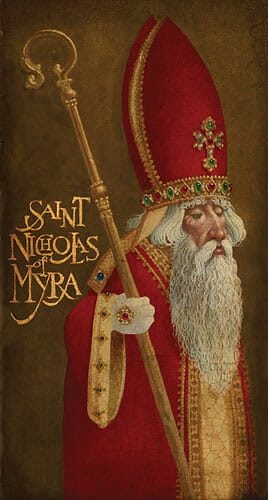
This is a feast day that was widely celebrated when I was growing up in Germany. We kids always woke up to shoes full of candy, but my father's shoe was always filled with coal (something that never failed to send us all into gales of laughter). More here.
Speaking of Germany...... last Friday the Murphy Institute dedicated one of its "Hot Topics: Cool Talk" programs to the recent grant of political asylum by U.S. Immigration Judge Lawrence Burman to German family (Uwe and Hannelore Romeike and their five children) who were home-schooling their children. (In Germany, attendance at an
officially recognized school – public, private or religious – is
mandatory.) Judge Burman ruled that “home-schoolers are a particular social group that the
German government is trying to suppress. This family has a well-founded
fear of persecution … therefore, they are eligible for asylum.” Luke Goodrich, a Becket Fund attorney who worked on their amicus brief supporting the Romeike’s asylum claim, debated this issue with David Abraham of the University of Miami School of Law. You can watch the video here.