Nearly 200 people gathered at the University of Dallas this past weekend for the annual Thomas More Conference. The theme this year was “Thomas More on Trial: Law and Conscience in More’s Last Letters and Trial Accounts. Many noted More scholars were joined on the program by practicing lawyers and jurists, including Judge Edith Jones (5th Circuit) and Sir Michael Tugendhat ( Judge of the High Court, England and Wales.
One of the many themes that unfolded during the weekend was the development and change in tone of More’s letters and writings in the tower as the months went by but especially as it became clear that he would suffer death. Dr. Seymour Baker House developed this theme in contrasting More’s Dialogue of Comfort Against Tribulation with the Sadness of Christ with the former much lighter and the latter much darker, being written probably after the execution of the Carthusian monks and just prior to Bishop Fisher’s execution. Dr. Elizabeth McCutcheon explored the changes in the letters to his daughter Margaret written after three different interrogations. And, Dr. John Boyle looked at the letters to fellow prisoner Wilson.
More’s trial was also examined from a number of angles – procedure (did he get a fair procedure for the time period and how does that contrast to today’s procedures), the substance (the Acts of Succession, Supremacy, and Treason; the indictment; the fact that Parliament had insisted that “malice” be an element of treason; whether Richard Rich may have misunderstood More rather than engaged in perjury – the consensus was a resounding “no;” and the roles of the King, Parliament, Judges, and jury).
One of the high points of the conference included a dramatic reading of the trial based upon the multiple accounts of the trial. The trial had the feel of a Good Friday Service and the trial of Jesus. During a question and answer session, one of the lawyers present opined that all the great trials in history are miscarriages of justice, revealing our fallen human nature and the need for redemption in Christ.
The conference was also a great place to begin friendships with fellow travelers, including practicing lawyers, English professors, and philosophers. I became acquainted with the journal Moreana and its editor who traveled from France
for the conference. Our hosts, Professor Jerry Wegemer and the Center for Thomas Studies were excellent hosts. Next years conference (Nov. 6-7) will focus on “Thomas More’s Life of Pico & Humanist Letters.”
Little Rock's new bishop, Anthony Taylor issued his first pastoral letter last week. For those interested in immigration, "I was a Stranger and You Welcomed Me..." A Pastoral Letter on the Human Rights of Immigrants is an important read.
Tuesday, November 4, 2008
I'll be in Dallas November 7-8 for the Thomas More Conference, but I wish I could bi-locate so that I could attend one of my favorite conferences, The Notre Dame Center for Ethics and Culture's Annual Fall Conference to be held Nov. 6-8 at Notre Dame. The theme for this year's interdiscplinary conference is the family. I am sure that our own Elizabeth Kirk played an important role in organizing the conference. Speakers include John Finnis, David Lyle Jeffrey, Janet Smith, Ralph Wood, Lynn Wardle, Bill Saunders, and Thomas Hibbs. The conference is so jam packed that attendees have to choose between Helen Alvare, Gilbert Meilander, and Francis Beckwith since they are all speaking at the same time. In touting the conference, I want to single out three speakers. MOJer Lisa Schiltz will give the Jack Schuster Memorial Lecture on Friday evening. Her lecture is entitled "Does Sarah + Joe = 3? The History and Future of Complementarity in Catholic Feminism." MOJer Richard Stith ("Abortion as Betrayal of Natural Dependents") and my daughter, Anamaria ("Against Dualism of Reason and Feeling") are on different panels from 3:15-4:45 on Saturday afternoon.
Sunday, November 2, 2008
A reader writes:
Steve Shiffrin's recent post responding to John Breen and Michael Scaperlanda is coarse, uncomprehending, and creepy.
He castigates those who use the "shrill rhetoric" of calling abortion murder. Yet he engages in the shrill, ideologically partisan, and philosophically unjustifiable rhetoric of calling human beings in the embryonic and early fetal stages of development mere "human organisms that could develop biologically," and "human organisms without nerves or brains." Coarse -- and hypocritical. He provides not the slightest argument to sustain the alleged distinction between a mere "human organism" and a human being. Nor does he take the first step towards answering those critics of abortion and embryo-destructive research who have argued that the distinction cannot be sustained in light of the facts of human embryogenesis and early develoment and the spectacular failure of efforts to identify the "person" or the "real" human being with the brain, or consciousness, or the immediately exercisable capacities for characteristically human mental functioning. Uncomprehending. The rhetoric of "human organism" (which, of course, is what all of us are) is a mere rhetorical ploy to define certain human beings -- those at early developmental stages when some people have an interest in being permitted to exterminate them -- out of membership in the human family. Creepy.
Religion need not be brought into any of this, but since MoJ is supposed to be a Catholic blog, it is worth asking on what basis a Catholic can possibly distinguish "living human organism" from "human being" -- especially when the distinction is deployed to justify failing to protect (and even licensing the killing of) those who are unfortunate enough to be categorized by those in power as mere "human organisms." If there is one thing that is utterly bedrock about the Catholic understanding of humanity, it is that all living members of the species Homo sapiens, irrespective of age, size, stage of development, location, or condition of dependency, are human beings -- persons possessing inherent and equal dignity and a right to life.
Clearheaded and intellectually honest advocates of abortion do not pretend that their position is compatible with the Catholic understanding of humanity and fundamental human equality and dignity. Take Princeton
philosopher Peter Singer, for example. Unlike Shiffren, Singer understands and freely acknowledges that "living human organisms" in the embryonic, fetal, and infant stages of development are human beings. He doesn't shrink from this truth, or engage in word games to obscure it from view. He knows that if "having a brain" makes a difference to moral standing, it is because the brain functions to enable creatures of certain kinds to possess self-awareness and to carry out certain forms of mental activity. But, of course, humans don't have a brain that functions in that way until months after birth. Hence, Singer defends the morality not only of abortion, but of infanticide. Singer's conclusion is horrific, but at least he faces up to the scientific facts and is honest enough to speak out loud about the implications of his moral-philosophical premises.
Evidently, Shiffren would like to find a middle ground (one that could somehow still count as "Catholic") between the view of the nature and basis of human dignity taught by the Catholic Church (though not by the Church exclusively, nor on the basis of sheer revelation) and a view like Singer's. If he takes the trouble to examine the scientific and philosophical literature, and to consider the facts and arguments carefully, he will join those who have already ventured forth and found that the "middle ground" is nothing but quicksand.
Steve S. says that John and I "do not respond to the point that killing a human being with a brain and a central nervous system is more serious than killing a human organism that could develop biologically." I would direct him to my post of October 23, 2006 in which I quoted at length from an essay by Francis Beckwith. I also linked to an important essay by Patrick Lee and Robert George entitled the wrong of abortion.
Wednesday, October 29, 2008
Richard S., thank you for linking to Cardinal Egan's column. It moved me, and I decided to include the beginnings of it here:
The picture on this page is an untouched photograph of a being that has been within its mother for 20 weeks. Please do me the favor of looking at it carefully. [you can click on it to enlarge it]
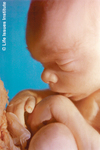
Have you any doubt that it is a human being?
If you do not have any such doubt, have you any doubt that it is an innocent human being?
If you have no doubt about this either, have you any doubt that the authorities in a civilized society are duty-bound to protect this innocent human being if anyone were to wish to kill it?
If your answer to this last query is negative, that is, if you have no doubt that the authorities in a civilized society would be duty-bound to protect this innocent human being if someone were to wish to kill it, I would suggest—even insist—that there is not a lot more to be said about the issue of abortion in our society. It is wrong, and it cannot—must not—be tolerated.

