Mirror of Justice

A blog dedicated to the development of Catholic legal theory.
Affiliated with the Program on Church, State & Society at Notre Dame Law School.

Wednesday, January 27, 2010

"only mildly interested in either God or the world"?

In response to Michael Perry's posting the blurb for Fr. James Keenan SJ's new book on the history of moral theology in the twentieth century, I was tempted to ask whether this book from Continuum bears the imprimatur.  But that jocular inquiry would have detracted from the seriousness of some questions that we should ask about what is being advertised. I haven't read the book (though I shall), so for now I'm just reacting to what Michael P. has commended to our attention.  I should add at the outset that I have always held Fr. Keenan in high personal regard, and I have learned much from his writings over the many years I have studied them, even when I have disagreed with his conclusions.

To the point, are Fr. Gerald Kelly SJ (who essentially founded Catholic medical ethics in this country and to whom Richard McCormick acknowledged owing a tremendous debt) and Fr. John Ford  SJ (who wrote one of the most important articles in 20th century just war theory on the morality of obliteration bombing) best captured by (or reduced to) the phrase "classical gate keepers, censoring innovation?"   And notwithstanding the genre of the book blurb, what underlying philosophical and theological commitments are being advanced by setting in opposition the views that "the locus of moral truth is in continuous, universal teachings of the magisterium or in the moral judgment of the informed conscience?" Perhaps Father Keenan's valuable task of recounting these internecine struggles and staking out his own position on them goes to show, as Alasdair MacIntyre remarked 30 years ago, "Roman Catholic theologians all too often give the impression of being only mildly interested in either God or the world; what they are passionately interested in are other Roman Catholic theologians."  I believe Father Keenan's real concerns bear on God and His creation, but unfortunately the blurb perhaps suggests otherwise.

But, as I say, I look forward to reading the book.  Perhaps we can revisit these questions here once some of us have had a chance to study what Fr. Keenan has written.


A History of Catholic Moral Theology in the Twentieth Century

From Confessing Sins to Liberating Consciences

by James F. Keenan

This is an historical survey of 20th Century Roman Catholic Theological Ethics (also known as moral theology). The thesis is that only through historical investigation can we really understand how the most conservative and negative field in Catholic theology at the beginning of the 20th could become by the end of the 20th century the most innovative one.

  • Imprint: Continuum
  • Pub. date: 17 Jan 2010
  • ISBN: 9780826429292
256 Pages, paperback World rights $29.95

This is an historical survey of 20th Century Roman Catholic Theological Ethics (also known as moral theology). The thesis is that only through historical investigation can we really understand how the most conservative and negative field in Catholic theology at the beginning of the 20th could become by the end of the 20th century the most innovative one. The 20th century begins with moral manuals being translated into the vernacular. After examining the manuals of Thomas Slater and Henry Davis, Keenan then turns to three works and a crowning synthesis of innovation all developed before, during and soon after the Second World War. The first by Odon Lottin asks whether moral theology is adequately historical; Fritz Tillmann asks whether it's adequately biblical; and Gerard Gilleman, whether it's adequately spiritual. Bernard Haering integrates these contributions into his Law of Christ. Of course, people like Gerald Kelly and John Ford in the US are like a few moralists elsewhere, classical gate keepers, censoring innovation. But with Humanae vitae, and successive encyclicals, bishops and popes reject the direction of moral theologians. At the same time, moral theologians, like Josef Fuchs, ask whether the locus of moral truth is in continuous, universal teachings of the magisterium or in the moral judgment of the informed conscience. In their move toward a deeper appreciation of their field as forming consciences, they turn more deeply to local experience where they continue their work of innovation. Each continent subsequently gives rise to their own respondents: In Europe they speak of autonomy and personalism; in Latin America, liberation theology; in North America, Feminism and Black Catholic theology; and, in Asia and Africa a deep post-colonial interculturatism. At the end I assert that in its nature, theological ethics is historical and innovative, seeking moral truth for the conscience by looking to speak crossculturally.

Preface


New Beginnings

1. Moral Pathology and The Manualists

2. The Inbreaking of History: Odon Lottin’s Initiatives and His Legacy

3. The Scriptures and Love: Tillman and Gilleman


Either/or

4. Moving toward two tracks: Pius Xii, Bernard Haring and Reaction

5. ultimate authorities? Conscience and the Magisterium: Fuchs, Paul VI, and John Ford:

6. European Revisionism (universities) and American Proportionalism debate: Hoose


Both and

7. Feminism and Natural Law

8. Justice and Virtue

9. Inculturation and Liberation


New vision, new competence

10. Epilogue: Working Locally, dialoging Globally

James F. Keenan, S.J., is professor of theological ethics at Boston College. He was principal editor of Catholic Ethicists on HIV/AIDS Prevention and is the author of numerous books, including The Works of Mercy: The Heart of Catholicism, Moral Wisdom: Lessons and Texts from the Catholic Tradition, Virtues for Ordinary Christians, Commandments of Compassion, Goodness and Rightness in Thomas Aquinas's Summa Theologiae, and (with Daniel Harrington) Jesus and Virtue Ethics annd Paul and Virtue Ethics.

Suk on trauma and abortion discourse

Harvard law prof Jeannie Suk has posted her new paper, The Trajectory of Trauma: Bodies and Minds of Abortion Discourse.  The abstract:

What is the legal import of emotional pain following a traumatic event? The idea of women traumatized by abortion has recently acquired a constitutional foothold. The present Article is about this new frontier of trauma. I argue that the legal discourse of abortion trauma grows out of ideas about psychological trauma that have become pervasively familiar in the law through the rise of feminism. The Supreme Court’s statement in Gonzales v. Carhart, that some women who have abortions feel “regret” resulting in “severe depression and loss of esteem,” has provoked searing criticism because talk of protecting women from psychological harm caused by their own decisions seems to recapitulate paternalistic stereotypes inconsistent with modern egalitarian ideals. I argue that a significant context for the newly prominent discourse of abortion regret is the legal reception of psychological trauma that has continually gained momentum through feminist legal thought and reform since the 1970s. Rather than representing a stark and unmotivated departure, the notion of abortion trauma continues a legal discourse that grew up in precisely that period: a feminist discourse of trauma around women’s bodies and sexuality. This intellectual context gives meaning to the present discourse of women’s psychological pain in our legal system. The ideas informing abortion regret are utterly familiar once contextualized in modern legal understandings of women that have developed in the period since Roe.

Archbishop Chaput on mass communications

Archbishop Chaput made this comment to the Congress of Priest and Laity today:

Part of what blocks a serious awareness and rethinking of our current culture is the “knowledge economy” we have created. In its 1999 statement Towards a Pastoral Approach to Culture, the Pontifical Council for Culture saw that the constant flow of “information provided by [today's] mass media . . . affects the way things are perceived: What people come to know is not reality as such, but what they are shown. [The] constant repetition of selected items of information involves a decline in critical awareness, and this is a crucial factor in forming what is considered public opinion.” It also causes “a loss of intrinsic value [in the specific] items of information, an undifferentiated uniformity in messages which are reduced to pure information, a lack of responsible feedback, and a . . . discouragement of interpersonal relationships.” This is all true. Much of modern technology isolates people as often as it brings them together. It attacks community as easily as it builds it up. It also forms the human mind in habits of thought and expression that are very different from traditional culture based on the printed word. And that has implications both for the Word of God and for the Church.

The full text of the speech is here.

"Separation of Pro-Life and State"

Over at First Things, Meghan Duke reports what should be (but, unfortunately, really isn't) a shocking story:

While visiting the National Gallery of Art this past Saturday, I ran into a pair of errant security guards who have taken to interpreting the Constitution in their spare time.

I decided to visit the Gallery after attending the March for Life the day before. There was an exhibit on processes of photography before the digital age that I hoped would confirm me in my refusal to give up on film. After searching my bag, the two guards at the Gallery told me, “You’re good to go in, but first you need to remove that pro-life pin.” He was indicating the small lime green pin with the message “impact73.org” and the silhouette of a small hand inside that of a larger hand that I had attached to the lapel of my coat. The pin, they informed me, was a “religious symbol” and a symbol of a particular political cause and it could not be worn inside a federal building. Why, I asked, can I not wear a religious or political symbol inside a federal building? Bringing to bear the full weight of the supreme law of the land, the guards informed that it was a violation of the First Amendment of the United States’ Constitution: The combination of me, wearing a pro-life pin, in a federal building was a violation of the separation of church and state.

This is ridiculous, of course, and on many levels.  (I am smothering every impulse to say something snarky about the current administration's alleged dedication to common ground and respectful dialogue on the question of abortion . . . oops.  Dang.)  Perhaps most troubling, though, is the premise of the guard's mistaken First Amendment analysis, i.e., that a pro-life symbol (think of the little-feet lapel pins one sometimes sees) is a "religious" symbol.  As Duke notes:

A pro-life pin is not necessarily a religious symbol because the pro-life movement is not a specifically religious cause. We do not argue that abortion should be outlawed on the basis of a divine mandate; we argue that it should be outlawed because children in utero are human beings with an inherent right to life, exercising the same claim to our protection of that right as other human beings. Had I been wearing a yellow bracelet that said Livestrong or a T-shirt that said Help Haiti I am sure I would not have been stopped. I would be expressing the same sort of belief—that we bear a responsibility to help a specific group of people—but no one would suspect that my views were religiously motivated, they would chalk them up to my sense of humanity. A sense of humanity entirely comprehensible apart from religion.

On the other hand, as some of us (Michael Perry, most prominently) have argued, all serious moral claims sounding in human rights in dignity are probably, in the end, inescapably "religious".  Duke again:

[T]he pro-life pin is not “entirely different” from the cross. My understanding of the inherent worth of every human being is founded in a Christian worldview. While almost anyone can vaguely intuit the dignity of the human person, the Christian recognizes that it is rooted in his being the image of God, a God who descended to become one of our species and suffered and died that we might have life.

Protecting unborn children by detaining negligent mothers

What do people think of this case:

TALLAHASSEE, Fla. (AP) - Samantha Burton wanted to leave the hospital. Her doctor strongly disagreed, enough to go to court to keep her there.

She smoked cigarettes during the first six months of her pregnancy and was admitted on a false alarm of premature labor. Her doctor argued she was risking a miscarriage if she didn't quit smoking immediately and stay on bed rest in the hospital, and a judge agreed.

Three days after the judge ordered her not to leave the hospital, Burton delivered a stillborn fetus by cesarian-section.

And six months after the pregnancy ended, the dispute over the legal move to keep her in the hospital continues, raising questions about where a mother's right to decide her own medical treatment ends and where the priority of protecting a fetus begins.. . .

Any thoughts?  Comments are open (and, of course, subject to monitoring).

Tuesday, January 26, 2010

Addendum: Focus on the Fractious Family

Hello again, All,

By way of a fellow at OpinionatedCatholic comes this added wrinkle to the Focus on the Family story: http://www.getreligion.org/?p=23909.  Dr. Dobson will apparently be leaving the organization at the end of February, and the circumstances appear to be a bit less than amicable.  Helas, such is our human frailty, it would seem, that even the most self-consciously and ideologically committed of 'families' sometimes finds difficulty in staying together.  Here's to a return to the true Upper Room.

All best, and thanks for the link to OC,

Bob  
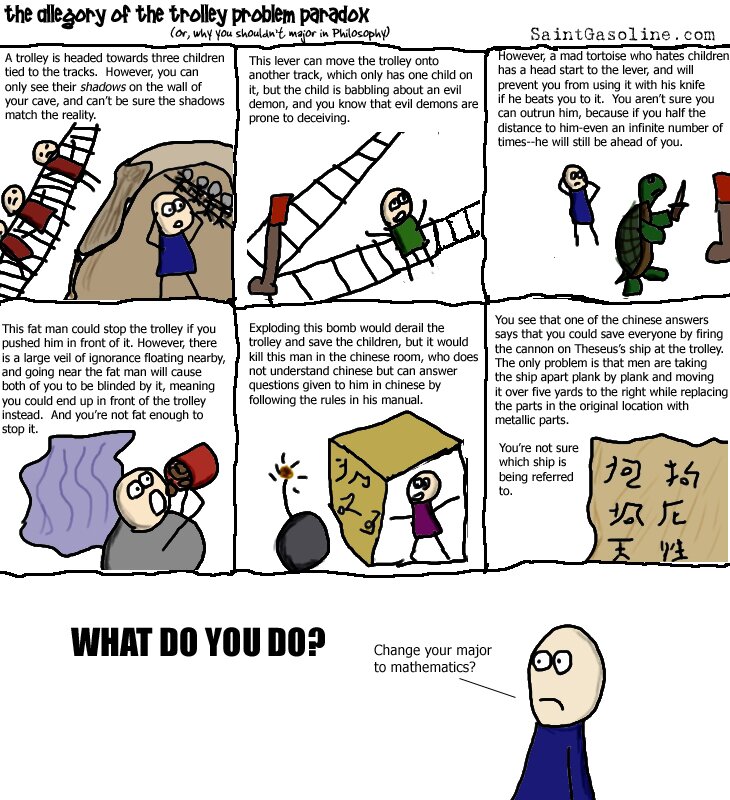
Any philosophy majors out there? (HT: Larry Alexander)

http://www.saintgasoline.com/comics/2007-03-04-Allegory_of_Trolley_Problem_Paradox.JPG

Consider the Source

Hello All,

I'm sympathetic to much of what Rob says in the post immediately below, but offer one mitigating consideration that might render the protest against CBS's decision a wee bit less depressing: It is possible that those protesting the planned ad are as concerned about the source of the ad as they are about its content.  I used, in the early 1990s, to listen to Dr. Dobson's radio programs with some regularity, and was impressed at the time by their charitable tones and evident sincerity in proclaiming the aim to provide succour and healing to all who voluntarily sought it.  But as that decade wore on, Dr. Dobson's messages and his involvement in American politics took on what in my view was a decidedly darker cast, filled with hard-hearted imprecations and paranoic likenings of Democratic political figures to servants of Satan.  And this is not even to mention the tendency I began to notice, as the decade wore on, for Dr. Dobson's programs to cast women in subordinate, 'follower' roles in relation to men.  I ceased listening altogether in disgust by the late 1990s.  Dr. Dobson's role in our polity has, it seems to me, become only more distasteful and uncharitable since the late 1990s, and it might well be that shared impressions of this sort account at least in part for the current protests against CBS's decision.  A helpful experiment would be presented us were Catholic Charities or, better yet, a group of women religious and/or the Catholic Worker movment to attempt to run a similar ad.  Were the protests to be the same in such case, I'd be a bit more able to join Rob in his depression.

Keep heart!,

Bob

Perhaps the most depressing protest ever?

CBS is taking heat from women's groups for agreeing to run an ad from Focus on the Family featuring Tim Tebow, whose mother rejected her doctors' advice that he be aborted:

“An ad that uses sports to divide rather than to unite has no place in the biggest national sports event of the year—an event designed to bring Americans together,” said Jemhu Greene, president of the New York-based Women’s Media Center.

This is depressing on several levels:

First, from what I understand, the ad will not advocate any particular legal response to abortion; it simply will celebrate life and the personal choices that make life possible.  If a message like that is too "divisive" to be expressed on a grand cultural stage, then we have a serious problem.  For those who insist that the concept of the common good has become so thin that a meaningful conversation on the subject is impossible, this might be Exhibit A.

Second, the logic underlying an argument that messages encouraging others to "choose life" are "demeaning" makes me want to poke myself in the eye with a sharp object.  It is a message aimed at hearts and minds; it is not (as far as I know) aimed at persuading the state to criminalize abortion (I'm not saying that those messages have no place in the public square, just that those message are understandably more controversial.)  But to insist that a mother telling her story of being blessed by her choice for life is "not being respectful of other people's lives" (according to Terry O'Neill, president of NOW) is to twist the concept of "respect" beyond recognition.

Third, the nature of the protest -- don't taint the sacred ground of the Super Bowl! -- speaks loudly about our society's rush to embrace events that give us a sense of community (and even transcendence), and how silly we sometimes look as a result.  Perhaps at one time those events were religious, but now we're left with the Super Bowl (and maybe American Idol).  As sports columnist Gregg Doyel wrote, “If you’re a sports fan, and I am, that’s the holiest day of the year.  It’s not a day to discuss abortion."

I've opened comments.