Monday, February 22, 2010
This conference, at Georgetown's Berkley Center, should be excellent:
In the context of a globalizing world marked by the freer flow of people and ideas, proselytism has become increasingly controversial. On March 3, 2010, the Berkley Center will sponsor a day-long symposium on proselytism and religious freedom in the 21st century. Experts from a variety of scholarly and policy fields will investigate the theological, legal, and political implications of the missionary impulse.
8:30 am - 8:55 am: Light breakfast available
9:00 am: Welcome: Thomas Banchoff, Director, Berkley Center
9:05 am - 10:20 am: Proselytism as Religious Duty
Richard Land, Southern Baptist Convention
Imam Mohamed Magid, All Dulles Area Muslim Society Center
Randi Rashkover, George Mason University
Moderator: Timothy Samuel Shah, Boston University
10:20 - 10:30: Break
10:30 am - 12:00 pm: The Political Implications of Proselytism
Salam Al Marayati, Muslim Political Action Committee
Leah Daughtry , House of Lord Church, Washington, DC
Matthew Richards, Brigham Young University
Moderator: Eric Patterson, Berkley Center
12:00 pm - 12:30 pm: Buffet Lunch
12:45 pm - 1:45 pm: Keynote Debate: Proselytism Pros and Cons
Jose Casanova, Georgetown and the Berkley Center
Gerard V. Bradley, Notre Dame Law School
Moderator: Thomas Farr, Berkley Center
1:45 - 2:00: Break
2:00 pm - 3:15 pm: The Legal and Social Dimensions of Proselytism
Robert Woodberry, University of Texas
Roger Finke, Penn State
Angela Wu, The Becket Fund for Religious Liberty
Moderator: Allen Hertzke, University of Oklahoma
For some of my own thoughts on proselytism and religious freedom, please read this paper, "Changing Minds: Proseyltism, Religious Freedom, and the First Amendment":
Proselytism is, as Paul Griffiths has observed, a topic enjoying renewed attention in recent years. What's more, the practice, aims, and effects of proselytism are increasingly framed not merely in terms of piety and zeal; they are seen as matters of geopolitical, cultural, and national-security significance as well. Indeed, it is fair to say that one of today's more pressing challenges is the conceptual and practical tangle of religious liberty, free expression, cultural integrity, and political stability. This essay is an effort to unravel that tangle by drawing on the religious-freedom-related work and teaching of the late Pope John Paul II and on a salient theme in the law interpreting the Free Speech Clause of the First Amendment.
Running through and shaping our First Amendment doctrines, precedents, and values is a solicitude for changing minds - our own, as well as others'. Put differently, the Amendment is understood as protecting and celebrating not just expression but persuasion - or, if you like, proselytism. There are, therefore, reasons grounded in our Constitution and traditions for regarding proselytism and its legal protection not as threats to the common good and the freedom of conscience, but instead as integral to the flourishing and good exercise of that freedom. This same solicitude for persuasion and freedom pervades the writing of Pope John Paul II, who regularly insisted that the Church's evangelical mission does not restrict freedom but rather promotes it. The Church proposes - thereby inviting the exercise of human freedom - she imposes nothing. The claim here, then, is that proposing, persuading, proselytizing, and evangelizing are at the heart of, and need not undermine, not only the freedoms protected by the Constitution, but also those that are inherent in our dignity as human persons.
TS is a wonderful periodical, "published quarterly for the Society of Jesus in the United States".
My issue arrived in today's mail, and three pieces caught my eye right away, one of them by MOJ's own Amy Uelmen:
Amelia J. Uelmen, "Caritas in veritate and Chiara Lubich: Human Development from the Vantage Point of Unity," pp. 29-45.
James F. Keenan, SJ, "Contemporary [Catholic] Contributions to Sexual Ethics," 148-67.
Kenneth R. Himes, OFM, "The United States at War: Taking Stock," pp. 190-209.
I am puzzled about the posture of Protestants (whatever
their political views) and most liberal Catholics on the New Testament canon. To
the chagrin of Elaine Pagels, for example, the Gospel of John is in the canon;
the Gospel of Thomas is not. Who decided to include John and include Thomas? It
is problematic for Protestants to say that the institutional church made this
decision because Protestants do not recognize the authority of the
institutional church. Nothing in the Bible says which books should be included
in it and which not. Some argue that God not only inspired the authors of at
least some of the books of the New Testament (citing proof texts), but also
inspired the institutional church to determine which books to include and which
to exclude. But, from a Protestant perspective, what justifies saying that the
inspiration stopped at that point? I am genuinely curious about the positions
Protestants take on this issue.
In terms of liberal Catholics, I am thinking of those
Catholics who believe that the institutional church has been wrong throughout
its history about many moral issues. What is the account that explains why the
Holy Spirit would let the Church go wrong on so many issues? Some would
distinguish questions of morals from those of faith, but Karl Rahner has argued
with considerable force that the church has changed its position on many issues
of faith as well. Assuming the church has been wrong on issues of faith and
morals, what justifies the liberal Catholic’s belief that the canon is God’s
canon? Again, I ask this in a spirit of inquiry, and I recognize that this is not a problem for most traditional Catholics (except to the extent they believe that Church history is marred by persistent error).
The New Testament is the record of what different followers
of Christ speaking to different audiences in different contexts said about
him. If many modern theologians
believe that these followers were not inspired by God, that need not prevent
them from maintaining otherwise conventional Christian views (though it might).
But those who do not believe that the New Testament is inspired by God are more
likely to broaden the canon.
This is cross-posted at religiousleftlaw.com where Patrick O'Donnell has an interesting reflection in the comments section.
Sunday, February 21, 2010
TO: Elizabeth Schiltz
FROM: Michael Perry
RE: Followup to earlier conversation
DATE: February 21, 1010
Britain's love of the underdog triumphed Sunday as intimate war
drama ''The Hurt Locker'' beat 3D spectacular ''Avatar'' to take six
prizes, including best picture, at the British Academy Film Awards.
Kathryn Bigelow won the best-director battle with ''Avatar'''s James Cameron, her ex-husband, for her intense depiction of a bomb-disposal squad in Iraq.
''It means so much that this film seems to be touching people's hearts and minds,'' Bigelow said.
Both films had eight nominations for the British awards, considered
an indicator of possible success at the Academy Awards in Los Angeles
next month. ''Avatar'' and ''The Hurt Locker'' each has nine Oscar
nominations.
''The Hurt Locker'' also took British prizes for original screenplay cinematography, editing and sound.
''Hurt Locker'' screenwriter Mark Boal dedicated the best-film prize
to the hope of peace ''and bringing the boys and girls back home.''
Bigelow also paid tribute to soldiers serving in Iraq, and said the
goal of the film was ''putting a bit of a spotlight on a very, very
difficult situation.''
The ''Avatar''/''Hurt Locker'' battle initially seemed like a
David-and-Goliath story. Cameron's last feature, ''Titanic,'' won 11
Oscars, including picture and director. ''Avatar'' is a global
phenomenon that has taken more than $2 billion at the box office.
''Hurt Locker'' has made about a hundredth that much.
''It did not seem like a slam-dunk commercial proposition,'' said
Boal, who thanked Bigelow and the cast for making ''an unpopular story
about an unpopular war.''
[HT: Associated Press. Full story here.]
Saturday, February 20, 2010
This looks interesting:
Abstract
When the action of a state agent results in the deprivation of the
federal rights of any “person” within the jurisdiction of the United
States, that person may bring a civil action under 42 U.S.C. § 1983. In
Roe v. Wade, the Supreme Court held that a fetus is not a
constitutional “person.” As a result, an unborn child injured by a
state agent may not raise a claim under § 1983. This result, however,
has at times appeared unjust. The bar on fetal 1983 claims has
obstructed access to state-funded prenatal care, denied fetuses the
protection of the police, and insulated state agents from liability
where their reckless or abusive actions have resulted in physical
injuries to the unborn.
Conceding that the language of Roe presents a virtually
insurmountable obstacle to fetal 1983 actions, this Comment argues that
neither the facts nor the reasoning of Roe logically support a regime
that refuses to compensate unborn children for injuries occasioned by
state actors. This Comment proceeds to analyze how the prohibition on
fetal 1983 claims generates legal inconsistencies and is unsound from a
policy perspective. A principled examination of the unavailability of
damages to compensate for in utero injuries reveals that the
longstanding bar on fetal 1983 claims should be reconsidered.
[The article--actually, a student "Comment" by the Articles Editor of the UCLA Law Review--is available here.]
Patron saint of troublemakers
James Martin SJ, August 07, 2009
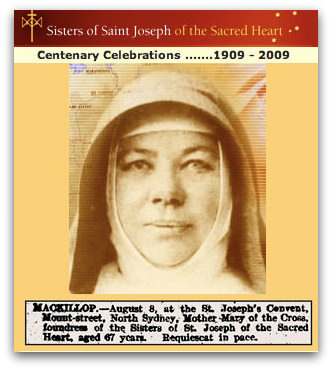 The headlines read: Pope hopes excommunicated nun might become saint.
Yes, you read that correctly.
Mother Mary MacKillop, the foundress of the Australian-based Sisters of
St Joseph of the Sacred Heart, was, in 1871, officially excommunicated
by her local bishop, on the grounds that 'she had incited the sisters
to disobedience and defiance'.
That same church leader, Bishop Sheil, had earlier invited her to work
in Adelaide, where she and her sisters would eventually set up schools,
a women's shelter and an orphanage, among their many works. But
MacKillop's independent spirit was a threat to Bishop Sheil, who had
her booted out of the Church.
Last month, Prime Minister Kevin Rudd spoke with Pope Benedict XVI
about MacKillop's possible canonisation. Just last year, the pope
visited MacKillop's tomb in Sydney during his visit to Australia for
World Youth Day. Prime Minister Rudd said that the visit 'left a deep
impression on the Holy Father'.
In April of this year, in an extraordinary gesture, Bishop's Sheil's
successor, the current archbishop of Adelaide, Philip Wilson, made a
public apology to the Sisters for their foundress's excommunication.
Standing before her statue, he said that he was 'profoundly ashamed of
the Bishop's actions in driving the Sisters out onto the streets'. . . .
MacKillop was beatified in 1995. From the sounds of Prime Minister's
Rudd's comments, and the implied message of the pope's visit to her
tomb, she will soon become a saint — perhaps the patron saint of
troublemakers.
[Read the entire piece here.]
[HT: Greg Kalscheur, SJ.]
