Here is an interesting opinion piece, by Thomas Hibbs, which discusses (among other things) the work of my Notre Dame colleagues at the Lab for Economic Opportunities. A bit:
We all understand poverty is a problem, one that can seem intractable and inevitable. But what if the way we have approached poverty has been wrong for years, for generations even?
There’s evidence it might be.
The traditional model of the American social service industry has long been a one-size-fits-all approach that treats the symptoms of poverty — transportation, child care, food insecurity — but does nothing to address the cause. The result traps the poor in a never-ending cycle of dependency and stigma, creating repeat customers.
That scathing indictment comes not from a critic of the war on poverty but from one of its most passionate advocates.
Originalist article and brief on ministerial exception. My students Nathaniel Fouch and Erik Money and I have just published a piece in the Federalist Society Review. It's Fouch, Money, and Berg, "Credentials Not Required: Why an Employee’s Significant Religious Functions Should Suffice to Trigger the Ministerial Exception." (PDF version here.) It arises from the two cases the Supreme Court just agreed to hear, St. James School v. Biel and Our Lady of Guadalupe School v. Morrisey-Berru., and an amicus brief that the St. Thomas Religious Liberty Appellate Clinic filed--with Nathaniel and Erik as student drafters--supporting certiorari (successfully) in the Morrisey-Berru case. The article expands on the brief but also reflects our personal views rather than the views of the amici we represented (although the views of course are very similar).
The article and brief criticize the Ninth Circuit's reasoning in these cases that religious-school teachers teaching religion classes, who had other significant religious functions, were nevertheless not "ministers," and thus not within First Amendment protections for the schools, because they did not have ministerial training, ordination, or other "credential[s]." We argue that this reasoning violates basic Religion Clauses principles that prohibit discrimination among religious groups/polities and judicial second-guessing of religious organizations' self-understanding. Most centrally, we have an originalist argument, pointing to 18th-century colonial laws in New England and Virginia that set educational and other credentials for ministers (and to which Baptists and other minority sects dissented). We argue:
In short, narrow definitions of minister—notably, laws setting educational and other credentials for ministers—were prominent among the evils to which the Religion Clauses were a response. Today, some courts are repeating this evil by effectively requiring that a minister possess “credential[s], training, or ministerial background” in order for an organization to invoke the ministerial exception. Such requirements impose civil authorities’ assumptions—almost inevitably majoritarian assumptions—that certain training or formalities are inherent in the concept of a minister.
Other 2019 work by the St. Thomas RL Clinic. Our clinic (info here) had a productive 2019. We filed or started work on amicus briefs in 4 cases in the Supreme Court (including the minister cases above), representing Christian, Jewish, and Muslim groups. Throughout the students did great work, and through the goal was to promote (in the way kids would put it on social media) #ReligiousFreedomForAll.
1) The Seventh Circuit upheld the validity of the federal tax provision allowing clergy to exclude housing allowances from taxable income (which equalizes religious groups that don’t own parsonages with those that do). The court cited our clinic's brief, filed on behalf of Christian and Jewish groups, which had presented various statistics and tax calculations to show how invalidating the provision would seriously harm tens of thousands of congregations, and especially harm small urban ones.
2) In April we filed a brief (successfully) supporting certiorari in Espinoza v. Montana Dept. of Revenue, the case on whether a state court can invalidate a school-choice law (tax credits for people indirectly supporting private schools) solely on the (discriminatory) basis that the program includes religious schools. Oral argument on the merits is Jan 22.
3) We’re happy that the Solicitor General urged the Court to grant review in Patterson v. Walgreen Co. and finally give teeth to Title VII's requirement that employers accommodate employee religious practice except in case of "undue hardship." Our brief, filed for Christian and Muslim organizations, documented that accommodation disproportionately protects minorities--Muslims, Jews, other Saturday sabbath observers, and others--and that the current weakness of the test disproportionately harms them.
4) We contributed to research to help the coalition proposing the new "Fairness for All"legislation, which offers a thoughtful solution to the knotty problem of giving meaningful antidiscrimination protection for gay, lesbian, and transgender rights and meaningful protection to the religious liberty of those conscientiously opposed to facilitating same-sex or transgender conduct.
5) We’re currently working on FNU Tanzin v. Tanvir, the new Supreme Court merits case where the FBI put Muslim Americans on the no-fly list for refusing to inform on fellow worshipers in what they regard as an overbroad security investigation. We'll be co-counsel on a brief of religious-liberty scholars supporting the plaintiffs' claim that they can sue individual agents for damages under the Religious Freedom Restoration Act.
I would like to thank the Notre Dame Law Moot Court Board students for again hosting an excellent religious freedom moot court tournament during the fall semester. The tournament was established in 2016 to bring together competitors, scholars, and practitioners from across the country to encourage legal dialogue on a religious freedom topic. The 2019 tournament, our fourth consecutive tournament at our Notre Dame campus, was made even better thanks to a generous grant from the Bradley Foundation. I feel very confident in our ability to host a first rate tournament for years to come, and I encourage all interested Law students to consider joining us in November of 2020. You can read more about the 2019 tournament here.
Speaking of religious freedom moot court tournaments, Notre Dame Law School will be involved with the 2020 International Moot Court Competition in Law and Religion. The tournament is hosted by the European Academy of Religion and is in its third year. We are thrilled that the tournament this coming March will take place at the Notre Dame Rome Global Gateway.
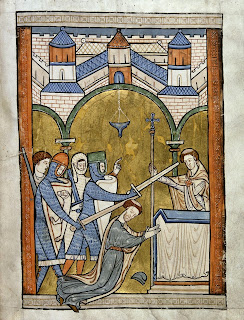
For today's Feast of St. Thomas Becket, below is a passage from the conclusion of historian Anne Duggan's very fine 2004 biography (previous posts on Becket's legacy drawing upon Tudor historian John Guy and GK Chesterton are here and here). 2020 will mark 850 years since Becket's martyrdom on December 29, 1170 and 800 years since the translation of his remains from the crypt of Canterbury Cathedral to a shrine on July 7, 1220. See here for information about a series of Becket2020 events and here for an exhibition on Becket at the British Museum opening October 15.
If one picture is worth a thousand words, the depiction of Becket’s murder—with the armour-clad knights brandishing their swords above the unprotected head of the priest—created an unforgettable image, which expressed the tension between religious and secular forces. No commentary was required to interpret the dramatic scene transmitted across Europe in manuscripts or on the reliquaries manufactured in Limoges. Detached from the specifics of the dispute with Henry II, that image became a powerful symbol of ecclesiastical steadfastness in the face of secular excess. In a sense, the image was the message; and the meaning of the message was not lost on Henry VIII, who destroyed the shrine and caused the hated name to be erased from the service books of the English Church; nor was it lost on the controversialists of the post-Reformation era, Catholic, Anglican and Protestant, who responded to the message with praise or censure according to its application to their own outlook.
Many secular heroes are made by single events: Richard I at Acre, Henry V at Agincourt, Nelson at Trafalgar, Wellington at Waterloo, Montgomery at El Alamein. For martyrs, it is the fact of their death in defence of their beliefs that justifies their claim. In Becket’s case, the cause for which he died was ultimately bypassed by history; but it had numerous analogues that could be recognized in very different historical settings. Even in this generation, the murder of Archbishop Oscar Romero of San Salvador in [1980], or of Father Jerzy Popiełuszko in Poland, called up the image of St Thomas of Canterbury, murdered for opposition to a powerful king. Becket’s example, of resistance to an aggressive “public power” and courage in the face of extreme violence, could be appreciated by men and women across the ages.
Jon Hannah already noted the good news that the Supreme Court has agreed to review the Ninth Circuit's (misguided) rulings in St. James School and Our Lady of Guadalupe school. In each of these cases, the Ninth Circuit adopted a very narrow version of the "ministerial exception," which was unanimously confirmed to be constitutionally required by the Supreme Court in the Hosanna-Tabor case. Here is an amicus brief, filed on behalf of a number of church-state scholars (including MOJers Michael Moreland and me), urging the Court to grant cert. (and reverse). From the "summary of the argument":
In Hosanna-Tabor, this Court affirmed that the ministerial exception protects the autonomy of religious organizations to select those who perform significant religious functions, including religion teachers and others who help transmit the faith. Both history and precedent show that the First Amendment forbids the government from “interfer[ing] with the internal governance of the church.” Hosanna-Tabor, 565 U.S. at 188. And to protect the right of religious autonomy, religious organizations must have the freedom to “control . . . the selection of those who will personify [their] beliefs” or “teach their faith.” Id. at 188, 196. The ministerial exception embodies this principle by prohibiting the government from imposing sanctions on religious organizations for the hiring and firing of key religious personnel, including religion teachers. In the decision below, the Ninth Circuit misconstrued the ministerial exception in two ways.
First, it misread Hosanna-Tabor as adopting a set of mechanical requirements that must be satisfied in every case for the ministerial exception to apply. Second, it failed to recognize that the core purpose of protecting religious autonomy requires applying the exception to all employees who have significant religious responsibilities.
The Ninth Circuit’s decision not only departs from this Court’s precedent and the history underpinning the ministerial exception, but also conflicts with every other Circuit to address this issue.
The Supreme Court agreed today to weigh in on whether the government can control who a church school chooses to teach its religion classes. In Our Lady of Guadalupe School v. Morrissey-Berru and in St. James Catholic School v. Biel, the Becket Fund for Religious Liberty is defending two California Catholic elementary schools’ right to choose ministers that embody their faith without government interference. After the U.S. Court of Appeals for the Ninth Circuit ruled against both schools and rejected the prevailing common-sense standard for allowing religious schools to choose their teachers, Becket appealed to the Supreme Court, which has now agreed to hear both cases.
A new report claims that values-based education offered by Catholic schools can serve as a model for all schools seeking to reform and to improve the long-term success of their students.
The report, “Catholic On the Inside: Putting Values Back at the Center of Education Reform,” released last week by the Manhattan Institute, states that while debates over school reform have intensified in the last two decades, “values, culture, and beliefs - the inside of a school - have largely taken a backseat to these external, structural changes.”
St. Anselm College monks have sued their own school, claiming that trustees’ efforts to reduce the power of the on-campus Benedictine monks threaten the 130-year-old institution’s Catholic identity.
The lawsuit, filed late last month in Hillsborough County Superior Court in Manchester, asks a judge to prohibit college trustees from changing bylaws without the consent of the monks, whose order founded the university.
The suit exposes rifts that have developed since 2009, when monks handed over many of the responsibilities for the Catholic liberal arts college to a board of trustees.
Read the full story from the New Hampshire Union Leader here.
The world of medieval history suffered a great loss on November 30 with the death of Professor Brian Tierney. Widely recognized as a leading scholar of medieval Western Christianity and how church law and institutions affected the broader culture of Europe, Tierney wrote widely but also deeply on topics ranging from the origins of papal infallibility to how religion shaped the development of constitutionalism.
We join many others in the Law & Religion community today in mourning Al McDonald’s death. In 1989, Mr. McDonald and his wife Suzie founded the McDonald Agape Foundation which works with a select group of universities and scholars who represent models of spiritual knowledge and deep faith.
Read more about the good work that Al and his foundation did for the field here.