An interesting discussion at Public Discourse.
Tuesday, March 15, 2011
Miller & Schaengold on Aristotle & MacIntyre
Lent "in the Ignatian tradition"
The Passing of William Stuntz
I was not lucky enough ever to meet Professor William Stuntz, whose passing is noted today here. But I do know his very thoughtful piece (authored together with the force of nature that is Professor David Skeel) on Christianity and the (Modest) Rule of Law. The implications for criminal law, in particular, for a "Christian" and "modest" law are well worth considering, especially in light of the federal criminal law's seemingly ever-increasing scope.
I wish I had had the chance to know Professor Stuntz.
Public opinion on the family: some opinions aren't changing
A new study shows that Americans are more accepting of families headed by a same-sex couple than they are of families headed by a single mom. And while the numbers on the same-sex couple question have moved dramatically in recent years, the numbers on the single-mom question have not. I'm not convinced that this reflects any illegitimate bias against single moms rather than an acknowledgment of the empirical data that kids raised by single parents do not fare as well on a number of scores as kids raised by two parents. We don't, as far as I'm aware, have similar data suggesting caution about same-sex couples. So maybe we're headed away from the broader "traditional" versus "non-traditional" split in public opinion on family social policy and toward a "two parent" versus "single parent" split?
Monday, March 14, 2011
"Is Capital Punishment Pro-Life?"
Tom Neven asks the question, at First Things. (Please read the piece before writing an outraged "of course not!" comment.) He concludes with this:
[I]t is out of my deep respect for human life, created in God’s image, that I think the only just punishment for a cold-blooded murder is that that life be avenged as God commands. But being human and fallible, I urge the greatest caution and certainty before doing so.
My view is that political communities should reject capital punishment, in part because such a rejection can (though we should not pretend it always, or even usually, does) provide a witness to the dignity of the human person. I do not think, though, the question is an easy one.
Gov. Daniels on school choice
Indiana's governor, Mitch Daniels, has been working to expand school-choice in Indiana. Good for him. Here's a link to an interview with him about it. Indiana's teacher-unions, though, are strongly opposing these efforts. Too bad.
Kersch on Conservative Constitutionalism
Professor Ken Kersch has posted a very interesting looking article on the development of conservative constitutionalism from the mid-20th century through 1980. I've only had a chance to skim it, but while the article focuses in parts on the influence of the National Review, it also isolates distinctive strands of legal conservatism, one of which -- the "traditionalists" -- contains several important Catholic thinkers.
The problem of tsunamis for believers
The horrific scenes from Japan bring to mind a conversation we had on MoJ in the wake of the 2004 tsunami. Earthly suffering often is mitigated by God's comfort; that comfort, at least for me, is more elusive in these settings. Back in 2004, I asked:
Clinging to a belief in an all-knowing, all-powerful, all-good deity appears hopeless in the wake of these deadly waves. Invoking human free will offers little help, as the earthquake (unlike all war, much famine, and many diseases) is not causally related to any human act or omission. Chalking it up to the mystery of God is understandably seen as a cop-out. Another common response is to insist that creation fell along with humanity, and this world is obviously not as God desired. But why would God have wired the earth itself to unleash death and destruction once humanity rejected Him? Murder is a human creation; plate tectonics are not. Is not God culpable for earthquakes? And if God is culpable, is not the entire Christian worldview proved to be the illogical relic portrayed by critics?
It seems to me that if we want a moral anthropology rooted in the Incarnation to be taken seriously, we must try to offer an explanation of a world in which tsunamis rip children from their mothers' arms. This is an age-old question, but it must lie at the heart of any effort to engage a culture made skeptical of our "Catholic legal theory" project, at least in part, by pervasive human suffering seemingly caused by the God we embrace.
Amy responded ("Part of God's invitation to us is: will you walk with me even if you don't understand.") as did Rick, who also linked to other responses around the web.
Weiler's Oral Testimony to the Grand Chamber
Professor Weiler was kind enough to forward me a link to his oral testimony before the Grand Chamber of the European Court of Human Rights in the Lautsi case. Weiler represented pro bono all of the intervening states in the appeal of the 7:0 decision below (that's 7:0!). A couple of noteworthy points.
First, at around the 15 minute mark or so, Weiler argues that the decision below would represent an "Americanization" of Europe by mandating "the separation of church and state." A quite effective rhetorical move, I thought, as the last thing that would appeal to a group of European intellectuals is the thought that they were following in the footsteps of an inferior, johnny-come-lately state. But on the merits, I'm much less certain -- at the very least, the "separation of church and state" is a highly contested concept in this country.
Second, the real power of the position Weiler takes rests on the mixed meaning of the cross -- both as Christian symbol and as marker of Western European identity. And by mixed, I don't only intend that it partakes of both meanings; it is not the kind of mixture that can be divided into fractions -- 1/3 identitarian, 2/3 religious. I mean mixed in the way that the Iron Age Pig is mixed -- truly a hybrid, whose selves cannot be disentangled.
Western Europe: the Iron Age Pig of the world.
Sunday, March 13, 2011
En Garde!
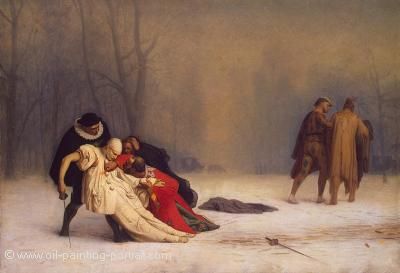
David Bentley Hart and Hadley Arkes have posted some interesting criticisms of the decision in Snyder v. Phelps. Professor Hart's is particularly spirited in calling for the revival of duelling. A bit:
[I]f we are going to grant that the fiends in the Westboro Baptist congregation have the right to make their noisome protests at a time and in a place where no sane society would allow them to do so, then we should be willing to allow for some simple mechanism to counterbalance the damage they do.
I imagine that if some champion of one of the families molested by that pestilent rabble—let’s imagine him as a Special Forces officer famed for his uncanny marksmanship—were allowed to challenge the Rev. Fred Phelps to acquit himself manfully on the field of honor, and allowed to issue the challenge with the full indulgence of the courts and the weight of social judgment on his side, the good reverend and his parishioners would in all likelihood quietly ooze back into the sewer from which they originally pullulated. If not—well, for the gentler souls among us, I suppose we could limit duels ideally to first blood, and allow for fatality only in the event of mishap.
Really, I can see no good argument against the proposition. “A duel is often just a legal murder,” you might object. But, if there is one thing legal history definitely tells us, it is that what we define as murder is largely a matter of legal convention. “Intentional and avoidable violence is a sin,” you might then say. Yes, but so what? The courts are not in the business of telling us how to care for our souls. Leave such concerns to the pulpit or the confessional.
Recent Posts
Categories
Monthly Archive
StatCounter
PageViews
Since February 19, 2008
