Mirror of Justice

A blog dedicated to the development of Catholic legal theory.
Affiliated with the Program on Church, State & Society at Notre Dame Law School.

Friday, February 10, 2012

MOJ Onion Edition 2: Louisiana Congressman Responds to New $8 Billion 'Abortionplex'

The Onion seems to be on a bit of a roll of late where what is sometimes ironically called 'reproductive health' and public policy are concerned.  Full story available here: http://nymag.com/daily/intel/2012/02/congressman-abortionplex-facebook-onion-john-fleming.html .

Congressman Alerts Facebook Followers to Onion Story About $8 Billion Abortionplex

Satire got the best of unsuspecting or factually impaired Republican Congressman John Fleming of Louisiana this past Friday. An ardent opponent of abortion, Fleming posted on his Facebook account a link to a May 11, 2011 story by The Onion titled "Planned Parenthood Opens $8 Billion Abortionplex."

Fleming's Facebook status, which has since been deleted, included the link with the note, "More on Planned Parenthood, abortion by the wholesale."

The congressman's followers were directed to Onion's faux-story that begins, "Planned Parenthood announced Tuesday the grand opening of its long-planned $8 billion Abortionplex, a sprawling abortion facility that will allow the organization to terminate unborn lives with an efficiency never before thought possible."

The gaffe was spotted by Literally Unbelievable, a blog that posts statuses from people who take Onion's satire as fact. Without further comment, Fleming’s spokesman Doug Sachtleben told Politico that Fleming's post was removed from his Facebook page. “The Onion is satire," wrote one commenter on Facebook before the post was deleted. "How exactly did you get elected?”

The Abortionplex report is awfully ridiculous even by Onion's standards. Among the greater flourishes from the story about the state-of-the-art abortion factory:

The remaining space is dedicated to amenities such as coffee shops, bars, dozens of restaurants and retail outlets, a three-story nightclub, and a 10-screen multiplex theater—features intended not only to help clients relax, but to foster a sense of community and make abortion more of a social event.

                                               *                                   *                                *

"I was kind of on the fence in the beginning," [one woman] said. "But after a couple of margaritas and a ride down the lazy river they've got circling the place, I got caught up in the vibe. By the time it was over, I almost wished I could've aborted twins and gotten to stay a little longer."

Planned Parenthood received a lot of attention last week when women's health fund-raising juggernaut the Susan G. Komen foundation announced that it would no longer support PP. After a severe, immediate backlash, the Komen foundation reversed course, explaining that "recent decisions that cast doubt upon our commitment to our mission of saving women's lives."

On January 31, Congressman Fleming, a family physician, posted on his Facebook page, "Susan G. Komen cutting funding to Planned Parenthood. It is time Congress should do the same as long as taxpayer money is used to take innocent life."

Onion editor Joe Randazzo enjoyed Fleming's complete misapprehension of the website's satirical story. “We’re delighted to hear that Rep. Fleming is a regular reader of America’s Finest News Source and doesn’t bother himself with The New York Times, Washington Post, the mediums of television and radio, or any other lesser journalism outlets,” he said in a statement.

Despite the abhorrent judgment by Fleming, he must be overcome with relief that the Abortionplex doesn't exist. The thought of an abortion factory with the largest rock climbing wall in Kansas, valet parking, and abortion suites "where women may enjoy a complimentary pedicure and a flute of champagne" would have been quite unsettling.

MOJ Onion Edition: Jewish Deli Ordered to Serve Pork – Civil Rights of Swine Eaters Cited

The newly created Department for the Regulation of Everything Not Yet Subject to Federal Regulation issued a new rule requiring kosher delis to make pork dishes available on their menus.

Government officials were quick to defend the regulation against the charge that it violates the principle of religious freedom.  “We’re not requiring the operators of these delis to consume pork products themselves, only that they make them available to others.  What those individuals decide to order from the menu is up to them” said a senior government official.  The great tradition of freedom of worship is, he said, fully respected under the law.  Although many regard the option of ordering pork as purely elective, the administration insisted that it regarded the availability of pork as “important” for a healthy diet.  (See here).

One member of Congress remarked (here) that it was “sad” when “the overwhelming practice was in favor” of pork consumption for some to try and use “the excuse of religious freedom” to thwart the administration’s efforts.

Mordecai Weisman, proprietor of Mort’s Deli, said he objected to the new regulation.  “What is this?  All of a sudden I’ve got no rights in this country?  How can I keep a kosher kitchen if I have to serve pork?  Oy!”  However, two of Mr. Weisman’s workers, Manny Garcia and Juan Rodriguez viewed the rule differently. “We work long hours and so we often have to take our meals here, which the deli provides.  We’d love to have the freedom of choose a good pork dish.”

Proponents of the measure such as the National Pork Producers Council (here and here) cited the fact that the vast majority of American Jews do not keep kosher and that many freely choose to consume pork, notwithstanding the traditional religious dietary prohibition (here, here, here, and here).

A lawyer for the ACLU remarked that regulations governing businesses serving food to the general public had been enacted in several states and upheld by their highest courts.  When a business hires non-believers it has “to at least some degree, be prepared to accept neutral regulations imposed to protect those employees’ legitimate interests in doing what their own beliefs permit” said the lawyer, paraphrasing one such opinion.  Thus, “as a legal matter, as a constitutional matter” the new rule was she said “completely unremarkable.” (See here).

The administration said that the fact that Mr. Weisman’s temple was not being required to serve pork represented a reasonable accommodation of religious liberty.

Mr. Garcia and Mr. Rodriguez said they were looking forward “to enjoying some chorizo and perhaps even a tasty cochinita pibil” in the near future.

Mr. Weisman said he hoped that the supporters of religious liberty would rally to his defense.

Update on the 'Walk Back'

Here is the White House press release concerning today's 'walkback' from the erstwhile contours of the HHS mandate: http://www.whitehouse.gov/the-press-office/2012/02/10/fact-sheet-women-s-preventive-services-and-religious-institutions .  (The grammar of the thing's inelegant, to say the least, which perhaps is testimony to the speed with which the White House came to realize that it must act.)  It is gratifying to see that the onus is being placed upon insurers, as Tom and I have hoped aloud since Wednesday.  Still awaited, though, is the specific guideline concerning how, if at all, religiously affiliated institutions are to make their employees aware of the continued availability of contraception coverage from their insurers.  Stay tuned.

Democrats for Life on the Contraception Mandate

We'll see what emerges from the administration sources' statements that it will seek a compromise on the contraception mandate.  The referral problem is there, and I don't know whether an employer's reference to other options can be made general enough.

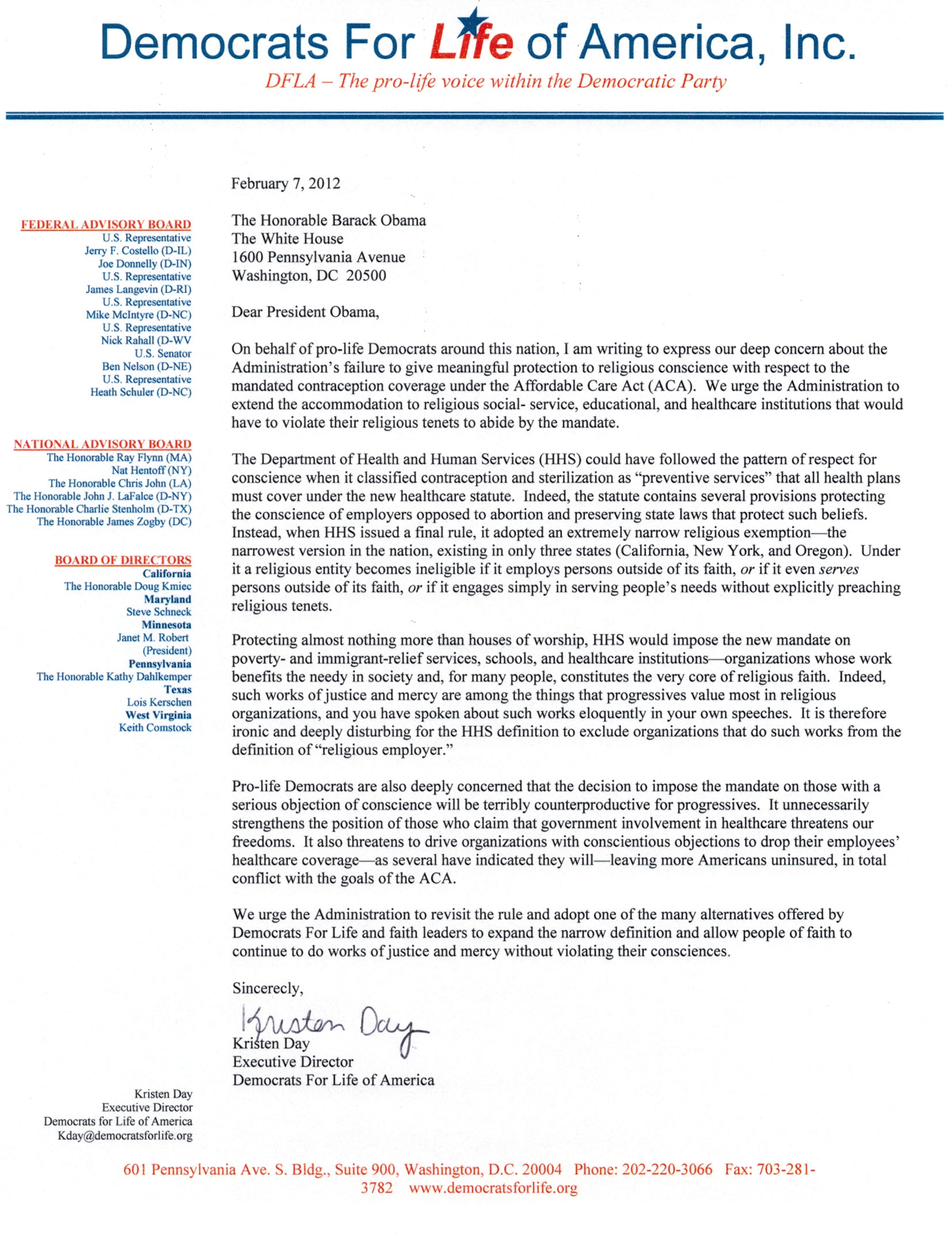
In the meantime, as another resource and part of the record, here is a letter to the President on Tuesday from Kristen Day of Democrats for Life (see also statement here), which argues that

works of justice and mercy are among the things that progressives value most in religious organizations, and you have spoken about such works eloquently in your own speeches.  It is therefore ironic and deeply disturbing for the HHS definition to exclude organizations that do such works from the definition of 'religious employer'. . .  [The mandate with minimal exception] unnecessarily strengthens the position of those who claim that government involvement in healthcare threatens our freedoms. 

On compromise and the Church's role in civil society

These words from Blessed John Paul II taken from his motu proprio of 2000 on Thomas More are worth pondering:

The life of Saint Thomas More clearly illustrates a fundamental truth of political ethics. The defence of the Church’s freedom from unwarranted interference by the State is at the same time a defence, in the name of the primacy of conscience, of the individual’s freedom vis-à-vis political power. Here we find the basic principle of every civil order consonant with human nature.

The conscience addressed here is the well-formed conscience that is essential to the freedom of the church about which Paul VI spoke at the conclusion of the Second Vatican Council. Like St. Thomas More, we have been blessed to live in challenging times.

RJA sj


A Question from Marty Lederman

Marty Lederman sends in the following in response to some of the discussion here about the contraception mandate.  I've opened comments for substantive responses to the specific questions that Marty asks.

I, too, am a longstanding proponent of RFRA, and of religious exemptions where the standards of RFRA are satisfied.  But Marc, before one even gets to the question of the "least restrictive means" of advancing the government’s public health interest, the employer would have to demonstrate a substantial burden on its exercise of religion.  And on that question, I remain genuinely baffled, because it seems to me the burden on religious exercise—the compelled “complicity with evil”—has merely been presumed, rather than explained, by virtually everyone involved in this debate.  

I am taking as a given a particular employer’s sincere belief that the use of contraception is sinful or greviously wrong, on religious grounds—and that material cooperation with that wrong would itself be wrongful.  Nevertheless, I would welcome anyone's careful and reasoned articulation of how the HHS rule would substantially burden an employer's religious exercise or, more to the point, how it would require material cooperation with evil under Catholic doctrine (or the equivalent under other religious precepts), or (as we now so often hear) "force the employer to choose between complying with the law or religious commands."  

Any employer's funds are, after all, invariably and regularly, but indirectly, used for activities that the employer considers wrong or sinful—through the government's use of taxes, the employee's use of salary, the employee's use of the employer's phone and computer (which of course might be used to purchase contraception, procure abortion services, etc.), and so on.  How is this case materially different?

Here, the state would merely be requiring the employer to offer a group health plan to its employees that covers all forms of medical care beneficial to health, including contraception.  (Contraception, that is to say, is hardly the focus of such a plan—it is but one of countless forms of health care that are required to be covered.)  The cost of the premiums would presumably be shared by the employer and employees, although it's not clear that federal law actually requires an employer payment.  (I may be wrong about that, but I don't believe federal law would require the employer to subsidize that plan at all—such subsidization is a function of market arrangements between employers and insurance companies.  I'll proceed here, however, on the assumption that, at least as a practical matter, virtually all employers would choose to pay part of the cost of the plan, in order to lower the premiums for their employees.)  The cost to the employer in subsidizing the group plan will, in turn, be reflected in lower salary payments to its employees.  In other words, the employer would have transferred the money in question to employees, anyway, but now that exchange will take a different form, one that facilitates a lower cost of health care through efficiencies of scale.  

Continue reading

Rep. Lesch puts the Church in its place

I've come to expect to hear weak arguments about how the Church should stop concerning itself with issues outside the sanctuary, but when they're made by a member of my state's legislature and given prominent placement on my local paper's op-ed page, it still raises my blood pressure before I've even finished my breakfast.  Consider this gem from Rep. John Lesch in today's Star-Tribune:

No one begrudges a bishop's role in squaring away his own flock. But when he runs a large hospital upon which a city relies for jobs and health care services, he need not be wagging his finger as you walk in the emergency-room door.

If I want to hear moralizing, I'll go to church. If I want to access legal health care, I'll go to my health care provider. And I think my conscience is adequate to understand the difference between the two.

And then, of course, a history lesson:

The pilgrims fled England because they prized individual conscience over the Church of England's mandates. The founding fathers recognized this and ensured that the First Amendment afforded individual freedom from religion.

Catholic or non-Catholic, our hard-won freedoms cannot afford another election-year intrusion.

Limiting the mandate to "large hospitals" would certainly be a step in the right direction (though still problematic, in my view).  I repeatedly see pro-mandate arguments ignoring the vast array of Catholic institutions that will be affected.  The broader point that pervades the piece, though -- that church is the building where worship services are held -- is troubling, especially coming from the "progressive" left (as Tom Berg eloquently argued in the Christian Century recently).  And the suggestion that "conscience" is what guides us in knowing that the Church oversteps its bounds when it enters into the realm of social services?  Ugh.

On a positive note, however, it appears increasingly likely that the Obama administration will be revising the rule, perhaps even later today.  Unfortunately, the reasoning employed by our pro-mandate elected officials is unlikely to disappear anytime soon.

A moment for remembering Fr. Neuhaus

In the midst of our struggles over the sanctity of human life, the meaning of marriage, and the future of religious liberty and the rights of conscience---struggles that will determine what we stand for as a nation and who we are as a people---we would, I think, do well to recall the wise teachings and inspiring example of the late Fr. Richard John Neuhaus. Here is a tribute to him that I did for First Things soon after we lost him only a few years ago: http://www.firstthings.com/onthesquare/2009/03/he-threw-it-all-away.

Walsh on Greenhouse

My friend Kevin Walsh has a smart reaction to the Linda Greenhouse column that I wrote about yesterday, noting that the least restrictive means portion of the RFRA standard is an almost sure loser for the Administration.  A bit from Kevin's analysis:

After beginning by criticizing the rhetoric of mandate opponents and noting the silence of mandate supporters on the question of conscience, Greenhouse states that “the purpose of this column is to examine the conscience claim itself, directly, to see whether it holds up.” But Greenhouse’s framing of the analysis reflects a basic misapprehension of the legal protections for religious liberty already embedded in federal law. Greenhouse writes that objecting religious institutions claim “a right to special treatment: to conscience that trumps law.” That is wrong: the objecting religious institutions claim that the mandate violates federal law. They do not argue that conscience “trumps law.” Far from placing conscience over law, the objecting institutions advance a claim under the law . . . .

The RFRA provides that the federal government cannot substantially burden the exercise of religion unless doing so is the least restrictive means of accomplishing a compelling government interest. Yet Greenhouse’s discussion contains no mention at all of the “least restrictive means” part of the test. Instead, Greenhouse says that a RFRA challenge “would pit the well-rehearsed public health arguments . . . against religious doctrine.” The omission is telling, because the weakest part of the government’s case will be this least restrictive means requirement. There are so many other ways for the federal government to accomplish its objectives that it should lose the RFRA claims on precisely this point.

Earlier in her column, Greenhouse notes the lack of a “full-throated defense” of the contraceptives mandate, “except on pure policy grounds.” The best explanation for the silence of the mandate supporters with respect to religious liberty may be the simplest: nobody likes to pick a fight that they cannot win.

Thursday, February 9, 2012

A Solution to the Contraception Insurance Issue

The administration has signaled that it is looking for a compromise to the contraception insurance issue. How about this? Those employers who conscientiously oppose providing contraception insurance to their employees should not be able to profit from a religious exemption. Accordingly, the employers should be required to increase employees' wages by the amount the employers save because of a religious exemption.

The employer might not want to pay higher wages, but could have no serious religious objection to the requirement. Employees could use the money to purchase insurance for contraception if they wished or for other purposes at their option.

From the perspective of the administration, this proposal has a disadvantage. A major reason for requiring employers to include contraception as a part of their insurance was to encourage greater use of preventative services by employees. One way to mitigate this disadvantage would be to afford a tax deduction for the premiums required to purchase contraception insurance. The fringe benefit of insurance was not taxable in the first place. Indeed, from the perspective of the administration, it would make sense to make all contraception expenses tax deductible or, alternatively, even a tax credit. If the evidence showed that tax policy of this character would increase contraception, we could expect abortions to decline in turn. Of course, the Catholic Church would oppose any such tax policy on moral grounds, but it could not argue that the policy would violate its religious freedom.