The Congregation for the Doctrine of the Faith has issued a new document called "Considerations for an Ethical Discernment Regarding Some Aspects of the Present Economic-Financial System." Although some pre-emptively criticize some "on the right" for imagining that the Church's social doctrines do not contain grounds for criticizing many aspects of contemporary economic and commercial practices, I doubt if anyone actually thinks they don't. Of course they do. As the document (quite correctly) points out, "economic" questions are (like all interesting questions) questions of "moral anthropology" -- a point that bloggers here at MOJ have been making for 14 years. So, some Catholic commentators will mine the document for quotes that they regard as useful rhetorical arrows to shoot at (mostly imaginary) Randians but that frustrating fact doesn't take away from the document's welcome reminder about the centrality of the question, "what are human persons, really, and what are they for?"
For me, there are at least two things missing from the document: First, the document fails to appreciate that regulatory complexity is, in fact, a subsidy to the rich and to those who are already "ahead." The document calls, repeatedly, for "regulation" (as if the economies in North America or western Europe are unregulated -- they certainly are not, and no one believes they should be) but does not acknowledge that "regulations" can be good, or bad; they can reduce dangers or they can simply protect narrow interests. Those who are best able to navigate complex regulatory environments will not be the poor. In this sense, regulatory complexity is like corruption. (Paragraph 31 comes close to recognizing this point, but in the context of tax avoidance.)
A second point: The document does, to its credit, say that "it is good to point out how often the public debt is also created by an incautious, if not fraudulent, management of the public administrative system." More was needed, though -- given the document's title -- on the urgent and moral dimensions of the saddling of the young and of coming generations with obligations simply to fund the social-welfare, pension, vacation, and retirement policies preferred by today's Baby Boomers. This is at least as important as, say, the use of "offshore sites" (with which the document was strikingly concerned) for various purposes.
In some Catholic commentary on these matters, it's suggested that there are "laissez faire" "libertarians" out there who are plotting an end to all "regulation." This is silly. Again, western economies, including the American one, are pervasively regulated, and the argument is (or should be) about which regulations serve their goals well and which do not. Some regulations do not protect the vulnerable but instead entrench monopolies and protect rent-seeking. "Competition" should not be an idol, or the foundational principle, but it's hardly the sole cause of the various features of modern life that we as Christians regret.
Friday, May 18, 2018
The story is here: "At the end of June, the City of Philadelphia will be terminating its contract with Catholic Social Services because of its beliefs about same-sex marriage. They will be doing this despite the fact that no same-sex couple has filed a complaint against them. They will be doing this despite that fact that the City of Philadelphia has 5,000 children in foster care and has recently asked for more people to step up to the plate to be foster parents."
Thankfully, the happy warriors at the Becket Fund are on the case.
I had the privilege, a few days ago, of drafting a discussion paper for the Dulles Colloquium, hosted by Rusty Reno and the Institute on Religion and Public Life, addressing the question, "Can a Liberal Society Favor One Religion Over the Others." The discussion was lively and definitely not monochronic or monotonal. Here's just a bit from the paper, and I'd welcome reactions:
. . . And, what makes a political authority, regime, or state “liberal”? I pass over here the fascinating “genealogical” work of Patrick Deneen, Brad S. Gregory, and others who have proposed accounts of how contemporary liberalism was made and the mechanisms, reactions, and dynamics that have given it its shape (or shapes). For present purposes, I have in mind William Galston’s recent statement of “the core idea of liberalism,” namely, “recognizing and protecting a sphere beyond the rightful reach of government in which individuals” – I would add natural and other associations and societies – “can enjoy independence and privacy.” Galston supplements this “core idea” with three others – the “republican principle” or popular sovereignty, i.e., the idea that “the people” are the source of (this-world) political legitimacy; “democracy,” which involves both formal political and civil equality and constrained majoritarianism; and “constitutionalism,” which “denotes a basic, enduring structure of formal institutional power,” a structure in which political power is granted, distributed, and constrained by entrenched and enforceable rights as well as other mechanisms. All this, taken together, makes up, in Galston’s account, “liberal democracy,” which is – while, again, not the only possible moral regime – the regime I think we are asking about.
Such a regime need not be (indeed, it should not be) Jacobin, comprehensive, redemptive, sacramental, eschatological, crusading, thick, ambitious, or even particular optimistic. It cannot be entirely neutral but it can be (indeed, I think it should be) cautious, historically aware, chastened, and humble. It can and should be clear-eyed, Schumpeterian, and MacIntyrian about its vulnerability and contradictions, about its tendency to self-undermine, about its dependence on virtues, practices, and traditions that it cannot, by itself, create or maintain. It is pluralistic – both in the sense that it tolerates different views about the good life and respects the exercise of the authority that rightfully belongs to non-state actors and societies. It is not jealous of society’s little platoons and is comfortably resigned to the persistence of humanity’s crooked timber. . . .
This discussion, between Pierre Manent and Remi Brague, at the Law and Liberty site, is well worth a read. Here's just a bit, from Brague:
I would not dare to speak about individualism in the presence of someone, precisely Pierre Manent, who has written a penetrating book on Tocqueville and thus has provided a conceptual formulation of individualism at a level to which I cannot attain. What I can say is that today it is the idea according to which history begins with us, with us as individuals, with each individual. Then one generalizes this false idea – it is false because the language by which we speak comes from well before us, not to mention our customs and manners – and applies it to the collective, and affirms that history begins today. From this idea comes educational curricula in which one has the impression that history began in May, 1968, and prehistory began with the Great Crash of 1929.
Therefore, it is the awareness of a long duration of time that one must try to restore, as, for that matter, the French historical school is doing and which we would do well to follow. This would entail, for example, that we grasp that the cathedrals are part of France and therefore we must not let them disappear (in the way that David Copperfield made the Eiffel Tower disappear!). However, certain speeches by high-placed officials tend in that direction. It would be good, therefore, to break with this voluntary amnesia concerning our roots
Saturday, May 5, 2018
It kicks off, appropriately, on the feasts of Sts. Thomas More and John Fisher. More here.
The chairman of the USCCB's Committee for Religious Liberty, Archbishop Joseph E. Kurtz of Louisville, states: "Religious freedom allows the space for people of faith to serve others in God's love in ministries like education, adoption and foster care, health care, and migration and refugee services. We encourage people of faith to reflect on the importance of religious freedom so that we might have the space to carry out our mission of service and mercy, and we invite everyone to pray for our brothers and sisters who face intense persecution in other parts of the world."
Thursday, May 3, 2018
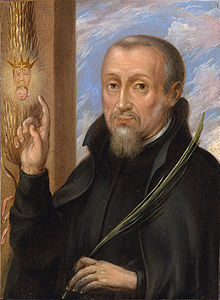
On this day, Henry Garnet, S.J., was hanged, drawn, and quartered. He was, for many years, the head of the secret Jesuit mission in England. Pray for us!
This paper looks really interesting:
This chapter is forthcoming in Nicholas Aroney and Ian Leigh (eds), Christianity and Constitutionalism (Cambridge University Press, 2018). It discusses the rise of a modern concept of sovereignty as prior to and grounding all law, and associated with an unlimited and indivisible power that prioritises the will of a recognised authority. It then explores how the Christian tradition contains a consistent thread of challenge. This is reflected in three parts: the parallel authority of priest and king, or church and civil authority; the cultivation of multiple sites of authority, at local, regional, and international levels; and the coordinating, encouraging, and cultivating place of ‘monarchical’ rule. Rather than sovereign rule, the Christian tradition has emphasised the inter-twining of duality, plurality, and the one. Importantly, each of these components are understood as pursuing a shared horizon, a tradition, or discerning of right. Indeed, as such, it could be suggested that what is ultimately sovereign is the good itself.
