I've had a chance to read the Court's decision as well as the three concurring opinions and the dissent. I'm still processing it, but here are some highlights.
The breakdown of votes was 15-2 on the central issue of whether Italy had violated Article 2 of Protocol #1 (the State's obligation, in the discharge of its educational function, to "respect the right of parents to ensure such education . . . in conformity with their own religious and philosophical convictions") or Article 9 of the Convention ("the right to freedom of thought, conscience and religion"). Of the three concurrences (representing four judges), one (Judge Bonello's) would have gone considerably further than the Court did, one (garnering two votes) signed on to the Court's decision "not without some hesitation," and the last one (by Judge Power) seemed largely to agree with the scope of the majority's decision.
The Court spent considerable time examining (1) the March 2005 judgment of the Veneto Administrative Court as to the symbolic meaning of the crucifix; (2) the April 2006 judgment of the Italian Consiglio di Stato (the highest administrative court) of April 2006 as to the same; (3) the view of the Corte di Cassazione (Italy's highest court) on related issues of secularism; (4) the history of Italy's domestic law and practice with respect to the crucifix in public schools; and (5) the law and practice of various member states with respect to the issue of religious symbols in public schools. This was all crucial material because it set the stage for and really grounded the Court's eventual conclusions. The Court adduced from this survey the reality that there is simply nothing approaching a European consensus involving the state's display of religious symbols. Courts even within Italy are divided on these issues. Even more than this, the Court's extensive examination revealed just how plural and conflicting the policies and approaches of the various member states truly are, perhaps the most interesting point of which is that "[i]n the great majority of member States . . . the question of the presence of religious symbols in State schools is not governed by any specific regulations."
After reviewing the decision below and the arguments of the parties (including Joe Weiler's position...in which the Court specifically mentioned that line about "Americanisation"...like a shark to chum), the meat of the decision begins at par. 57. To my mind, what is most striking about the decision is that it really analyzes the issues through the prism of public education, and what a public education ought to mean. Article 2 is foregrounded.
The Court says that while the State must help to maintain "public order, religious harmony and tolerance in a democratic society," (60), that obligation does not mean that "parents can require the State to provide a particular form of teaching." The setting of curriculum, says the Court, is a matter for the State, and so long as "information or knowledge" is being "conveyed in an objective, critical, and pluralistic manner, enabling students to develop a critical mind" and without "indoctrination," the parents of students cannot complain. (62) For me, these claims brought to mind the debates in the Mozert case, but that is a subject for another time.
How does the crucifix fit in here? The Court says that "the decision whether crucifixes should be present" in public schools "forms part of the functions assumed by the respondent State in relation to education and teaching" and that it is therefore within the compass of Article 2 as well.
What is the meaning of the crucifix? "[T]he crucifx is above all a religious symbol . . . . The question whether the crucifix is charged with any other meaning beyond its religious symbolism is not decisive[.]" (66) The Court therefore did not decide for itself whether the crucifix partook of an identitarian or cultural meaning independent of and in addition to its religious meaning. But it accepted that the State (here Italy) believed that the crucifix was a symbol with multiple meanings, some of which were foundational as to its civic traditions, and...and here is the key..."the decision whether or not to perpetuate a tradition falls in principle within the margin of appreciation of the respondent State." (68)
The concept of the margin of appreciation, interestingly enough, in some ways is similar to the doctrine of subsidiarity (see Prof. Paolo Carozza's excellent work on this issue) and the concept was absolutely crucial to the Court's judgment. Because of the well-documented lack of consensus among and even within the European states, and because the crucifix was a "passive symbol" (compare the Folgero and Zengin cases out of Norway and Turkey, respectively -- par. 71) whose purpose was not "indoctrination," the decision whether to retain the crucifix fell within Italy's margin of appreciation. (70-72).
This early report indicates that the Grand Chamber of the European Court of Human Rights reversed the earlier decision on the permissibility of the crucifix in Italian public schools. They have been deemed permissible. More anon, after I've read the decision (I'd be grateful for comments from readers with knowledge of or links to the decision).
Rob mentioned this a few weeks ago, but if you are in the New York City area tomorrow or Saturday, I hope you will consider coming to a conference organized by Professor David Gregory here at St. John's Law School, The Theology of Work and the Dignity of Workers. Dave has put together many wonderful, interesting, and eclectic panels and speakers. Hope to see you here.
I was not lucky enough ever to meet Professor William Stuntz, whose passing is noted today here. But I do know his very thoughtful piece (authored together with the force of nature that is Professor David Skeel) on Christianity and the (Modest) Rule of Law. The implications for criminal law, in particular, for a "Christian" and "modest" law are well worth considering, especially in light of the federal criminal law's seemingly ever-increasing scope.
I wish I had had the chance to know Professor Stuntz.
Professor Ken Kersch has posted a very interesting looking article on the development of conservative constitutionalism from the mid-20th century through 1980. I've only had a chance to skim it, but while the article focuses in parts on the influence of the National Review, it also isolates distinctive strands of legal conservatism, one of which -- the "traditionalists" -- contains several important Catholic thinkers.
Professor Weiler was kind enough to forward me a link to his oral testimony before the Grand Chamber of the European Court of Human Rights in the Lautsi case. Weiler represented pro bono all of the intervening states in the appeal of the 7:0 decision below (that's 7:0!). A couple of noteworthy points.
First, at around the 15 minute mark or so, Weiler argues that the decision below would represent an "Americanization" of Europe by mandating "the separation of church and state." A quite effective rhetorical move, I thought, as the last thing that would appeal to a group of European intellectuals is the thought that they were following in the footsteps of an inferior, johnny-come-lately state. But on the merits, I'm much less certain -- at the very least, the "separation of church and state" is a highly contested concept in this country.
Second, the real power of the position Weiler takes rests on the mixed meaning of the cross -- both as Christian symbol and as marker of Western European identity. And by mixed, I don't only intend that it partakes of both meanings; it is not the kind of mixture that can be divided into fractions -- 1/3 identitarian, 2/3 religious. I mean mixed in the way that the Iron Age Pig is mixed -- truly a hybrid, whose selves cannot be disentangled.
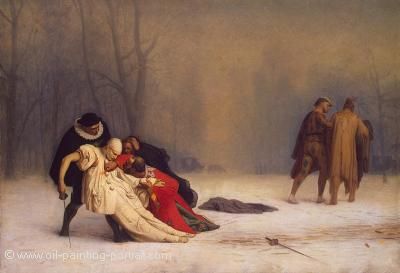
David Bentley Hart and Hadley Arkes have posted some interesting criticisms of the decision in Snyder v. Phelps. Professor Hart's is particularly spirited in calling for the revival of duelling. A bit:
[I]f we are going to grant that the fiends in the Westboro Baptist congregation have the right to make their noisome protests at a time and in a place where no sane society would allow them to do so, then we should be willing to allow for some simple mechanism to counterbalance the damage they do.
I imagine that if some champion of one of the families molested by that pestilent rabble—let’s imagine him as a Special Forces officer famed for his uncanny marksmanship—were allowed to challenge the Rev. Fred Phelps to acquit himself manfully on the field of honor, and allowed to issue the challenge with the full indulgence of the courts and the weight of social judgment on his side, the good reverend and his parishioners would in all likelihood quietly ooze back into the sewer from which they originally pullulated. If not—well, for the gentler souls among us, I suppose we could limit duels ideally to first blood, and allow for fatality only in the event of mishap.
Really, I can see no good argument against the proposition. “A duel is often just a legal murder,” you might object. But, if there is one thing legal history definitely tells us, it is that what we define as murder is largely a matter of legal convention. “Intentional and avoidable violence is a sin,” you might then say. Yes, but so what? The courts are not in the business of telling us how to care for our souls. Leave such concerns to the pulpit or the confessional.
That is the title of this piece by my friend, Joseph Landau.
I share this piece here because, whether or not one agrees with Landau as a matter of morality, normative legal theory, or right-minded policy about these issues, or about the President's decision not to defend DOMA in court, I think that he makes a very convincing case that the President's new position with respect to the issue of the level of scrutiny that applies may well have enormously far-reaching implications.
Every so often, I spend the whole day cooking. Generally it's Italian cuisine, though occasionally I will venture off as far as the hinterlands of France. Yesterday was a day in the kitchen: a Bolognese sauce, a lobster bisque, and the beginnings (to be finished today) of a wild forest mushroom risotto -- oysters, morels, and porcini mushrooms. And all of this with appropriate libationary accompaniments.
Whenever I have days like this, my thoughts turn routinely and as a matter of natural and quite obvious course to religion. Lately I've been waiting for the decision of the Grand Chamber of the European Court of Human Rights in Lautsi v. Italy -- the case dealing with the permissibility of displaying the crucifix in Italian public schools. The decision of the full chamber is, according to the ECtHR's web page, coming this Friday the 18th. (Here is a translation of the original decision from the French by "The Humanist Federation").
I've been anticipating it, but not with much optimism that the Grand Chamber will do anything to rectify the inadequate opinion that it had issued earlier. And so, in my high state of readiness, I thought I'd share the best criticism I have read of the earlier opinion: this elegant rumination from last June by Professor Joseph Weiler emphasizing the uniqueness of the histories and cultures of each individual Western European nation, and the need for the ECtHR to be sensitive to those special and specific qualities in discussing these issues.
I may have mentioned before at MOJ that food metaphors are frequently illuminating, and this affair is no exception. Consider the hegemony of garlic. Insisting on the domination of "laique," or secular, neutrality to the exclusion of all other values is like insisting on the domination of garlic over all other tastes in one's cuisine. Of course, garlic's crude appeal will draw in and placate the broadest range of palates; just about everybody has a taste for the potently thick-booted allure of garlic, and, oh great, it's healthy too! That is why restaurants that don't know what they're doing frequently mask their ineptitude by loading up on the garlic -- it disguises lack of depth and the complications of culinary tradition with an easily appealing, eminently recognizable little taste.
But the trouble with garlic is that it overpowers everything with which it comes into contact. Garlic is the suffocating equalizer of the kitchen. And demanding that garlic be prominent in every dish, no matter the provenance or the particular, local flavor, will kill the dish -- it will destroy that which is distinctive, and uniquely pleasurable, about it. Whatever it is that renders Italian and French cooking the grandes dames of gustatory delight (as they are) is choked off and flattened out by the common, acrid banality of garlic.
More and related thoughts, Lucullian and otherwise, on the 18th.
Linda Greenhouse has this "opinionator" column about Justice Scalia's dissents, wondering what Justice Scalia could "think[] his bullying accomplishes" with dissenting opinions which use strong and sometimes highly critical language. Greenhouse doesn't think that his dissents win over anybody on the current court and only alienate his peers. In my view, she also engages in some regrettable amateur psychology, suggesting that on "his 75th birthday" "fear as well as anger [is] palpable" and the Justice is feeling frustrated because he realizes that he "has accomplished surprisingly little." Philip Roth would approve.
In response, Orin Kerr writes that Justice Scalia knows exactly what he is doing: he is writing for future generations of "bored" law students reading opinions in casebooks -- and of course for the lawyers and judges of the future -- who may perhaps agree with him.
Both of these accounts of judicial opinion writing take an instrumental view of the practice: the worth of judicial opinions is their influence on others. Language ought to be chosen which is most effective in converting the great unwashed to one's view -- whether the unwashed are one's unenlightened colleagues or future readers. "Overheated" language does not (Greenhouse), or may (Kerr), persuade, and therefore it ought not/ought to be used.
I want to suggest a different way to understand the use of intense and even acerbic language. Strongly worded opinions stake out depth of disagreement. They indicate not only difference with respect to one case, or one issue, but more extensive, thicker, and perhaps unbridgeable divides. They are, in this way, more honest, truer. If they really do reflect profound differences, then they have more integrity than opinions which, for perceived (short or long term) strategic reasons, paper over or mask those differences for the sake of winning an extra vote here or there. Strongly worded opinions are not necessarily intended to persuade anyone. They are a mark for posterity -- that the Justice stood here, at this moment in history, and that the place where others stood was deeply, irremediably, wrong.
People who have a responsibility for the shape and direction of the law often map out shrewdly how their views can win friends and influence people; that is certainly a part of this line of work. But when they write without regard for those aims, even (especially) when using astringently heart-felt language, when their writing reflects the full scope of their real views, they are to be admired for performing another kind of crucial function -- they are acting with integrity in shooting the world straight.