As posted at Catholic Culture:
Instruction Concerning the Criteria of Vocational Discernment Regarding Persons with Homosexual Tendencies
Introduction
Following the teaching of Vatican II and, in particular, the decree Optatam Totius on priestly formation, the Congregation for Catholic Education has published different documents to promote an adequate formation integral of future priests, offering guidance and precise norms regarding their several aspects. In the meantime also the Synod of Bishops in 1999 reflected on the formation of priests in the present circumstances, with the intent to bring to fulfillment the conciliar doctrine on the subject and to render it more explicit and incisive in the contemporary world. Following this Synod, John Paul II published the post-Synodic apostolic exhortation Pastores Dabo Vobis.
In light of this rich teaching, the present Instruction does not intend to linger on all the questions by nature emotional or sexual that require careful discernment throughout the whole period of the formation. It contains norms regarding a particular question, made more urgent by the present situation, that is that of the admission or non-admission to the seminary and Holy Orders of candidates who have profoundly deep-rooted homosexual tendencies.
I. Emotional maturity and spiritual fatherhood
According to the constant Tradition of the Church, baptized males alone may validly receive Holy Orders. By means of the sacrament of Orders, the Holy Spirit shapes the candidate, to a new and specific role, to Jesus Christ: the priest, in fact, represents sacramentally Christ, Head, Pastor, and Spouse of the Church. Because of this shaping to Christ, the entire life of the holy priest must be alive with the gift of his whole person to the Church and with an authentic pastoral love.
The candidate for ordained ministry, therefore, must reach emotional maturity. That maturity renders him able to put himself in the proper relation with men and women, developing in him a true sense of spiritual fatherhood in confrontation with the ecclesiastic community that will rely upon him.
II. Homosexuality and ordained ministry
From Vatican II until today, several documents of the Magisterium—and especially the Catechism of the Catholic Church— have confirmed the teaching of the Church on homosexuality. The Catechism differentiates between homosexual acts and homosexual tendencies.
Regarding acts, it teaches that, in Sacred Scripture, these are presented as grave sins. Tradition has constantly considered them to be intrinsically immoral and contrary to natural law. These, consequently, may not be approved in any case.
Concerning profoundly deep-rooted homosexual tendencies, that one discovers in a certain number of men and women, these are also objectively disordered and often constitute a trial, even for these men and women. These people must be received with respect and delicacy; one will avoid every mark of unjust discrimination with respect to them. These are called to realize the will of God in their lives and to unite to the Sacrifice of the Lord the difficulties that they may encounter.
In light of this teaching, this department, in agreement with the Congregation for Divine Worship and the Discipline of the Sacraments, holds it necessary clearly to affirm that the Church, while profoundly respecting the persons in question, may not admit to the seminary and Holy Orders those who practice homosexuality, show profoundly deep-rooted homosexual tendencies, or support the so-called gay culture.
The above persons find themselves, in fact, in a situation that gravely obstructs a right way of relating with men and women. The negative consequences that may derive from the Ordination of persons with profoundly deep-rooted homosexual tendencies are by no means to be ignored.
If, instead, one were to examine homosexual tendencies that might only be the expression of a transitory problem, as in, for example, one whose adolescence is not yet complete, he must however pass clearly at least three years before ordination to the diaconate.
Discernment of qualification of the candidates on the part of the Church
There are two indissociable aspects in every priestly vocation: the free gift of God and the responsible liberty of the man. Vocation is a gift of divine grace, received through the Church, in the Church and for the service of the Church. Responding to the call of God, the man offers himself freely to Him in love. The desire alone to become a priest is not sufficient and there is no right to receive Ordination. It is the duty of the Church— in Her responsibility to define the necessary requisites for the reception of the Sacraments instituted by Christ— to discern the qualification of he who wishes to enter the seminary, to accompany him during his years of formation and to call him to Holy Orders, if he be judged to be in possession of the requisite qualities.
The formation of future priests must articulate, in an essential complimentarity, the four dimensions of formation: human, spiritual, intellectual, and pastoral. In this context, it is necessary to reveal the particular importance of the human formation, the necessary foundation of all formation. To admit a candidate to the ordination to the diaconate, the Church must verify, among others, that he have reached emotional maturity of a candidate for the priesthood.
The call to Orders is the personal responsibility of the Bishop or the major superior. Holding present the opinion of those to whom the responsibility of the formation is entrusted, the bishop or the major superior, before admitting a candidate to ordination, must reach a morally certain judgment on their quality. In the case of a serious doubt in this respect, they must not admit him to ordination.
The discernment of the vocation and the maturity of the candidate is also a grave duty of the rector and the other teachers of the seminary. Before every ordination, the rector must express his judgment on the quality of the candidate required by the Church.
In the discernment of qualification for Ordination, there is a grave duty for the spiritual director. While being bound by secrecy, he represents the Church in the entire forum. In meetings with the candidate, the spiritual director must especially remember the demands of the Church regarding priestly celibacy and the emotional maturity specific of a priest, as well as help him to discern if he has the necessary qualities. He has the obligation to assess all the qualities of the personality and to ascertain that the candidate does not present sexual troubles incompatible with the priesthood. If a candidate practices homosexuality or present profoundly deep-rooted homosexual tendencies, his spiritual director, like his confessor, must dissuade him, in conscience, from proceeding towards Ordination.
It remains understood that the candidate himself has the first responsibility for his own formation. He must offer himself with faith to the discernment of the Church, the bishop who calls to Orders, the rector of the seminary, the spiritual director, and the other teachers of the seminary to whom the bishop or the superior general has entrusted the duty of forming future priests. It would be gravely dishonest if a candidate were to hide his own homosexuality to enter, notwithstanding everything, to Ordination. An attitude so inauthentic does not correspond to the spirit of truth, allegiance, and availability that must characterize the personality of he who believes to be called to serve Christ and His Church in the priestly ministry.
Conclusion
This Congregation confirms the necessity that the bishops, the superior generals, and all the responsible involved fulfill a painstaking discernment regarding the qualification of candidates for Holy Orders, from the admission to the seminary until Ordination. This discernment must be done in light of a conception of the ministerial priesthood in concordance with the teaching of the Church.
The Bishops, the Episcopal Conferences, and the Superior Generals must be vigilant that the norms of this Instruction be observed faithfully for the good of the candidates themselves and always to guarantee to the Church suitable priests, true pastors according to the Heart of Christ.
The Sovereign Pontiff Benedict XVI, August 31 2005, approved this Instruction and ordered its publication.
Rome, November 4, 2005, Memorial of Saint Charles Borromeo, Patron of Seminaries
- Cardinal Zenon Grocholewski, Prefect
- Archbishop J. Michael Miller, CSB; Secretary
This item 6717 digitally provided courtesy of CatholicCulture.org
Wednesday, November 16, 2005
The U.S. Conference of Catholic Bishops has stumbled again on the path to bring the faithful the Mass in English that is faithful to the tradition, but the Conference, thank God, has pushed through other mighty barriers to speak against death's being used as a criminal sentence.
From the Catholic News Service, 15 Nov. 2005:
. . . A statement approved today by the U.S. Catholic bishops by a vote of 237 - 4 declares the United States cannot “teach that killing is wrong by killing those who kill.” The use of the death penalty contributes to a cycle of violence in our society that must be broken, according to A Culture of Life and the Penalty of Death. “The sanction of death violates respect for human life and dignity.”
The statement describes the death penalty as a continuing sign of a “culture of death” in U.S. society. “It is time for our nation to abandon the illusion that we can protect life by taking life,” the bishops’ document asserts. “When the state, in our names and with our taxes, ends a human life despite having non-lethal alternatives, it suggests that society can overcome violence with violence. The use of the death penalty ought to be abandoned not only for what it does to those who are executed, but what it does to all of society.
The statement echoes the powerful words and courageous action of Pope John Paul II who taught clearly and forcefully against the use of the death penalty. In his encyclical, The Gospel of Life, Pope John Paul II insisted that punishment “ought not go to the extreme of executing the offender except in cases of absolute necessity: in other words, when it would not be possible otherwise to defend society. Today, however, as a result of steady improvements in the organization of the penal system, such cases are very rare, if not practically non-existent.”
In a visit to St. Louis in 1999, Pope John Paul II said, “The new evangelization calls for followers of Christ who are unconditionally pro-life: who will proclaim, celebrate and serve the Gospel of life in every situation. A sign of hope is the increasing recognition that the dignity of human life must never be taken away, even in the case of someone who has done great evil…I renew the appeal I made…for a consensus to end the death penalty, which is both cruel and unnecessary.”
The new statement from the bishops of the United States also acknowledges that more must be done to assist victims of violence and loss. “They deserve our compassion, solidarity and support—spiritual, pastoral and personal. However, standing with families of victims does not compel us to support the use of the death penalty … No act, even an execution, can bring back a loved one or heal terrible wounds. The pain and loss of one death cannot be wiped away by another death.”
The statement includes brief statements and stories from the families of victims of deadly crimes as well as from a former death row inmate who was exonerated.
While the statement acknowledges that people of goodwill can disagree on this issue, the bishops encourage engagement and dialogue, not judgment and condemnation, in the hope of leading others to a reexamination and conversion.
This statement is part of a wider Catholic Campaign to End the Use of the Death Penalty including a new web site (www.ccedp.org). Many people, especially Catholics, are reexamining their past support for the death penalty. A survey conducted by Zogby International, Inc. in November 2004 and March 2005 of 1700 Catholics suggested that support for the death penalty among Catholics had dropped from 70 percent in the 1970’s to under 50 percent in 2005. It also reported that those who attend Church often are more likely to oppose the use of the death penalty, with respect for life cited most frequently as the reason.
The Catholic Campaign to End the Use of the Death Penalty urges Catholics to pray for victims of crime and their families as well as those on death row and the prison officials who watch over them; to reach out to families who have lost loved ones through violence; to learn more about the Church’s teaching on the death penalty; to educate others, especially through the Church’s parishes, schools and other programs; to advocate for the end of the use of the death penalty in states that have capital punishment; and to change the debate by emphasizing life over death.
“We don’t really expect the use of the death penalty to end in one piece of sweeping legislation or a stunning court decision, although we’re making significant progress in both legislatures and the courts,” explained Bishop Nicholas DiMarzio, chair of the bishops’ Domestic Policy Committee. “Rather, it will wither away in the daily and individual choices of prosecutors and legislators, judges and jurors and ordinary Catholics and others. We believe this day will not come easily, but with hard work and prayer it will come sooner rather than later.”
The statement, which was developed by the USCCB Domestic Policy Committee with the support of the Committee on Pro-Life Activities and the Committee on Doctrine, is the first comprehensive statement focused on the death penalty by the Catholic bishops of the United States in twenty-five years.
The statement and the campaign call on Catholics to defend all human life and unite together to be “people of life for life.” This issue, says the statement, “is more than public policy; it involves our faith…[it] is more than how to respond to violent crime; it is about justice and what kind of society we want to be…this initiative is not about ideology, but life and death.”
Friday, November 11, 2005
That's the title of the new two-volume study published this month by Columbia University Press; it's subtitle reads "On Law, Politics, and Human Nature." Edited by Emory's John Witte, Jr. and Frank Alexander, the study is the culmination of a three-year project funded by the Pew Charitable Trusts and encouranged in various ways by the University of Notre Dame and Emory's Law and Religion Program. "Praise" found on the jacket comes from Martin Marty, Jean Elshtain, Robert Bellah, and Don Browning. Martin Marty and Judge Noonan have each provided a Foreword to the study; its Afterwords are by Kent Greenawalt and Harold Berman. This is not Christianity Lite.
The volumes pursue law, politics, and human nature as they have emerged in reflection and teaching in the Catholic, Protestant, and Orthodox traditions since the late nineteenth century. One volume is packed with original essays on the leading contributors in each of the three traditions; the other volume is an anthology of original writings, of those leading figures. Among the Catholics covered are Leo XIII, Jacques Maritain, John C. Murray, Gustavo Gutierrez, Dorothy Day, and Pope John Paul II. Among the Protestants are Abraham Kuyper, Susan B. Anthony, Karl Barth, Dietrich Bonhoeffer, Reinhold Niebuhr, Martin Luther King , Jr., and William Stringfellow. The Orthodox figures studied are Vladimir Soloviev, Nicholas Berdyaev, Vladimir Lossky, Mother Maria Skobtsova, and Dumitru Staniloae.
The combination of analytical essays and corresponding primary sources, plus a magisterial introduction to each of the three traditions, should make this a valuable teaching tool. But this is not just a teaching tool. These volumes contain much to be mined by many, including those interested in Catholic Legal Theory I'll leave it to other readers of the volumes to begin here a discussion of the volumes' theses, insights, and significance. Congratulations to John Witte, Frank Alexander, and all their collaborators and supporters for bringing us all this great gift of learning. As Martin Marty says of the study, "It stands alone."
Monday, October 24, 2005
Belated thanks to Greg Sisk for his "federal sovereign immunity" follow-up to my ruminations on what CST has to say about claims of soverignty on behalf of the state or its law. In teaching federal sov. immunity in the Federal Courts class I defend a position close to the one Greg lays out so nicely, viz., first, that decisions about individual remediation vis-a-vis the state are best settled, for the most part, by Congress and, second, that for some individual legal wrongs no individual remediation may need to be available. The most troubling strand in the jurisprudence of federal sovereign immunity, to my mind, is the one that submerges the question of just remediation in the "sovereign dignity" (Alden) of the states. Professor Caminker observes that "According to the Court's phraseology, it is precisely because private persons are deemed beneath the states in state that suits by the former constitute an 'indignity' to the latter. . . . One therefore cannot easily confine the sovereign immunity doctrine to making a statement about the proper relationship between Congress and the states; it is necessarily makes a statement about the relationship between people and the states as well, and here the expression seems squarely antithetical to the presupposed by popular sovereignty." I'd go him one further and ask where recognizing the places of jurisgenerative communities and, ultimately the sovereignty of God leaves us on the question of the state's role in protecting against indignity; "the sovereignty of the people," unless the phrase be implicitly qualified, is too much to swallow writ large.
Many have thanked me for my posts on the sad fate of St. Brigid's and the sad operation of the Archdiocese of San Francisco. This morning's news suggests that this may be my last, for the appalling reasons reported below. A decade of efforts to save the place as a parish failed, and, you will recall, the Archdiocese expressed self-satisfaction at having at least saved the building (by selling to the U. of the Academy of Art). Now the sometime "owners" of the church are looting the place. (I place quotation marks around owners because, of course, in some places at this very moment theories of ownership of this kind are being contested by ordinaries eager not to be forced to sell). Would this be happening if Archbishop Levada were still in San Francisco? At all events, imagine what would have happened had the Chancery Office had it in for St. Brigid's all along. I respectfully dissent. The Church in San Francisco has been her own worst enemy.
Calling for your help!
| October 23, 2005 Dear Friends:
We’re going to court early next week to protect St. Brigid’s interior from demolition until the city’s Board of Supervisors can act to declare the entire building, both outside and in, as a city landmark.
But because of delays required by the city’s charter, the Board cannot act to protect St. Brigid for at least two weeks. 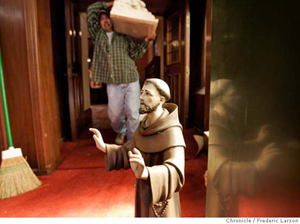
So this week, after selling St. Brigid Church to the Academy of Art University, the Archdiocese has had crews in the sanctuary, tearing out statues and otherwise wrecking the church’s interior, racing to finish their destruction before the formal landmark designation takes effect, hoping, we presume, that what is already destroyed cannot be protected.
They have done this in defiance of no fewer than three “stop work” notices from the city’s Department of Building Inspection, for violations ranging from doing work without a permit to subjecting their workers to potential danger from the piles of fallen asbestos ceiling tiles in the sanctuary.
They have continued to try to do this, even as members of our committee have sat in the doorway of the church to block them from loading their trucks.
Friday afternoon the San Francisco Police stopped them, for the afternoon anyway, from removing the artwork.
The church’s treasures are, at this moment, staged just inside the door of St. Brigid’s sacristy, ready for quick loading into trucks.
We suspect that the Archdiocese will attempt to remove these statues (even though they are now prohibited by law from even entering the building) before a judge can act to protect them. So we are standing vigil, day and night, by the church’s doors, until a judge can issue a restraining order.
In the past few weeks they have ignored the will of San Francisco’s Board of Supervisors, its Planning Commission and its Department of Building Inspection, but we hope the Archdiocese will respect the will of the state’s courts.
We need your help in two things:
- We don’t yet know the exact time or date of the hearing, but we hope you’ll be able to come to the State courthouse to show support (on short notice) early next week. When we get the time and date of the hearing, we’ll send another e-mail.
- Help us stand vigil at the church to keep the Archdiocese from taking out the church’s artwork. Please call to volunteer: 415-364-1511 and leave a message with your number.
Thanks very much, Joe Dignan
Committee To Save St. Brigid Church
P.O. Box 641318
San Francisco, CA 94164-1318
Voice Mail: (415)364-1511
Web: www.st-brigid.org
e-Mail: [email protected]
|
|
Wednesday, October 19, 2005
I appreciated Fr. Araujo's suggestion that those pursuing CST might do well to consider and pursue the "sovereignty" of a people that has formed itself around wholesome principles. Analytically, sovereignty is a tough nut to crack, dangerously so. It enters the political dialect as a bid for a scalar quantity; all and absolute power in one place (unless and until conceded to others). The impossibility of such a power leads to variously grudging acknowledgments that "sovereignty" is shared (as in "our federalism"), though of course the claims of multiple, ranked sovereigns defy the original notion while continuing to use the word. Another move is to relocate sovereignty in the people; but if the people are sovereign, it is not in the that older sense of being unbound by the natural and divine law. "God alone is sovereign," said Maritain; everyone else is under the (natural and divine) law. One can describe a people or peoples as sovereign, but, with Maritain, I suspect that the original sense of "solutus legibus" is apt to slip back in to do treacherous work. Maritain's judgment was that the word is Protean enough to be better avoided, particularly when it comes to questions of the legitimacy of claims to self-determination. The modern tendency to call the law itself sovereign seems benign enough; even the English version of the Compendium (sec. 408), of which I am an admirer, mistranslates Centesimus annus to the say that "the law is sovereign." But whatever the (considerable) virtues of legal positivism in some of its implementations, CST can hold positive law "sovereign" in only a very diminished sense. When I hear today's Supreme Court invoking "sovereignty" to justify the denial of adequate legal remedies for state violations of positive legal rights, I suspect that a better analysis. I know that the concept of sovereignty does good work in some contexts; Vitoria comes to mind. But the Hobbesian version is always there in the background, too.
Tuesday, October 18, 2005
Regarding the question of how to pursue questions of Catholic social thought in the law classroom, I should have mentioned my current effort earlier this semester. I am for the first time teaching a seminar titled "The Metaphysics and Jurisdiction of Sovereignty." Over nearly ten years of teaching Federal Courts I discovered more and more deeply the (obvious) fact that through doctrines of sovereign immunity exceedingly profound questions are being asked and answered in quotidian rules of jurisdiction and suability. And the Court is today re-writing those rules and thus giving those questions new answers. Those new answers include (to me) startling claims on behalf of the "dignity," even the sovereign dignity," of the states. The Federal Courts course did not provide a proper forum for tracing and probing the political science, history, theology, and philosophy that are at work here (or should be at work). The new seminar allows students to see how -- pace the rhetoric one sometimes hears-- even "mere" rules of jurisdiction and suability have deep theoretical content and philosophically challengeable consequences. The readings include the leading S.Ct. cases in sovereign immunity and the 11th amendment, and these span more than two centuries. Other decisions of the Court bearing on sov. imm. are also included; e.g., Ex parte Young. The secondary sources include Bodin, Hobbes, the Federalist, James Wilson, O. v. Gierke, J. Maritain, H. Laski, W.J. Stankiewicz, Judge Noonan, C. Pierson, E. Young, R. Fallon, A. Althouse, P. Kahn, J. Resnik, and S. Sherry. The bringing together of such varied perspectives on the relations among rights, remedies, and "the state" (a "public service corporation" (Laski) or an entity possessed of "sovereign dignity" (SCOTUS)) has so far proved productive of very engaged discussion. Claims of dignity get and sustain attention -- which, of course, is the Court's point, and mine too. We'll see how the rest of the semester goes.
Sunday, October 16, 2005
I've written here before about Steve Smith's stunningly good Law's Quandary (Harvard, 2004). Everyone doing legal theory should read the book and ponder its theses. I mention the book again now because those interested in hearing it put in critical context will want to come to CUA's Columbus School of Law on Tuesday, October 25, 2005. There and then Professor Smith's achievement will be honored with a day-long symposium on the book. Joining Professor Smith in dialogue about law's metaphysics will be Joseph Vining (University of Michigan Law School), Lloyd Weinreb (Harvard Law School), Patrick Brennan (Villanova School of Law), and Justice Antonin Scalia. For more information on the event and to see how to reserve a seat, please visit the Columbus School of Law website and click on "The Perplexity is Metaphysical."
