Today's USCCB document on religious liberty is a powerful statement (one that needed saying, I think), and I'm sure we'll have a lot to discuss about it. But can I protest one law-related aspect distinct from the merits? The statement is followed by a copyright notice, appropriately, but then comes this sentence: "No part of this work may be reproduced or transmitted in any form or by any means, electronic or mechanical, including photocopying, recording, or by any information storage and retrieval system, without permission in writing from the copyright holder."
This is a boilerplate assertion found commonly in books and other copyrighted works. But as numerous copyright scholars have pointed out, it plainly misstates the law: "De minimis copying is not infringement, and fair use also permits certain kinds of reproduction." (Jason Mazzone, "Copyfraud," PDF p. 24.) Nor can the author create a contractual agreement against reproduction with every person who accesses a broadly distributed work. Of course, no one takes the blanket copyright claim seriously. Many of us will copy and transmit parts of the bishops' statement to comment on it, as we should, and presumably as the bishops want us to do. But that is precisely why, I think, our Christian organizations should avoid--rewrite--such blanket claims.
Actually, I see two reasons why they should do so. First, we should tell the truth. The notice does not make an accurate statement about the law, or about the organization's intentions (the bishops probably want a good deal of reproduction of excerpts for education and comment without having to give permission in each case), or about what is moral (it is perfectly moral as well as legal to reproduce parts of a work for fair use and similar purposes).
Second, our Christian organizations should model a more hospitable attitude toward sharing of creative work--and at least should not reinforce the most inflated versions of the moral status of copyright (i.e., "all copying is theft"). The Pope himself, like other Vatican officials, has argued against "an excessive zeal for protecting knowledge through an unduly rigid assertion of the right to intellectual property." (Let me shamelessly plug my piece on "Intellectual Property and the Preferential Option for the Poor," which expands on the argument why Catholic moral teaching, while validating copyright and other IP rights, cuts against the most inflated versions of them.)
Again, the blanket copyright assertion probably will mean little in practice. But I'd urge the bishops and other Christian groups to model, and teach implicitly, the better understanding of IP laws and morals. I wouldn't say that necessarily means joining up with Creative Commons and foregoing essentially all claims against reproduction (although in many cases that might be the right thing to do to spread the Gospel). But good modeling certainly means dropping the blanket notice, instead explaining--and welcoming!--fair uses, and so forth.
When Christian student groups at Vanderbilt complained about the university's policy forbidding registered student organizations to set eligibility criteria for leaders, Vanderbilt officials assured everyone that
We recognize that some groups, including some religious student organizations, may decide not to register. We will respect any such decisions and hope that those groups will continue to be actively engaged with our students and community, albeit without the rights and privileges accorded registered student organizations.
Now we have a report that one of those little rights and privileges to be lost is the ability to use the name "Vanderbilt" in the group's title. University officials have demanded that Vanderbilt Catholic change its name because it decided not to register rather than give up its requirement that leaders be Catholics.
“Those student groups who choose not to comply with the university’s nondiscrimination policy do forfeit the privileges associated with registered student organization status and that includes the use of the Vanderbilt name,” spokesperson Beth Fortune told Fox News.
Unless there is something missing in this report, it reveals the utter dishonesty, and confirms the intolerance, of the Vanderbilt administration. "[B]e actively engaged with our students and community," they soothingly said--"You just can't refer to yourself as being at Vanderbilt."
I assume that forbidding "use of the Vanderbilt name" includes forbidding a name such as "The Catholic Community at Vanderbilt." BUT I would think that if the Catholic group made such a change, the university would be unable to stop it legally. Vanderbilt's only claim would be a trademark suit, and the group would have a winning defense of fair use: the group is simply referring to its location and focus, not implying university sponsorship. (Would the university then try to bar the group from any activity or publicity on campus? How far is it willing to go in revealing that it in fact does want these groups off of campus altogether?)
Tom
Monday, March 19, 2012
The lawsuits brought against HHS over the contraception mandate raise interesting issues under the Religious Freedom Restoration Act, and under the Free Exercise Clause insofar as various nonreligious exceptions made in the statute and by HHS undercut the mandate's "general applicability" under Employment Division v. Smith. I think that the suits by religious organizations have a good prospect on the merits if the Administration doesn't cure significant problems with the narrow coverage of the existing and proposed religious exemptions (although I don't think the claims made for general commercial businesses have much of a chance). What I do know is that there's a lot more to the issue than is indicated in this piece, just published in Commonweal, which cites the Smith case in favor of the mandate and then stops. As sometimes happens with student exams, I found myself wondering whether the last few pages of the piece had gotten lost somewhere.
Sunday, February 19, 2012
Ellis West (University of Richmond) has published an op-ed in the Richmond Times-Dispatch arguing that "if if the question is whether the [contraception-coverage] regulation violates the religious freedom guaranteed in the First Amendment, the answer is clear. It does not." Much of the piece presents arguments that the framers did not intend the Free Exercise Clause to require exemptions from facially neutral, generally applicable laws. I believe the historical issue is more debatable than Ellis does, but let me focus on a couple of smaller but important points about the religious-freedom legal challenges to the mandate.
One point is about the constitutional free-exercise claim. According to Ellis, Catholic objectors are arguing that "groups have a right to be exempt from obeying valid laws everyone else has to obey, provided they have religious reasons." Actually, though, it is definitely not the case that "everyone else has to obey" the mandate. As the complaints in the lawsuits state, millions of small employers (employing under 50 people) are exempt; significant percentages of other employers are grandfathered; and individualized waivers, running probably in the thousands, have been granted by HHS to others. See paragraphs 36-53 of that complaint (filed by a non-Catholic objector, Colorado Christian University). When the law accommodates the interests of so many organizations--the interest in alleviating burdens on small business, the various interests reflected in the granted waivers--there is a strong First Amendment argument that the law must likewise accommodate the constitutionally recognized interest in religious conscience. In the terms of Employment Division v. Smith and cases following it, the mandate is not "generally applicable."
The other points are about the Religious Freedom Restoration Act, on which the challengers rely. Ellis says that Congress passed RFRA "because of pressure from religious organizations," and that Americans need to decide "which kind of religious freedom they want": the kind that gives exemptions from facially neutral laws or the kind that doesn't. Actually, RFRA also had support from a host of secular civil-liberties organizations, including the ACLU and People for the American Way. And as this article reminds us, "Support was so widespread that the RFRA passed the House in a voice vote. In the Senate, the final version passed 97–3." Unless Congress was monumentally out of touch, these margins suggest that Americans from across the political spectrum really do want the kind of religious freedom in which, after the political tug-of-war has produced a substantial burden on religious exercise, courts take a second look whether that burden is justified by strong reasons.
I think the right phrase is "Americans do want" such freedom rather than "did want," but it's a little less clear today than in 1993, when people from across the political spectrum thought religious conscience deserved that chance for accommodation depending on circumstances. Today, you hear more liberals saying that accommodations are simply improper, affronts to the rule of law. That's a change: an abandonment, unfortunately, of a longstanding liberal commitment to protecting religious conscience from majoritarian imposition.
Saturday, February 11, 2012
I guess we'll now turn to evaluating the White House "compromise" on the mandate, but let me add a little to what others have said in comments responding to Marty Lederman's thoughtful inquiry why the mandate (at least pre-compromise) imposes a substantial burden under RFRA. I start with the Dana Dillon exchange that Marty mentions. As one participant there notes, insurance coverage of contraception has symbolic meaning: "[T]he refusal to provide contraceptive coverage is one of the (few!) ways in which the Catholic church as a whole can be said to be 'upholding' the Church’s teaching," given that it is not widely followed by the laity or widely promoted in homilies. This to me makes it easy to understand seeing the mandate as a serious burden. For the Church to be forced to give up this means of upholding the teaching would have a significant effect on a doctrine already under siege, and on the role of that doctrine in tying to the Church organizations whose affiliation with it is otherwise fairly loose. As others remarked in the comments, saying "we're doing this but we're against it" is insufficient because any claimant subject to a law has that option. (And needless to say, the fact that the teaching is currently followed--even articulated--very imperfectly in the Church is not a reason to find no burden; the institutional leaders should be able to decide when to man the barricades.)
We defer, within a pretty wide berth, to a religious claimant's argument that a government mandate forces her to violate her religious beliefs. (And we unquestionably have a mandate here, one very difficult to avoid, even compared to the most far-reaching state version.) U.S. v. Lee found a burden on the Amish in a similar context, as Kevin Walsh remarked in the comments. And Thomas v. Review Bd., the case about the Jehovah's Witness making parts ultimately used in tanks, likewise deferred to a claimant's understanding of the degree of connection that constitutes cooperation. This question cannot be reduced to microeconomic analysis (under which many, many things could be said to have some effect--or not enough--because money is fungible). It can't even be reduced entirely to moral-theology hypos about cooperation with evil. The importance of symbolic elements justifies substantial deference to the claimant's judgment on when a mandate like this--again, unquestionably a mandate--conflicts with its claimant's beliefs.
Finally, I don't think that the "intervening private choice" analysis from the voucher ruling applies here, as Marty suggests, to say there's no burden. The taxpayer's connection to the ultimate voucher expenditure is far less significant than the employer's connection to employees' decisions to use coverage. First, there are millions more taxpayers in a state than there are employees for any religious employer. Second, unlike the taxpayer, the employer has to include something in an actual policy of its own, has to respond to inquiries by saying that it does cover contraception--even unwillingly--and so forth.
Friday, February 10, 2012
We'll see what emerges from the administration sources' statements that it will seek a compromise on the contraception mandate. The referral problem is there, and I don't know whether an employer's reference to other options can be made general enough.
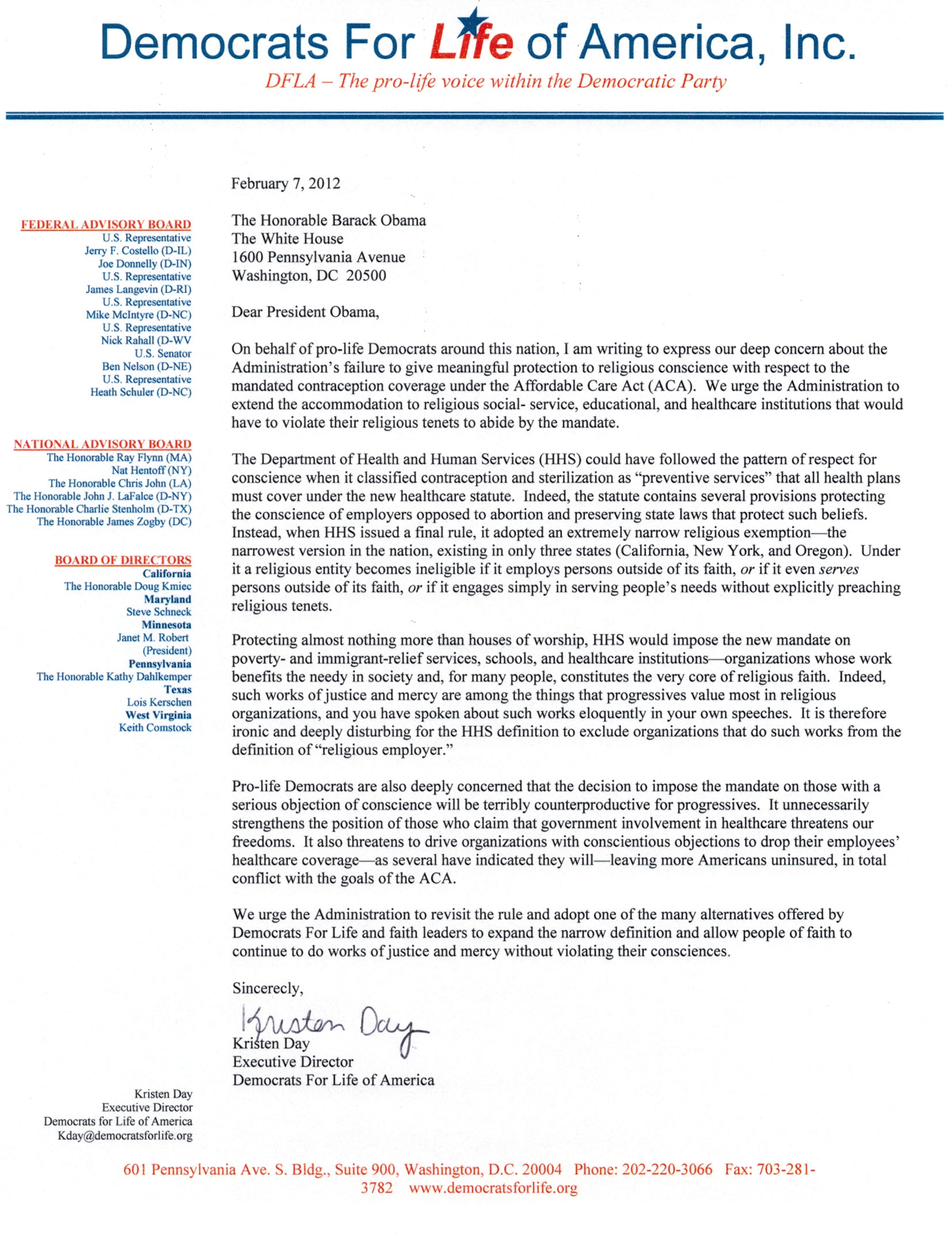
In the meantime, as another resource and part of the record, here is a letter to the President on Tuesday from Kristen Day of Democrats for Life (see also statement here), which argues that
works of justice and mercy are among the things that progressives value most in religious organizations, and you have spoken about such works eloquently in your own speeches. It is therefore ironic and deeply disturbing for the HHS definition to exclude organizations that do such works from the definition of 'religious employer'. . . [The mandate with minimal exception] unnecessarily strengthens the position of those who claim that government involvement in healthcare threatens our freedoms.
Wednesday, February 8, 2012
The White House seems to be taken aback by the negative reaction to its refusal to accommodate in the contraception mandate. As both Anthony Picarello (USCCB general counsel) and my wife said today, when Chris Matthews calls President Obama way off base, the President's in trouble. According to one report, administration officials interested in a compromise are thinking of a broader exemption but with a requirement, similar to the Hawaii statute that Melissa Rogers described last fall, that
religious employers that decline to cover contraceptives must provide written notification to enrollees disclosing that fact and describing alternate ways for enrollees to access coverage for contraceptive services. Hawaii law also requires health insurers to allow enrollees in a health plan of an objecting religious employer to purchase coverage of contraceptive services directly and to do so at a cost that does not exceed ‘the enrollee’s pro rata share of the price the group purchaser would have paid for such coverage had the group plan not invoked a religious exemption.
It would be nice if insurers were called on to take up the slack here, instead of objecting religious organizations. As to "describing alternate ways" of access ... As I blogged before, the idea of requiring religious objectors to inform their employees about alternative access generally does not assuage conscientious objections: moral theology treats referring someone to the nearest abortion clinic as impermissible cooperation with evil. However, if a mention of alternatives were required, I wonder if it would be palatable if the alternative in question were the insurance company. Suppose what Catholic Charities must say upfront to employees is, "We do not cover premiums for contraception; for questions, see the insurance company directly at [phone number]." Would that be an impermissible referral, or would the generality of the language, and the fact that the insurer might be an obvious contact anyway, mean it's not impermissible? I'd be interested in others' answers to that question, because models like this may receive serious discussion soon.
Rick and I keep posting letters that our group of law professors has been writing, arguing to various state legislatures considering the recognition of same-sex marriage that they should also enact meaningful religious-liberty protections. It's not that we think readers want to see the details of each and every state's laws; we' re just keeping an archive of these letters. Here's the page compiling them all (it's also in the list of links at the bottom left of the blog). For some poor poli sci grad student slaving away on a dissertation in 2052....
So here is the latest, a followup to Washington legislators, who have expanded their proposed religious-liberty protection but left the protections incomplete and, frankly, wildly inconsistent between different sections.