Sunday, February 12, 2012
"If the church is not the church . . . ."
The HHS mandate is (still) inconsistent with religious freedom
A letter, signed by a hundred or so academics, activists, journalists, clergy, and others, explaining why what is being described in the press as a "compromise" on the HHS mandate does not cure the religious-liberty difficulties with the relevant policy is available here. Those signing include Mary Ann Glendon, John Garvey, Jean Bethke Elshtain, John Cavadini, Robert George, and many others. Check it out.
An Unacceptable "Accommodation"
Here is the text of a statement on the "accommodation" for religious institutions proposed by President Obama in the wake of the firestorm over his administration's mandating of employer coverage of abortion-inducing drugs, sterilizations, and contraceptives. The statement, drafted by John Garvey, Mary Ann Glendon, Carter Snead, Yuval Levin, and myself, rejects the accommodation as a mere accounting trick that does nothing of moral substance to eliminate the mandate's unjust, and, we believe, unconstitutional, imposition on religious freedom and the rights of conscience. We have been joined by dozens of scholars, university presidents, and others, including Michael McConnell of Stanford Law School, Donald Landry of Columbia Medical School, Jean Bethke Elshtain of the University of Chicago, Rabbi Meir Soloveichik of Yeshiva University, Larry Alexander and Steven Smith of the University of San Diego Law School, Gilbert Meilaender of Valparaiso, my Princeton colleagues John Londregan and Thomas Kelly, and Gary Anderson, Rick Garnett, Gerry Bradley, and a large number of other leading members of the faculty from many disciplines at the University of Notre Dame. A complete list of signatories can be found here: http://www.becketfund.org/wp-content/uploads/2012/02/Garvey-Glendon-George-Snead-Levin-stmt-Feb-11-2012.pdf
Unacceptable
The Obama administration has offered what it has styled as an “accommodation” for religious institutions in the dispute over the HHS mandate for coverage (without cost sharing) of abortion-inducing drugs, sterilization, and contraception. The administration will now require that all insurance plans cover (“cost free”) these same products and services. Once a religiously-affiliated (or believing individual) employer purchases insurance (as it must, by law), the insurance company will then contact the insured employees to advise them that the terms of the policy include coverage for these objectionable things.
This so-called “accommodation” changes nothing of moral substance and fails to remove the assault on religious liberty and the rights of conscience which gave rise to the controversy. It is certainly no compromise. The reason for the original bipartisan uproar was the administration’s insistence that religious employers, be they institutions or individuals, provide insurance that covered services they regard as gravely immoral and unjust. Under the new rule, the government still coerces religious institutions and individuals to purchase insurance policies that include the very same services.
It is no answer to respond that the religious employers are not “paying” for this aspect of the insurance coverage. For one thing, it is unrealistic to suggest that insurance companies will not pass the costs of these additional services on to the purchasers. More importantly, abortion-drugs, sterilizations, and contraceptives are a necessary feature of the policy purchased by the religious institution or believing individual. They will only be made available to those who are insured under such policy, by virtue of the terms of the policy.
It is morally obtuse for the administration to suggest (as it does) that this is a meaningful accommodation of religious liberty because the insurance company will be the one to inform the employee that she is entitled to the embryo-destroying “five day after pill” pursuant to the insurance contract purchased by the religious employer. It does not matter who explains the terms of the policy purchased by the religiously affiliated or observant employer. What matters is what services the policy covers.
The simple fact is that the Obama administration is compelling religious people and institutions who are employers to purchase a health insurance contract that provides abortion-inducing drugs, contraception, and sterilization. This is a grave violation of religious freedom and cannot stand. It is an insult to the intelligence of Catholics, Protestants, Eastern Orthodox Christians, Jews, Muslims, and other people of faith and conscience to imagine that they will accept an assault on their religious liberty if only it is covered up by a cheap accounting trick.
Finally, it bears noting that by sustaining the original narrow exemptions for churches, auxiliaries, and religious orders, the administration has effectively admitted that the new policy (like the old one) amounts to a grave infringement on religious liberty. The administration still fails to understand that institutions that employ and serve others of different or no faith are still engaged in a religious mission and, as such, enjoy the protections of the First Amendment.
Saturday, February 11, 2012
A Thought About What Makes a Burden "Substantial"
There has been some discussion about what it is that would make a "burden" qualify as "substantial" under the terms of the Religious Freedom Restoration Act. I had a thought about this that I wanted to try out here. It seems to me that the gravity of a burden is frequently intimately connected with the centrality, or importance, of the belief that is felt to be burdened: the more central, or important, the religious tenet or view, the greater the obligation that the claimant will feel in adhering to it, and the more substantial will be the burden felt by the claimant in having to endure not adhering to it. Yet RFRA eliminated the inquiry into centrality. That decision was, I think, intended to prevent courts from making judgments about (a) how important a belief was, in order to determine (b) how severe or substantial the burden was. One reason for eliminating the centrality inquiry was an establishmentarian concern; another was a concern about competence.
The difficulty is that the standard continues to be a "substantial" burden. That cannot only mean a burden as to which a claimant sincerely objects on religious grounds. But how would one determine a burden's substantiality without being permitted to inquire at all about a belief or practice's centrality, or importance? I'm not even sure what the inquiry would look like. And that may be why, in the RFRA case law, one tends to see a great deal of deference to the claimant about what constitutes a "substantial" burden in the first place (and cases often get resolved under the compelling interest leg) -- exactly because of the danger that an inquiry into the burden's gravity, or substantiality, can easily bleed over into an inquiry about the belief or practice's centrality, or importance, within the religious system. Sometimes one sees the statement that a substantial burden is one where the state puts "substantial pressure on an adherent to modify his behavior and to violate his beliefs." Thomas v. Rev. Bd. But that only seems to restate a kind of subjective test -- how much pressure is "substantial pressure" will depend upon an inquiry about the nature of the coercion felt by the claimant in light of the religious belief's importance to the claimant. Pressure only matters if the belief is religious (not generally a question) and about something important...or central. That is, a claimant is sensitive to pressure if government is squeezing a pressure point. But because centrality is no longer a cognizable concern, we are necessarily left with a healthy measure of deference to the claimant's feelings about the quality of the burden. Thoughts?
Heresy expressed at the Business Insider
The unsayable is said out loud at, of all places, Business Insider:
I once heard the late Irving Kristol express the same heretical thought, privately, at a dinner at the American Enterprise Institute after a lecture I gave there.
Response to Marty on the Mandate
I guess we'll now turn to evaluating the White House "compromise" on the mandate, but let me add a little to what others have said in comments responding to Marty Lederman's thoughtful inquiry why the mandate (at least pre-compromise) imposes a substantial burden under RFRA. I start with the Dana Dillon exchange that Marty mentions. As one participant there notes, insurance coverage of contraception has symbolic meaning: "[T]he refusal to provide contraceptive coverage is one of the (few!) ways in which the Catholic church as a whole can be said to be 'upholding' the Church’s teaching," given that it is not widely followed by the laity or widely promoted in homilies. This to me makes it easy to understand seeing the mandate as a serious burden. For the Church to be forced to give up this means of upholding the teaching would have a significant effect on a doctrine already under siege, and on the role of that doctrine in tying to the Church organizations whose affiliation with it is otherwise fairly loose. As others remarked in the comments, saying "we're doing this but we're against it" is insufficient because any claimant subject to a law has that option. (And needless to say, the fact that the teaching is currently followed--even articulated--very imperfectly in the Church is not a reason to find no burden; the institutional leaders should be able to decide when to man the barricades.)
We defer, within a pretty wide berth, to a religious claimant's argument that a government mandate forces her to violate her religious beliefs. (And we unquestionably have a mandate here, one very difficult to avoid, even compared to the most far-reaching state version.) U.S. v. Lee found a burden on the Amish in a similar context, as Kevin Walsh remarked in the comments. And Thomas v. Review Bd., the case about the Jehovah's Witness making parts ultimately used in tanks, likewise deferred to a claimant's understanding of the degree of connection that constitutes cooperation. This question cannot be reduced to microeconomic analysis (under which many, many things could be said to have some effect--or not enough--because money is fungible). It can't even be reduced entirely to moral-theology hypos about cooperation with evil. The importance of symbolic elements justifies substantial deference to the claimant's judgment on when a mandate like this--again, unquestionably a mandate--conflicts with its claimant's beliefs.
Finally, I don't think that the "intervening private choice" analysis from the voucher ruling applies here, as Marty suggests, to say there's no burden. The taxpayer's connection to the ultimate voucher expenditure is far less significant than the employer's connection to employees' decisions to use coverage. First, there are millions more taxpayers in a state than there are employees for any religious employer. Second, unlike the taxpayer, the employer has to include something in an actual policy of its own, has to respond to inquiries by saying that it does cover contraception--even unwillingly--and so forth.
Friday, February 10, 2012
MOJ Onion Edition 2: Louisiana Congressman Responds to New $8 Billion 'Abortionplex'
The Onion seems to be on a bit of a roll of late where what is sometimes ironically called 'reproductive health' and public policy are concerned. Full story available here: http://nymag.com/daily/intel/2012/02/congressman-abortionplex-facebook-onion-john-fleming.html .
Congressman Alerts Facebook Followers to Onion Story About $8 Billion Abortionplex
Satire got the best of unsuspecting or factually impaired Republican Congressman John Fleming of Louisiana this past Friday. An ardent opponent of abortion, Fleming posted on his Facebook account a link to a May 11, 2011 story by The Onion titled "Planned Parenthood Opens $8 Billion Abortionplex."
Fleming's Facebook status, which has since been deleted, included the link with the note, "More on Planned Parenthood, abortion by the wholesale."
The congressman's followers were directed to Onion's faux-story that begins, "Planned Parenthood announced Tuesday the grand opening of its long-planned $8 billion Abortionplex, a sprawling abortion facility that will allow the organization to terminate unborn lives with an efficiency never before thought possible."
The gaffe was spotted by Literally Unbelievable, a blog that posts statuses from people who take Onion's satire as fact. Without further comment, Fleming’s spokesman Doug Sachtleben told Politico that Fleming's post was removed from his Facebook page. “The Onion is satire," wrote one commenter on Facebook before the post was deleted. "How exactly did you get elected?”
The Abortionplex report is awfully ridiculous even by Onion's standards. Among the greater flourishes from the story about the state-of-the-art abortion factory:
The remaining space is dedicated to amenities such as coffee shops, bars, dozens of restaurants and retail outlets, a three-story nightclub, and a 10-screen multiplex theater—features intended not only to help clients relax, but to foster a sense of community and make abortion more of a social event.
* * *
"I was kind of on the fence in the beginning," [one woman] said. "But after a couple of margaritas and a ride down the lazy river they've got circling the place, I got caught up in the vibe. By the time it was over, I almost wished I could've aborted twins and gotten to stay a little longer."
Planned Parenthood received a lot of attention last week when women's health fund-raising juggernaut the Susan G. Komen foundation announced that it would no longer support PP. After a severe, immediate backlash, the Komen foundation reversed course, explaining that "recent decisions that cast doubt upon our commitment to our mission of saving women's lives."
On January 31, Congressman Fleming, a family physician, posted on his Facebook page, "Susan G. Komen cutting funding to Planned Parenthood. It is time Congress should do the same as long as taxpayer money is used to take innocent life."
Onion editor Joe Randazzo enjoyed Fleming's complete misapprehension of the website's satirical story. “We’re delighted to hear that Rep. Fleming is a regular reader of America’s Finest News Source and doesn’t bother himself with The New York Times, Washington Post, the mediums of television and radio, or any other lesser journalism outlets,” he said in a statement.
Despite the abhorrent judgment by Fleming, he must be overcome with relief that the Abortionplex doesn't exist. The thought of an abortion factory with the largest rock climbing wall in Kansas, valet parking, and abortion suites "where women may enjoy a complimentary pedicure and a flute of champagne" would have been quite unsettling.
MOJ Onion Edition: Jewish Deli Ordered to Serve Pork – Civil Rights of Swine Eaters Cited
The newly created Department for the Regulation of Everything Not Yet Subject to Federal Regulation issued a new rule requiring kosher delis to make pork dishes available on their menus.
Government officials were quick to defend the regulation against the charge that it violates the principle of religious freedom. “We’re not requiring the operators of these delis to consume pork products themselves, only that they make them available to others. What those individuals decide to order from the menu is up to them” said a senior government official. The great tradition of freedom of worship is, he said, fully respected under the law. Although many regard the option of ordering pork as purely elective, the administration insisted that it regarded the availability of pork as “important” for a healthy diet. (See here).
One member of Congress remarked (here) that it was “sad” when “the overwhelming practice was in favor” of pork consumption for some to try and use “the excuse of religious freedom” to thwart the administration’s efforts.
Mordecai Weisman, proprietor of Mort’s Deli, said he objected to the new regulation. “What is this? All of a sudden I’ve got no rights in this country? How can I keep a kosher kitchen if I have to serve pork? Oy!” However, two of Mr. Weisman’s workers, Manny Garcia and Juan Rodriguez viewed the rule differently. “We work long hours and so we often have to take our meals here, which the deli provides. We’d love to have the freedom of choose a good pork dish.”
Proponents of the measure such as the National Pork Producers Council (here and here) cited the fact that the vast majority of American Jews do not keep kosher and that many freely choose to consume pork, notwithstanding the traditional religious dietary prohibition (here, here, here, and here).
A lawyer for the ACLU remarked that regulations governing businesses serving food to the general public had been enacted in several states and upheld by their highest courts. When a business hires non-believers it has “to at least some degree, be prepared to accept neutral regulations imposed to protect those employees’ legitimate interests in doing what their own beliefs permit” said the lawyer, paraphrasing one such opinion. Thus, “as a legal matter, as a constitutional matter” the new rule was she said “completely unremarkable.” (See here).
The administration said that the fact that Mr. Weisman’s temple was not being required to serve pork represented a reasonable accommodation of religious liberty.
Mr. Garcia and Mr. Rodriguez said they were looking forward “to enjoying some chorizo and perhaps even a tasty cochinita pibil” in the near future.
Mr. Weisman said he hoped that the supporters of religious liberty would rally to his defense.
Update on the 'Walk Back'
Here is the White House press release concerning today's 'walkback' from the erstwhile contours of the HHS mandate: http://www.whitehouse.gov/the-press-office/2012/02/10/fact-sheet-women-s-preventive-services-and-religious-institutions . (The grammar of the thing's inelegant, to say the least, which perhaps is testimony to the speed with which the White House came to realize that it must act.) It is gratifying to see that the onus is being placed upon insurers, as Tom and I have hoped aloud since Wednesday. Still awaited, though, is the specific guideline concerning how, if at all, religiously affiliated institutions are to make their employees aware of the continued availability of contraception coverage from their insurers. Stay tuned.
Democrats for Life on the Contraception Mandate
We'll see what emerges from the administration sources' statements that it will seek a compromise on the contraception mandate. The referral problem is there, and I don't know whether an employer's reference to other options can be made general enough.
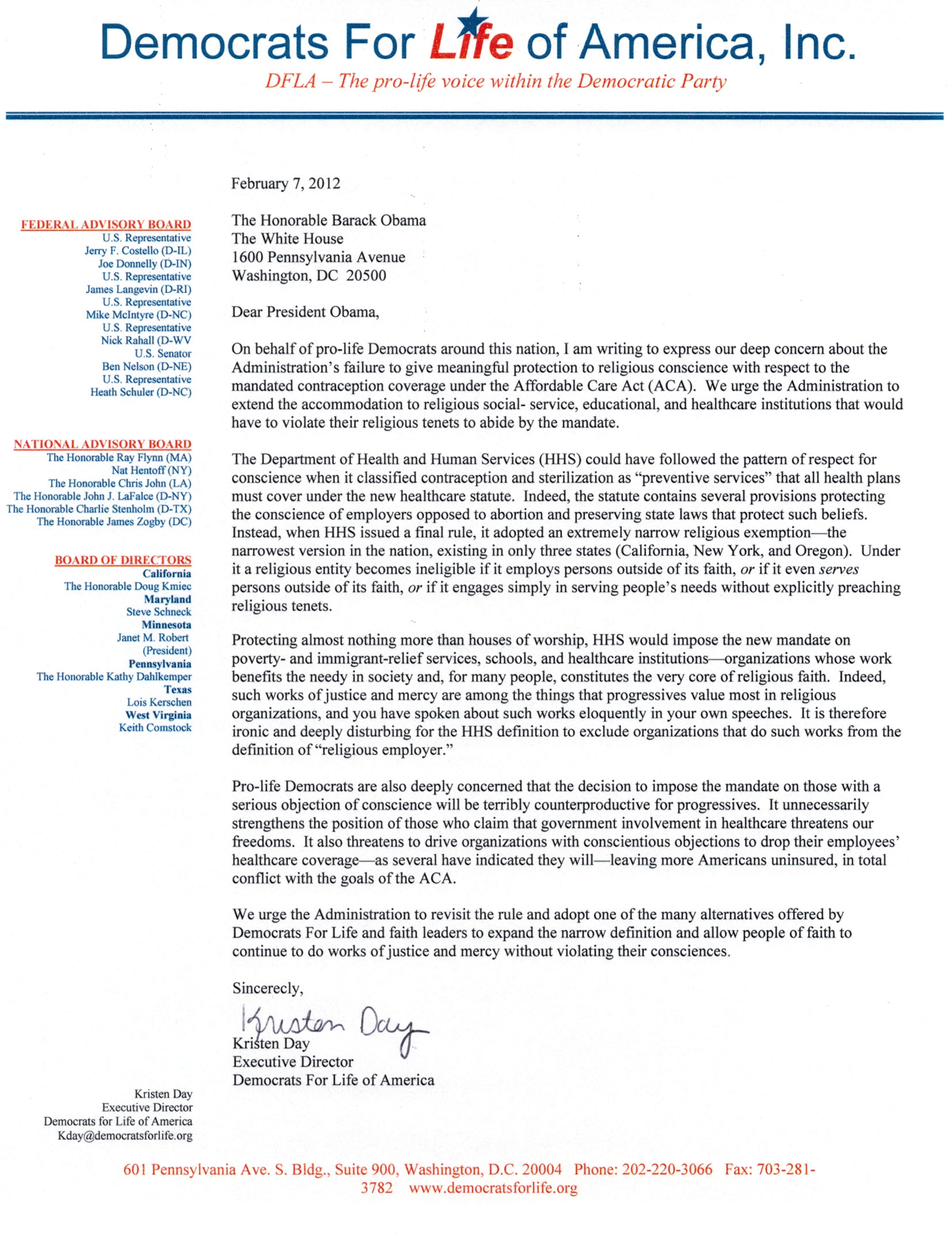
In the meantime, as another resource and part of the record, here is a letter to the President on Tuesday from Kristen Day of Democrats for Life (see also statement here), which argues that
works of justice and mercy are among the things that progressives value most in religious organizations, and you have spoken about such works eloquently in your own speeches. It is therefore ironic and deeply disturbing for the HHS definition to exclude organizations that do such works from the definition of 'religious employer'. . . [The mandate with minimal exception] unnecessarily strengthens the position of those who claim that government involvement in healthcare threatens our freedoms.
Recent Posts
Categories
Monthly Archive
StatCounter
PageViews
Since February 19, 2008