
Tuesday, January 26, 2010
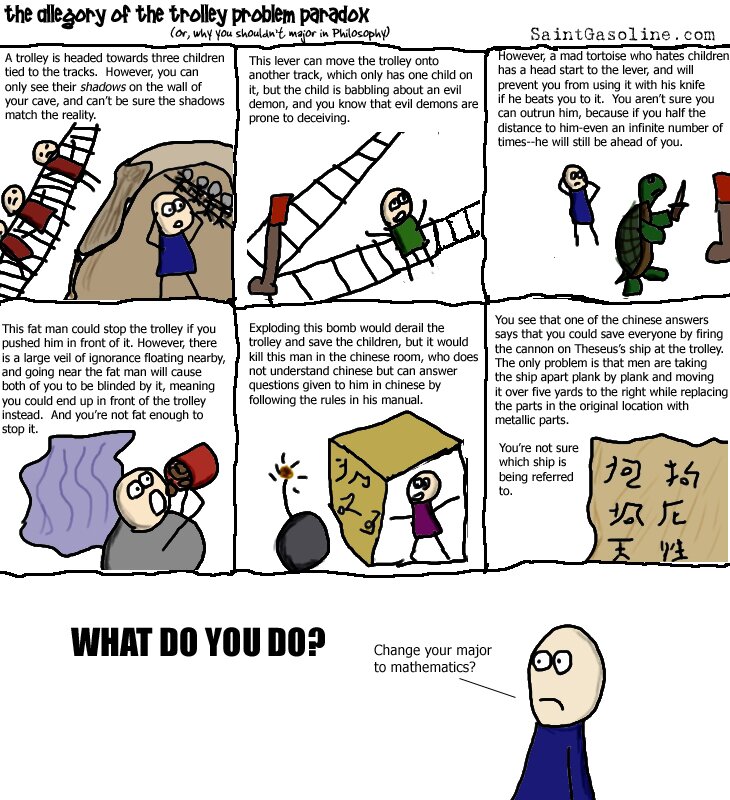
Any philosophy majors out there? (HT: Larry Alexander)
Consider the Source
Hello All,
I'm sympathetic to much of what Rob says in the post immediately below, but offer one mitigating consideration that might render the protest against CBS's decision a wee bit less depressing: It is possible that those protesting the planned ad are as concerned about the source of the ad as they are about its content. I used, in the early 1990s, to listen to Dr. Dobson's radio programs with some regularity, and was impressed at the time by their charitable tones and evident sincerity in proclaiming the aim to provide succour and healing to all who voluntarily sought it. But as that decade wore on, Dr. Dobson's messages and his involvement in American politics took on what in my view was a decidedly darker cast, filled with hard-hearted imprecations and paranoic likenings of Democratic political figures to servants of Satan. And this is not even to mention the tendency I began to notice, as the decade wore on, for Dr. Dobson's programs to cast women in subordinate, 'follower' roles in relation to men. I ceased listening altogether in disgust by the late 1990s. Dr. Dobson's role in our polity has, it seems to me, become only more distasteful and uncharitable since the late 1990s, and it might well be that shared impressions of this sort account at least in part for the current protests against CBS's decision. A helpful experiment would be presented us were Catholic Charities or, better yet, a group of women religious and/or the Catholic Worker movment to attempt to run a similar ad. Were the protests to be the same in such case, I'd be a bit more able to join Rob in his depression.
Keep heart!,
Bob
Perhaps the most depressing protest ever?
CBS is taking heat from women's groups for agreeing to run an ad from Focus on the Family featuring Tim Tebow, whose mother rejected her doctors' advice that he be aborted:
“An ad that uses sports to divide rather than to unite has no place in the biggest national sports event of the year—an event designed to bring Americans together,” said Jemhu Greene, president of the New York-based Women’s Media Center.
This is depressing on several levels:
First, from what I understand, the ad will not advocate any particular legal response to abortion; it simply will celebrate life and the personal choices that make life possible. If a message like that is too "divisive" to be expressed on a grand cultural stage, then we have a serious problem. For those who insist that the concept of the common good has become so thin that a meaningful conversation on the subject is impossible, this might be Exhibit A.
Second, the logic underlying an argument that messages encouraging others to "choose life" are "demeaning" makes me want to poke myself in the eye with a sharp object. It is a message aimed at hearts and minds; it is not (as far as I know) aimed at persuading the state to criminalize abortion (I'm not saying that those messages have no place in the public square, just that those message are understandably more controversial.) But to insist that a mother telling her story of being blessed by her choice for life is "not being respectful of other people's lives" (according to Terry O'Neill, president of NOW) is to twist the concept of "respect" beyond recognition.
Third, the nature of the protest -- don't taint the sacred ground of the Super Bowl! -- speaks loudly about our society's rush to embrace events that give us a sense of community (and even transcendence), and how silly we sometimes look as a result. Perhaps at one time those events were religious, but now we're left with the Super Bowl (and maybe American Idol). As sports columnist Gregg Doyel wrote, “If you’re a sports fan, and I am, that’s the holiest day of the year. It’s not a day to discuss abortion."
I've opened comments.
Monday, January 25, 2010
Allen's "Future Church" -- Trend Two: Evangelical Catholicism
Last week Amy kicked off our discussion of John Allen's important new book, The Future Church, with Allen's first trend ("A World Church"), and this week I'm going to continue the conversation by focusing on his second trend: "Evangelical Catholicism." I'll lay out the basics of Allen's thesis, then raise some questions about what the trend could mean for Catholic legal education.
Citizens United and corporations' speech-goals
Just two quick thoughts in response to Kevin's and Rob's recent posts on the Citizens United case -- which, in my view, is welcome, and perhaps even cause for (non-churlish!) celebration.
First, Kevin's post is very thoughtful, and I endorse nearly all of it, but I'd hesitate before adopting the view that the goods that corporations will promote through their political speech are any more likely to be "material, consumerist, and sensuous goods, ones fit for economic growth, but not fit for living authentic, effective human lives." It would be possible to overstate natural persons' tendency to engage in political speech for other-regarding ends, and it would be possible to understand the extent to which corporations can, and do, promote public, or general interests through their political speech. Also, it is crucial to recall that the laws at issue in Citzens United did not apply only to for-profit corporations, but also to groups that, we might think, exist in order to promote the common good (as they understand it). Much of the criticism of the decision has overlooked (or ignored) this fact.
Second, we have heard, in much of the criticism of the decisions, the mantra that "corporations are not people and only people have First Amendment rights." I am inclined to think that Catholic legal theorists should reject the latter half of this claim. Thoughts?
As an experiment . . . comments are open.
Can a corporation transcend consumerist goods?
I do not have a strong opinion on Citizens First v. FEC, and I'm inclined agree with Kevin's assertion that the range of goods corporations are likely to pursue in their political speech are "material, consumerist, and sensuous goods, ones fit for economic growth, but not fit for living authentic, effective human lives." But is this limited range of goods intrinsic to the nature of the corporation, or does it also reflect our limited understanding of the corporation's potential? Even under the "nexus of contracts" conception, there is no reason why corporations cannot stake out more distinctive roles as venues through which the values necessary for "authentic, effective human lives" can be pursued and expressed. As Alasdair MacIntyre puts it, we discover the common good -- and even our individual goods -- not through theoretical reflection, but through "everyday shared activities." Can corporations be one type of venue in which those shared activities occur? I've tried to develop the argument further in this paper.
Corporate Freedom of Speech
On his personal blog, MOJ friend, Stephen Bainbridge, has provided a useful round-up of the blogging on last week’s controversial Supreme Court decision on corporate free speech in Citizen’s First v. FEC. I greatly admire Professor Bainbridge's work and carefully consider his analysis of issues like this.
The responses to the decision have predictably ranged from abject horror to churlish celebration. Bainbridge’s own take on this case is to criticize Justice Stevens for suggesting that the state has “effectively delegated responsibility for ensuring society’s economic welfare” to the corporation. Bainbridge argues that the corporation is nothing more than a nexus of contracts, as Ronald Coase theorized many years ago. The corporate form is a standard structure by which the state facilitates a private ordering. Therefore, Brainbridge views limitations on corporate speech as improper governmental interferences with the private ordering of persons who deserve Constitutional protection.
While Professor Bainbridge, who is clearly a better economist that me, would disagree, I believe that Catholic social thought, particularly John Paul II's, offers some cautionary insights into this important issue. It seems likely that he would have challenged the formal conceptions of rationality that support economic theory for being far too reductive and limiting. The danger, as he often warned, is that poor assumptions about the person develop into political regimes that destroy human freedom and dignity. He often observed that Fascism and Communism were born of false understandings of the human person.
If he were alive today, John Paul II might agree with behavioral economists in concluding that human beings, in the full range of their personhood, often do not actualize the formal conception of economic rationality. But, he would have a substantially different assessment of the significance of that conclusion than would the behaviorists. For them, economic rationality is a good that is in short supply. John Paul II, on the other hand, would most likely have viewed economic rationality as a mistake that can be blinding to the true sources of the good and the genuine structure of human freedom.
This suggests that Catholics might be concerned about the range of goods that corporations might pursue in their political speech. They are likely to be material, consumerist, and sensuous goods, ones fit for economic growth, but not fit for living authentic, effective human lives. If Coase’s theory of the firm is correct, the corporation will advance the goods of overlapping self-interest rather than the agreement to share in the love of God. The social organization that results from the corporate nexus of contract is indeed organized, but toward the ends of self-satisfaction rather than the glory of the Lord. Corporate political speech, it seems to me, can do nothing other than bring the corporation’s over-riding telos—maximization of self-interested self-satisfaction—to the state, eventually crowding out traditional conceptions of the true goods of democratic politics articulated long ago by thoughtful citizens who, like Pericles, sought authentic human fulfillment in their public lives.
Saturday, January 23, 2010
A Dayof Penance . . . And Hope
Today I found myself, quite unexpectedly, at the 12:10 afternoon Mass at Our Lady of the Angels Cathedral in Los Angeles. I say "unexpectedly" because my trip to L.A. was quite a big surprise, arranged by my wife and a dear friend from law school who wanted me to come to Los Angeles to celebrate the birthday of Robert Burns, the great poet of Scotland. The celebration includes the singing and recitation of Burns' poetry, the consumption of haggis and other Scottish delicacies, and the drinking of much Scotch.
Today, however, my friend had things to attend to at his law firm in downtown L.A., and so I was left with some free time to walk around that part of the city. Truth be known, he gave me the choice of walking around the campus at USC (his alma mater) or touring downtown. As a Notre Dame grad, I have in the past ventured to the land of Troy -- a pilgrim in an unholy land. So this time, I chose "the better part."
I was in fact very curious to see Our Lady of the Angels Cathedral which I had not had an opportunity to visit before. I arrived just in time for Mass. I would estimate that over three-hundred people were in attendance. After the procession and greeting the priest said that just prior to the liturgy someone had asked him "Father, why are you wearing purple? Lent hasn't begun yet." And he explained to the congregation that this day on the Church's calendar in the United States is a day of penance, because today marks the sad anniversary of Roe v. Wade, the Supreme Court decision that created a constitutional right to abortion, under the authority of which millions of unborn human beings have been destroyed. Thus, today he said was a day of penance in which we seek God's forgiveness for our nation for the sin of abortion and we seek God's help in changing the hearts and minds of those who support abortion and in building a culture of life.
In his homily the priest noted that although today was a day of penance, it was also a day of hope. He explained that the following evening Cardinal Mahoney would be celebrating a Requiem Mass for the Unborn at the cathedral. At one point in the liturgy he said a number of children would come forward and place 148 candles around the altar representing the 148 abortions that take place on average in Los Angeles County each day. The priest said that this was, however, a hopeful sign in that only a few years ago the altar would be surrounded by 300 candles representing the average number of abortions perfomed each day in Los Angeles County at that time. This, he said, showed that despite all the cultural messages in favor of abortion, people were being convinced of the evil of this act and turning to embrace the cause of life. Yet, he said, 148 candles is 148 too many, so much work remains to be done.
In extinguishing the flame of abortion we seek to make another light shine, "the light of the human race, the light [that] shines in the darkness, and the darkness has not overcome it."
Friday, January 22, 2010
Faith-based investing
MOJ friend Elizabeth Brown sent me this article from the Financial Times, about religiously-based investment funds. According to the article, more than 1/10th of all US managed funds are now invested according to some sort of socially-responsible criteria. The occasion for the article was Monday's opening of the NYSE session by the investment advisor "FaithShares", which offers different investment funds that invest according to values of different faith traditions: Baptist, Catholic, Lutheran, Methodist, or 'Christian'. Apparently the Baptist fund invests in no sellers of alcohol, the Lutheran fund avoids seller of spirits, and the Catholic fund has no qualms about alcohol. Islamic funds, avoiding both sellers of alcohol and banks, have apparently been performing pretty well lately.
Candy-making Nuns
Speaking of being more open to the influence of the spiritual world, here's the best explanation I've seen for Scott Brown's victory in Massachusetts.
Recent Posts
Categories
Monthly Archive
StatCounter
PageViews
Since February 19, 2008
