Rosa Parks, who almost 50 years ago precipitated a major civil rights movement by refusing to give up her seat on a bus to a white man, died yesterday at the age of 92. Her act of courage is an inspiration to all who work for justice and peace. Thank you, Rosa. Click here for the New York Times piece today about her life and death.
Tuesday, October 25, 2005
Rosa Parks, RIP
Monday, October 24, 2005
Scalia reviews Smith
The latest First Things includes a review by Justice Scalia of Prof. Steve Smith's latest book, "Law's Quandary." We've already agreed here at MOJ that Quandary is great. And, in fact, there is a must-attend conference tomorrow, at Catholic University's Columbus School of Law, dedicated the book, featuring MOJ-er Patrick Brennan, Joseph Vining, Justice Scalia, Lloyd Weinreb, and Prof. Smith.
Here is Justice Scalia's opening line:
Steven Smith takes us on a lively, thought-provoking romp through the philosophy of law. Like most romps, it has no destination, but the experience is worth it.
Classic. He continues, after summarizing Smith's set-up:
Law’s quandary, then, is that we believe like legal realists but act as though there were indeed some omnipresent, overarching law. Smith proceeds to discuss why the broad variety of twentieth-century jurisprudential movements—sociological jurisprudence, legal realism, legal process, law and policy (including law and economics), law and society, law and philosophy, critical legal studies, law and literature, feminist jurisprudence, critical race theory, legal pragmatism and, oh yes, textualism—try but fail to resolve this quandary, try but fail to explain “how the law makes sense without ‘the law.’”
After fleshing out some of his disagreements with Smith, Justice Scalia concludes:
His book describes what he believes to be the quandary but does not resolve it, examining and rejecting various solutions—except, of course, the classical one, which is out of bounds because it violates the “norm prescribing that religious beliefs are inadmissible in academic explanations.” The book’s last paragraph acknowledges that “perplexity is not a resting place” but concludes that “we would perhaps be wise to confess our confusion and to acknowledge that there are richer realities and greater powers in the universe than our meager modern philosophies have dreamed of.”
Hmmm. Richer realities and greater powers than our modern philosophies have dreamed of. Could there be a subversive subtext here? Why does Smith bring in at the outset of his book a third ontological category—religion—which he immediately disclaims, not because it is wrong, necessarily, but because it violates academic ground-rules? And why does his book repeatedly point out how the “classical school”—premised, alas, upon religion—was coherent where modern jurisprudence is not? And why does his penultimate chapter describe at length (though with the academically correct acknowledgment that it is “foreign to prevailing ontological assumptions”) the work of Joseph Vining, which speaks of a hypothetical author who “would need in some sense to be actually present,” and “to display qualities of caring, and of mindfulness”? Lawyers, Vining says, either “must believe what they do with legislation is often foolish and deceptive; or they do believe and confess a belief in an informing spirit in the legislated words that is beyond individual legislators.” Holy cow! Could it be that . . . ?
Read the review. Read the book. Go to the conference. And, tell me about it.
Archbishop O'Malley pledges "openness"
"O'Malley pledges financial openness," the Boston Globe reports:
O'Malley said that he will release audited financial reports early next year with ''full disclosure" of the archdiocese's revenues and expenditures, as well as an explanation of the cost and source of all clergy sex abuse settlement payments. He also promises to release an accounting next fall of the finances -- including assets and liabilities -- of each of the archdiocese's parishes, which currently number 295. O'Malley said the disclosures would then be made annually.
But Sen. Marian Walsh is not impressed:
"A voluntary policy can be changed by anyone, this year or next year or anytime," said Walsh, a West Roxbury Democrat. ''We want to make sure the taxpayers and donors are protected in statute."
Sen. Walsh has proposed a bill, by the way, that would impose new disclosure and reporting requirements on churches, and authorize intrusive review and supervision by government officials of financial and other decisions by churches. Boston College's John Garvey does a good job, here, of explaining that that the bill is a striking assault on the freedom of the Church, and on any meaningful understanding of religious freedom (the link also includes the legislative testimony about the bill by the Executive Director of the Massachusetts Catholic Conference):
[I]t is not the government's business to take sides in internal church disputes. You can imagine a legal system where it does. British courts supervise the way churches use their members' money. But the Church of England is controlled by the government. Our First Amendment forbids any such arrangement. When we talk about separation of church and state, this is what we mean -- that it is none of the state's business to say how churches are run.
Proponents of the disclosure bill might argue that it doesn't really regulate churches. The attorney general couldn't actually prevent church closings. The bill would only require public disclosure of financial information. It would then be up to a church and its members (with input, of course, from the media) to decide on the best course of action.
But that defense of the bill is too subtle. Walsh wants the government to get involved because some of her constituents are unhappy. They would like the archdiocese to economize in some other way -- by selling rectories or other assets rather than churches or schools. The bill will force the church to make its case in the court of public opinion, and go to the bargaining table with disappointed parishioners.
It is unconvincing to say that this is not regulation. The government often commands disclosure, forces negotiation, and reengineers decision making to change the outcomes that private actors would reach on their own. This is how our securities laws work as well as our labor and environmental laws.
So Walsh's bill is regulation. But, its proponents might say, it's not outright regulation. The First Amendment does prevent the government from treating the church like Enron. But unlike Enron the church gets a tax exemption. Full financial disclosure is the price it must pay for that favorable tax treatment. Or so the bill's supporters might say. But churches are not like other taxpayers. For the rest of us, the tax system is a two-way street: We pay in; the government pays out. Individuals get education grants. Farmers get agricultural subsidies. Small businesses get loans. Airlines and auto manufacturers get bailouts.
The First Amendment forbids the government to support churches in this way, though. This is the other side of the principle of separation. It means that the tax exemption for churches stands on a different footing from other cases of tax relief. The Constitution favors an arrangement that leaves churches financially independent: The government does not support them; it should not inhibit their efforts to support themselves, and it should not get involved in reviewing how they spend their money. That is a matter for churches and their members to resolve among themselves.
Stay tuned.
More on Chaput and the Death Penalty
Here is a really good post, over at "Get Religion," about Archbishop's recent editorial on the death penalty (about which I blogged here).
Moral Disapproval and Animus
I appreciate Richard's comments on the Kansas case, which I think go straight to the heart of important issues. He points out that the 18-year-old defendant might have been characterized as a "sexual predator," with two previous offenses with younger teens. But I think that this highlights the problem with the "Romeo and Juliet" law. Under it, no 18-year-old boy engaged in repeated opposite-sex acts with 14-year-old girls can be treated as a sexual predator; the maximum sentence is 15 months, and there can be no post-sentence probation or sex-offender registration, the legal marks that brand someone as a predator. I don't think it's unfair to say that the law treats all those opposite-sex acts as involving "our kids," who are redeemable and therefore shouldn't have their lives unalterably put our of whack by a long prison term. No matter how repeated the behavior, we're going to try to understand this person as a kid whom the law should handle carefully. But the statute doesn't give such consideration to teenagers engaged in same-sex acts.
I don't think that classifying homosexuality as an "objective disorder" is irrational, or that courts should hold it to be irrational as a constitutional matter. But can that classification come close to bearing the weight that the Kansas differential statutory scheme puts on it? At some point, it seems to me, the state's treatment of a person resembles less a judgment about the objective disorder of this particular conduct, or this particular aspect of a person's life, and more a judgment than the person as a whole is irredeemably flawed and unworthy of respect from society. After all, there are people out there -- including some from Kansas -- carrying "God hates fags" signs. Can we really assert that such sentiments don't play a considerable role in the passage of laws like this with such huge potential differences in prison terms?
I have said that I think the constitutional questions are tough, because moral disapproval of conduct is a rational basis for legislating and I worry that courts won't try to draw sensitive lines between that and pure hatred or dismissal of the person. Moreover, the strongest objections here may go to the individual sentence, which could be attacked under other legal theories. But as I understand Catholic thought, it draws the line between disapproval of conduct and dismissal of the person, and so I don't think that Catholic legal theory should rule it out a priori as a line for courts to draw. Maybe it's a judicially unmanageable line to draw in constitutional review, but we shouldn't conclude that without further exploration of the kinds of distinctions that might help in drawing the line. To reiterate, the problem is not per se with treating homosexual conduct worse, but rather with the nature and severity of the differential treatment.
I think that Richard's post, in citing the Bradley and George approach in their Lawrence brief, runs the very same risk that their brief runs: harming the traditionalist's ability to critique the culture of "anything goes" heterosexuality. Yes, one can make the distinction that the opposite-sex activity is bad while the same-sex activity is worse. But when the differential in legal treatment one is trying to defend is so great, one inevitably ends up sending one of two messages: either (1) the same-sex behavior is just horribly, horribly atrocious, or (2) the opposite-sex behavior really isn't so bad. Since message #1 starts to shade over in the public view into animus (which loses the argument constitutionally and otherwise), there's a strong tendency for the message also to include some of #2 -- that the opposite-sex behavior isn't really that bad -- which is what undercuts the traditionalist cultural critique.
Obviously, this last point goes not to the constitutionality of laws like the Kansas one, but only to the prudence of enacting -- and defending -- them. I realize that, once a really bad law gets enacted and challenged (and isn't repealed because of the challenge), there are reasons to defend it because of the need to defend certain broader principles that striking it down would endanger. The most obvious conclusion to draw from all this, I guess, is that -- to the extent traditionalists lawyers and legal scholars have any influence over legislators -- they should (and I imagine many do) say vehemently to the legislators: Don't pass laws like this! Don't push us toward having to defend them!
Tom
Marty on Niebuhr and the World of Religious Discourse Today
Martin Marty has some reflections on the influence of Reinhold Niebuhr -- who I've claimed, in a draft piece posted at the right, has important (and even sympathetic) things to say concerning Catholic legal theory -- and, also of interest to this blog, on the world of religious discourse in which we live today as opposed to that of Niebuhr's time (mid-20th-century).
To the young'uns, Niebuhr may seem a relic of the Middle Ages. Yet when people get serious, most of them come back to him. If you want an introduction or a refresher on Niebuhr, you can hardly do better than to consult the discussion organized by public radio's Krista Tippett, host of Speaking of Faith. Says Tippett: "Reinhold Niebuhr has been cited as an influence by more of my guests than any other figure past or present, and on a vast and vivid range of topics."
Marty refers to Arthur Schlesinger's N.Y. Times op-ed this fall, "Forgetting Reinhold Niebuhr," which Michael linked to here.
Schlesinger ends with a question that many of us also ask, or are asked: Where are the Reinhold Niebuhrs of this century?
The first thing to say is: there was but one in the previous century. Only Paul Tillich comes close in the citation-game, and he had a different agenda and influence. The second thing to say is that Niebuhr was a genius, and one does not find geniuses under every bush. I'd add a third thing: the culture to which Niebuhr spoke is gone. The constituencies are dispersed. He gained a hearing in the last few decades, or minutes, of an era in which there were coherent audiences and readerships for a religious thinker. It was certainly the last round for a broad mainstream Protestantism. Niebuhr spoke out of and to and through that cohort to the larger public, which included Catholics, Jews and secular folk.
Today, postmodernism by whatever name has replaced that intact modern world. Whether labeled "Catholic," "Protestant" or "evangelical," the religious canopies these days are full of individual booths, and people in one booth pay little attention to any other. There is no point in looking for a new Niebuhr. There is definitely a point in summoning our gifted figures who work in niches to speak up and to link up with others to spread messages of judgment and hope. Odds are, they will sound a bit like Niebuhr. But they won't match him.
I'm glad to be part of the particular "booth" of MOJ (as well as, I guess, some other booths and niches). One good thing, in my view, about the "Catholic" booth is that, at its best, it offers a language and conceptual apparatus that can be used to speak comprehensibly to people in the other booths.
Tom
More on the indignities to be prevented
Belated thanks to Greg Sisk for his "federal sovereign immunity" follow-up to my ruminations on what CST has to say about claims of soverignty on behalf of the state or its law. In teaching federal sov. immunity in the Federal Courts class I defend a position close to the one Greg lays out so nicely, viz., first, that decisions about individual remediation vis-a-vis the state are best settled, for the most part, by Congress and, second, that for some individual legal wrongs no individual remediation may need to be available. The most troubling strand in the jurisprudence of federal sovereign immunity, to my mind, is the one that submerges the question of just remediation in the "sovereign dignity" (Alden) of the states. Professor Caminker observes that "According to the Court's phraseology, it is precisely because private persons are deemed beneath the states in state that suits by the former constitute an 'indignity' to the latter. . . . One therefore cannot easily confine the sovereign immunity doctrine to making a statement about the proper relationship between Congress and the states; it is necessarily makes a statement about the relationship between people and the states as well, and here the expression seems squarely antithetical to the presupposed by popular sovereignty." I'd go him one further and ask where recognizing the places of jurisgenerative communities and, ultimately the sovereignty of God leaves us on the question of the state's role in protecting against indignity; "the sovereignty of the people," unless the phrase be implicitly qualified, is too much to swallow writ large.
on Kansas. Limon
A few comments on this case and the point raised by Rick and challenged by Michael. First, I have great doubts about the wisdom of the Kansas law and in particular the lengthy prison sentence. Of course, we might have different reactions about the length of the sentence if the Kansas authorities had pursued the case on the grounds that they are mentioning in press reports--that Limon was a sexual predator. Second, this post doesn't address the constitutional arguments invovled. I think, though, that Rick is correct to be worried about the idea that moral disapproval is not a legitimate state interest. This view--which Justice Scalia railed against in Lawrence--was the basis for the federal district court's ruling in the Extreme Associates case that obscenity laws are unconstitutional after Lawrence. That case was argued before the 3rd Circuit in the last week.
I wanted to comment on Rick's point that there might be a plausible rationale for Kansas treating same-sex sexual activity differently than sexual activity between minors of the opposite sex. The Catholic Church still takes the view that homsexual inclination is an "objective disorder." Obviously, this view is not popular. The American Psychiatric Association changed its view on this issue in 1973, although that was regarded by many as largely a political decision. There are psychologists who adhere to the traditional position on this issue. (See the Catholic Medical Association's website for a statement on homosexuality.) If the view taken in the Catechism is plausible then I could understand why a legislature might be more concerned about same-sex sexual activity than heterosexaul conduct. Even if the latter were immoral (because non-marital), the legislature might think along the lines of Bradley and George that there are more serious reasons to be concerned about minors engaging in conduct that is objectively disordered. Is the Kansas Supreme Court able to say with such confidence that the moral views expressed in the Catechism are so far out of the mainstream that they ought to be treated as insufficient to satisfy even the rational basis test?
Richard
Homeless on "Paradise Drive"
Peter Lawler has an interesting review of David Brooks's recent book, Paradise Drive, in the current issue of The Intercollegiate Review. The review is called "Two Views of Americanization", and the two views in question are those of Chesterton and Heidegger. Here's a bit from the introduction:
The question of “the American identity” is intertwined with another question about
what it means to say the world is becoming “Americanized.” Our country’s two
best twentieth-century critics—Martin Heidegger and G. K. Chesterton—differ
profoundly on the meaning and significance of this Americanization. For the German
Heidegger, the American middle class lives in the thrall of a technological
utopianism that is making human beings everywhere ever more displaced or homeless.
Our poetic pragmatists, such as David Brooks in his recent Paradise Drive, seem to
differ from Heidegger mainly by putting an optimistic American spin on the technological
fate that Heidegger abhors.For the English Catholic Chesterton, however, to Americanize the world would
be to make every displaced person throughout the world at home in the American
way—which is to say, at home with the truth about being human. For Chesterton,
to be a middle-class American is to live in light of the truth about our spiritual existence
between the other animals and God.Heidegger and Chesterton are both partly right, as we can see from the evidence that
the judicious and conflicted Brooks has presents in his books and New York Times
columns.
Rick
The fate of St. Brigid's sede vacante
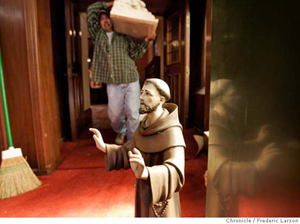
Many have thanked me for my posts on the sad fate of St. Brigid's and the sad operation of the Archdiocese of San Francisco. This morning's news suggests that this may be my last, for the appalling reasons reported below. A decade of efforts to save the place as a parish failed, and, you will recall, the Archdiocese expressed self-satisfaction at having at least saved the building (by selling to the U. of the Academy of Art). Now the sometime "owners" of the church are looting the place. (I place quotation marks around owners because, of course, in some places at this very moment theories of ownership of this kind are being contested by ordinaries eager not to be forced to sell). Would this be happening if Archbishop Levada were still in San Francisco? At all events, imagine what would have happened had the Chancery Office had it in for St. Brigid's all along. I respectfully dissent. The Church in San Francisco has been her own worst enemy.
Calling for your help!
| October 23, 2005 Dear Friends: We’re going to court early next week to protect St. Brigid’s interior from demolition until the city’s Board of Supervisors can act to declare the entire building, both outside and in, as a city landmark. But because of delays required by the city’s charter, the Board cannot act to protect St. Brigid for at least two weeks. So this week, after selling St. Brigid Church to the Academy of Art University, the Archdiocese has had crews in the sanctuary, tearing out statues and otherwise wrecking the church’s interior, racing to finish their destruction before the formal landmark designation takes effect, hoping, we presume, that what is already destroyed cannot be protected. They have done this in defiance of no fewer than three “stop work” notices from the city’s Department of Building Inspection, for violations ranging from doing work without a permit to subjecting their workers to potential danger from the piles of fallen asbestos ceiling tiles in the sanctuary. They have continued to try to do this, even as members of our committee have sat in the doorway of the church to block them from loading their trucks. Friday afternoon the San Francisco Police stopped them, for the afternoon anyway, from removing the artwork. The church’s treasures are, at this moment, staged just inside the door of St. Brigid’s sacristy, ready for quick loading into trucks. We suspect that the Archdiocese will attempt to remove these statues (even though they are now prohibited by law from even entering the building) before a judge can act to protect them. So we are standing vigil, day and night, by the church’s doors, until a judge can issue a restraining order. In the past few weeks they have ignored the will of San Francisco’s Board of Supervisors, its Planning Commission and its Department of Building Inspection, but we hope the Archdiocese will respect the will of the state’s courts. We need your help in two things:
Joe Dignan Committee To Save St. Brigid Church |
Recent Posts
Categories
Monthly Archive
StatCounter
PageViews
Since February 19, 2008
